Sunday, September 7, 2014

The End of the World -- Archibald MacLeish

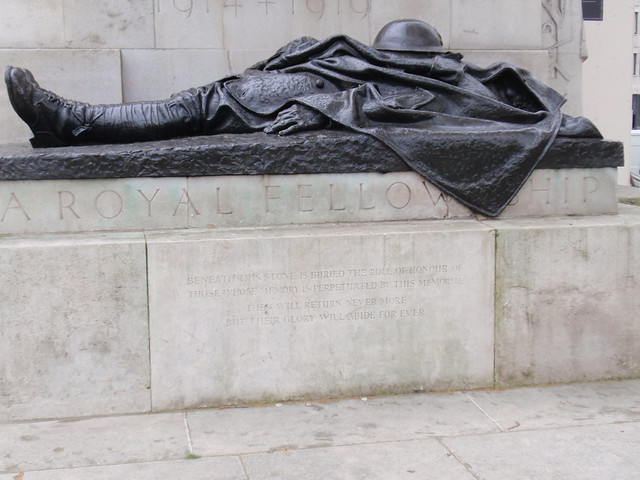
"Here was a Royal Fellowship of Death" -- Royal Artillery Memorial, London


Quite unexpectedly, as Vasserot
The armless ambidextrian was lighting
A match between his great and second toe,
And Ralph the lion was engaged in biting
The neck of Madame Sossman while the drum
Pointed, and Teeny was about to cough
In waltz-time swinging Jocko by the thumb
Quite unexpectedly the top blew off:

And there, there overhead, there, there hung over
Those thousands of white faces, those dazed eyes,
There in the starless dark, the poise, the hover,
There with vast wings across the cancelled skies,
There in the sudden blackness the black pall
Of nothing, nothing, nothing -- nothing at all.   


Saturday, September 6, 2014

Send me to the Electric Chair -- Dinah Washington (live)


Judge you wanna hear my plea, before you open up your court
But I don't want no sympathy, 'cause I done cut my good man's throat

I caught him with a trifling Jane, I warned him 'bout before
I had my knife and went insane, and the rest you ought to know

Judge, judge, please mister judge, send me to the 'lectric chair
Judge, judge, good mister judge, let me go away from here

I wanna take a journey, to the devil down below
I done killed my man, I wanna reap just what I sow

Oh judge, judge, lordy lordy judge, send me to the 'lectric chair
Judge, judge, hear me judge, send me to the 'lectric chair

I love him so dear, I cut him with my Barlow, I kicked him in the side
I stood here laughing o'r him, while he wallowed around and died

Oh judge, judge, lordy judge, send me to the 'lectric chair
Judge, judge, sweet mister judge, send me to the 'lectric chair
Judge, judge, good kind judge, burn me 'cause I don't care

I don't want no one good mayor, to go my bail
I don't want to spend no, ninety-nine years in jail
So judge, judge, good kind judge, send me to the 'lectric chair

Songwriters: Brooks, George


Friday, September 5, 2014

IN RE: Gov. Bob McDonnell -- "Got him."


Nice Rolex.


RICHMOND, Va.— Former Virginia Gov. Bob McDonnell and his wife, Maureen, were found guilty of multiple counts of conspiracy and public corruption Thursday in a case alleging they traded access to the governor's office for $165,000 in loans and luxury gifts from a businessman seeking to win backing from the powerful couple for one of his company's nutritional supplements. 
The former governor was found guilty on 11 of 13 federal charges, his wife on nine of 13. Sentencing is scheduled for Jan. 6. Family members wept as the verdicts were read.
...
The month-long trial had an almost soap opera feel to it, as defense attorneys offered intimate details of the couple's frayed relationship in their effort create sympathy for the former Virginia first lady and make the case that there was so little communication between the two that they couldn't have conspired to trade the power of the governor's office for their own personal gain. 
 ...

Williams received immunity to testify against the McDonnells. He said he showered the couple with gifts, trips and arranged loans for the powerful couple because he wanted the governor's office to promote his company's tobacco-derived anti-inflammatory supplement.
In their unusual defense, the McDonnells—who had separate legal defense teams—tried to portray their marriage as so broken that they could not have conspired to take bribes as federal prosecutors charged.
... 
In addition to springing for the $20,000 shopping spree for McDonnell, prosecutors said Williams wrote a $15,000 check to daughter Cailin McDonnell Young to pay for her wedding reception, gave a $50,000 loan to Maureen McDonnell, hosted the McDonnells at his multimillion-dollar vacation home, and paid for more than $5,000 worth of golf games and equipment from Kinloch Golf Club.
"The single, simple question of this case is why did he give them, why did they take them?" prosecutor Harbach said. Jonnie Williams knew what he wanted, Harbach added, and "the defendants knew what Jonnie Williams wanted."


Thursday, September 4, 2014

Nazi Medical Killings of the Disabled

This poster (from around 1938) reads: "60,000 Reichsmark is what this person suffering from a hereditary defect costs the People's community during his lifetime. Fellow citizen, that is your money too. Read '[A] New People', the monthly magazine of the Bureau for Race Politics of the NSDAP."


On April 23, 1940 Anna was gassed to death at the Grafeneck Euthanasia Center in Grafeneck Castle, south of Stuttgart. She was one of 70,000 Germans with disabilities such as developmental delay or mental illness whom the Nazis murdered as part of their euthanasia program, which was code-named T4. An estimated 300,000 people throughout Nazi-occupied Europe were put to death in this program.
A monument commemorating the euthanasia program’s victims will be dedicated in Berlin this week, which marks the 75th anniversary of the outbreak of World War II. The monument was built at 4 Tiergartenstrasse, the address of the villa where the euthanasia program was planned. The program’s code-name, T4, is a shortened form of the address of the building, which had previously belonged to Jews and had been “Aryanized.” The building at 4 Tiergartenstrasse is next to the current home of the Berlin Philharmonic Orchestra.
Dozens of physicians participated in this program of mass murder, which lasted between 1939 and 1941. While the program was stopped in the wake of public protest, the killing continued secretly until the end of the war. Children and teenagers such as Anna were forcibly taken from their families to one of six Nazi-operated “health centers,” where they were murdered. The families then received letters stating falsely that their children had died of disease. Later on, the Nazis used the experience in mass killing that they had gained in this operation to murder the Jews of Europe.
The euthanasia program was a product of Nazi ideology, which saw sick and weak people as a nuisance that interfered with the fulfillment of the Germans’ vision of a healthy nation.

U.S. Holocaust Memorial Museum

The so-called "Euthanasia" program was National Socialist Germany's first program of mass murder, predating the genocide of European Jewry, which we call the Holocaust, by approximately two years. The effort represented one of many radical eugenic measures which aimed to restore the racial "integrity" of the German nation. It endeavored to eliminate what eugenicists and their supporters considered "life unworthy of life": those individuals who--they believed--because of severe psychiatric, neurological, or physical disabilities represented at once a genetic and a financial burden upon German society and the state.
CHILD "EUTHANASIA" PROGRAM
In the spring and summer months of 1939, a number of planners--led by Philipp Bouhler, the director of Hitler's private chancellery, and Karl Brandt, Hitler's attending physician--began to organize a secret killing operation targeting disabled children. On August 18, 1939, the Reich Ministry of the Interior circulated a decree compelling all physicians, nurses, and midwives to report newborn infants and children under the age of three who showed signs of severe mental or physical disability. Beginning in October 1939, public health authorities began to encourage parents of children with disabilities to admit their young children to one of a number of specially designated pediatric clinics throughout Germany and Austria. The clinics were in reality children's killing wards where specially recruited medical staff murdered their young charges by lethal overdoses of medication or by starvation.
At first, medical professionals and clinic administrators incorporated only infants and toddlers in the operation, but as the scope of the measure widened, they included juveniles up to 17 years of age. Conservative estimates suggest that at least 5,000 physically and mentally disabled German children perished as a result of the child "euthanasia" program during the war years.
EXTENDING THE "EUTHANASIA" PROGRAM
Euthanasia planners quickly envisioned extending the killing program to adult disabled patients living in institutional settings. In the autumn of 1939, Adolf Hitler signed a secret authorization in order to protect participating physicians, medical staff, and administrators from prosecution; this authorization was backdated to September 1, 1939, to suggest that the effort was related to wartime measures. Because the Führer Chancellery was insular, compact, and separate from state, government, or Nazi Party apparatuses, Hitler chose this, his private chancellery, to serve as the engine for the "euthanasia" campaign. Its functionaries called their secret enterprise "T4." The operation took its code-name from the street address of the program's coordinating office in Berlin: Tiergartenstrasse 4. According to Hitler's directive, Führer Chancellery director Phillip Bouhler and physician Karl Brandt undertook leadership of the killing operation. Under their auspices, T4 operatives established six gassing installations for adults as part of the "euthanasia" action: Brandenburg, on the Havel River near Berlin; Grafeneck in southwestern Germany; Bernburg and Sonnenstein, both in Saxony; Hartheim, near Linz on the Danube in Austria, and Hadamar in Hessen.
Utilizing a practice developed for the child "euthanasia" program, T4 planners began in the autumn of 1939 to distribute carefully formulated questionnaires to all public health officials, public and private hospitals, mental institutions, and nursing homes for the chronically ill and aged. The limited space and wording on the forms, as well as the instructions in the accompanying cover letter, combined to convey the impression that the survey was intended to gather statistical data.
The form's sinister purpose was suggested only by the emphasis which the questionnaire placed upon the patient's capacity to work and by the categories of patients which the inquiry required health authorities to identify: those suffering from schizophrenia, epilepsy, dementia, encephalitis, and other chronic psychiatric or neurological disorders; those not of German or "related" blood; the criminally insane or those committed on criminal grounds; and those who had been confined to the institution in question for more than five years. Secretly recruited "medical experts," physicians--many of them of significant reputation--worked in teams of three to evaluate the forms. On the basis of their decisions beginning in January 1940, T4 functionaries began to remove patients selected for the "euthanasia" program from their home institutions and to transport them by bus or by rail to one of the central gassing installations for killing.

Within hours of their arrival at such centers, the victims perished in especially designed gas chambers, disguised as shower facilities, utilizing pure carbon monoxide gas. Thereafter, T4 functionaries burned the bodies in crematoria attached to the gassing facilities. Other workers took the ashes of cremated victims from a common pile and placed them in urns to send to the relatives of the victims. The families or guardians of the victims received such an urn, along with a death certificate and other documentation, listing both a fictive cause and date of death.
Because the program was secret, T-4 planners and functionaries took elaborate measures to conceal its deadly designs. Even though in every case, physicians and institutional administrators falsified official records to indicate that the victims died of natural causes, the "euthanasia" program quickly become an open secret. In view of widespread public knowledge of the measure and in the wake of private and public protests concerning the killings, especially from members of the German clergy, Hitler ordered a halt to the euthanasia program in late August 1941. According to T4's own internal calculations, the "euthanasia" effort claimed the lives of 70,273 institutionalized mentally and physically disabled persons at the six gassing facilities between January 1940 and August 1941.


Wednesday, September 3, 2014

The Dementing of the Baby Boomers


[D]ementia creates what should not be: mindless persons. Mindless, selfless, unreasonable creatures, somehow still looking like human beings. We see a metaphysical incompatibility in them, and it is deeply unsettling. They might as well be headless bodies, up and shambling around.
...[E]ach dementia story comes across as an individual tragedy. You read it or watch it or hear about it, and you might fear something similar happening to you, but you can’t really imagine such a thing ever happening to you. Literallydementia is unimaginable. We can’t put ourselves in the place of the demented; we can’t wrap our minds around what it must be like to lose your mind. Instead, you and me, storytelling animals that we arewe invent confident memories of our future.
And then, of course, it happens to us.
There is no cure, preventive regimen, or way to halt the damage of Alzheimer’s. Right now, the only means for change lie within us: how we conceive of the illness, how we think of the afflicted. So many people are going to have to live with this dehumanizing disease! How do we make sure that they are able to do so with dignity, compassion? The importance of this question cannot be overstated. How are we going to accommodate the least of usand those tasked with their careonce they become so many?

"By 2050, the number of people age 65 and older [in the United States] with Alzheimer's disease may nearly triple, from 5 million to as many as 16 million." www.alz.org


Tuesday, September 2, 2014

It's a Thin Line Between Love and Hate -- The Persuaders (1971)

 First day of Forensic Psychology:


It's a thin line, between love and hate

It's 5 o'clock in the morning
And I'm just getting in, I knock on the door
A voice sweet and low says, who is it?
She opens up the door and lets me in
Never do she once say, sir, where have you been?

No, she says, are you hungry?
Are you hungry, honey? Did you eat yet?
Let me hang up your coat, your coat, your coat
And the woman tells me, pass me your hat too
All the time she smiles, never once raises her voice
It's 5 o'clock in the morning and I don't give it a second thought

It's a thin line between love and hate..

The sweetest woman in the world
Can be the meanest woman in the world
If you make her that way, you keep on hurting her
She keeps being quiet
She might be holding something inside
That really really hurt you one day

Here I am laying in the hospital
Bandaged from feet to head
In the state of shock
Just that much from being dead
I didn't think my woman could do something like this to me
I didn't think she had the nerve, so here I am
I guess actions speaks louder than words

It's a thin line between love and hate..


Monday, September 1, 2014

C.S. Lewis: Mere Christianity


"Put it this way. Imagine three men who go to war. One has the ordinary natural fear of danger that any man has and he subdues it by moral effort and becomes a brave man. Let us suppose that the other two have, as a result of things in their sub-consciousness, exaggerated, irrational fears, which no amount of moral effort can do anything about. Now suppose that a psychoanalyst comes along and cures these two: that is, he puts them both back in the position of the first man. Well it is just then that the psychoanalytical problem is over and the moral problem begins. Because, now that they are cured, these two men might take quite different lines. The first might say, "Thank goodness I've got rid of all those doodahs. Now at last I can do what I always wanted to do-my duty to the cause of freedom." But the other might say, "Well, I'm very glad that I now feel moderately cool under fire, but, of course, that doesn't alter the fact that I'm still jolly well determined to look after Number One and let the other chap do the dangerous job whenever I can. Indeed one of the good things about feeling less frightened is that I can now look after myself much more efficiently and can be much cleverer at hiding the fact from the others." Now this difference is a purely moral one and psychoanalysis cannot do anything about it. However much you improve the man's raw material, you have still got something else: the real, free choice of the man, on the material presented to him, either to put his own advantage first or to put it last. And this free choice is the only thing that morality is concerned with.

The bad psychological material is not a sin but a disease. It does not need to be repented of, but to be cured. And by the way, that is very important. Human beings judge one another by their external actions. God judges them by their moral choices. When a neurotic who has a pathological horror of cats forces himself to pick up a cat for some good reason, it is quite possible that in God's eyes he has shown more courage than a healthy man may have shown in winning the V.C. [Victoria Cross] When a man who has been perverted from his youth and taught that cruelty is the right thing, does some tiny little kindness, or refrains from some cruelty he might have committed, and thereby, perhaps, risks being sneered at by his companions, he may, in God's eyes, be doing more than you and I would do if we gave up life itself for a friend.

It is as well to put this the other way round. Some of us who seem quite nice people may, in fact, have made so little use of a good heredity and a good upbringing that we are really worse than those whom we regard as fiends. Can we be quite certain how we should have behaved if we had been saddled with the psychological outfit, and then with the bad upbringing, and then with the power, say, of Himmler? That is why Christians are told not to judge.

We see only the results which a man's choices make out of his raw material. But God does not judge him on the raw material at all, but on what he has done with it. Most of the man's psychological make-up is probably due to his body: when his body dies all that will fall off him, and the real central man. the thing that chose, that made the best or the worst out of this material, will stand naked. All sorts of nice things which we thought our own, but which were really due to a good digestion, will fall off some of us: all sorts of nasty things which were due to complexes or bad health will fall off others. We shall then, for the first tune, see every one as he really was. There will be surprises."