Showing posts with label military. Show all posts

Sunday, March 26, 2017

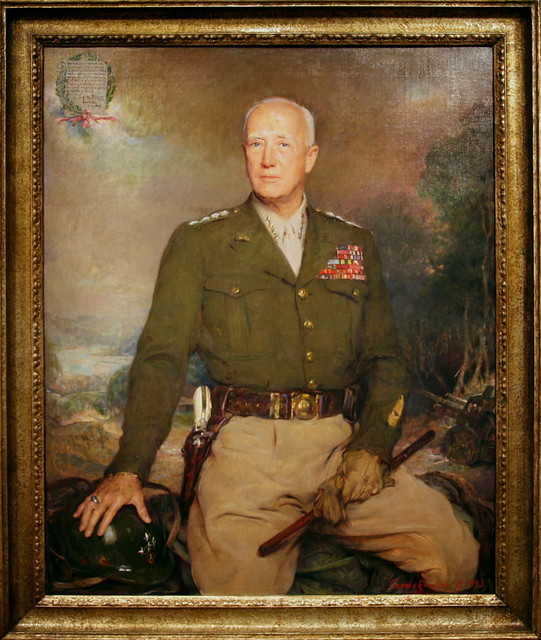
Through a Glass, Darkly -- GEN George S. Patton, Jr.


Through the travail of the ages,
Midst the pomp and toil of war,
Have I fought and strove and perished
Countless times upon this star.

In the form of many people
In all panoplies of time
Have I seen the luring vision
Of the Victory Maid, sublime.

I have battled for fresh mammoth,
I have warred for pastures new,
I have listed to the whispers
When the race trek instinct grew.

I have known the call to battle
In each changeless changing shape
From the high souled voice of conscience
To the beastly lust for rape.

I have sinned and I have suffered,
Played the hero and the knave;
Fought for belly, shame, or country,
And for each have found a grave.

I cannot name my battles
For the visions are not clear,
Yet, I see the twisted faces
And I feel the rending spear.

Perhaps I stabbed our Savior
In His sacred helpless side.
Yet, I've called His name in blessing
When after times I died.


In the dimness of the shadows
Where we hairy heathens warred,
I can taste in thought the lifeblood;
We used teeth before the sword.

While in later clearer vision
I can sense the coppery sweat,
Feel the pikes grow wet and slippery
When our Phalanx, Cyrus met.

Hear the rattle of the harness
Where the Persian darts bounced clear,
See their chariots wheel in panic
From the Hoplite's leveled spear.

See the goal grow monthly longer,
Reaching for the walls of Tyre.
Hear the crash of tons of granite,
Smell the quenchless eastern fire.

Still more clearly as a Roman,
Can I see the Legion close,
As our third rank moved in forward
And the short sword found our foes.

Once again I feel the anguish
Of that blistering treeless plain
When the Parthian showered death bolts,
And our discipline was in vain.

I remember all the suffering
Of those arrows in my neck.
Yet, I stabbed a grinning savage
As I died upon my back.


Once again I smell the heat sparks
When my Flemish plate gave way
And the lance ripped through my entrails
As on Crecy's field I lay.

In the windless, blinding stillness
Of the glittering tropic sea
I can see the bubbles rising
Where we set the captives free.

Midst the spume of half a tempest
I have heard the bulwarks go
When the crashing, point blank round shot
Sent destruction to our foe.

I have fought with gun and cutlass
On the red and slippery deck
With all Hell aflame within me
And a rope around my neck.

And still later as a General
Have I galloped with Murat
When we laughed at death and numbers
Trusting in the Emperor's Star.

Till at last our star faded,
And we shouted to our doom
Where the sunken road of Ohein
Closed us in it's quivering gloom.

So but now with Tanks a'clatter
Have I waddled on the foe
Belching death at twenty paces,
By the star shell's ghastly glow.


So as through a glass, and darkly
The age long strife I see
Where I fought in many guises,
Many names, but always me.

And I see not in my blindness
What the objects were I wrought,
But as God rules o'er our bickerings
It was through His will I fought.

So forever in the future,
Shall I battle as of yore,
Dying to be born a fighter,
But to die again, once more.





Friday, March 17, 2017

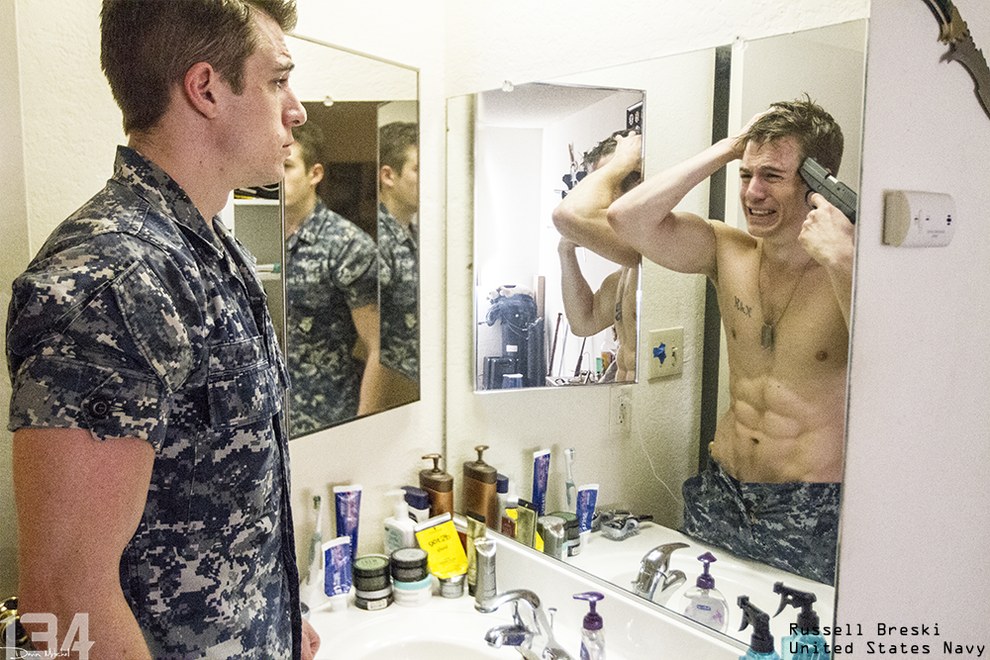
MG Dana Pittard reduced suicides at Fort Bliss, but his initiatives were abandoned by the US Army

Image result for dana pittard


Politico

"[US Army MAJ GEN Dana] Pittard says he never thought about suicide while in combat or at West Point. Both were stressful environments where he felt he was expected to fail—in Iraq because of the difficulty of the mission, and at West Point because he was one of the few black cadets. “I didn’t want to give people the satisfaction,” he says. “Whatever enemy we’re fighting, they’re going to have to kill me.”
But he wonders if his time in Iraq left him too comfortable with death, even numb to it. On April 29, 2004, north of Baghdad, an IED intended for Pittard exploded moments after his truck passed by, hitting the Humvee behind him and killing 20-year-old Specialist Martin Kondor. The soldier was one of thousands to serve under Pittard during the war, but Pittard can still recall Kondor’s name, hometown — York, Pennsylvania — and the date of the bombing. He says details like these stick in his mind. “Stuff like that kind of haunts me.”
Suicides haunt him, too. One of the soldiers in his brigade in Iraq committed suicide, alone in his room with the door locked. He didn’t leave a note. “We all lived so close together,” Pittard recalls. “To this day, I’m not sure why.”
After Kondor’s death, Pittard says, there came a point when he felt sure he was going to be killed in Iraq. He says he stopped worrying about his safety, a feeling he described as “empowering” and “liberating.”
“Of course I thought about my family, but I knew they’d be taken care of. They just wouldn’t have me physically there,” says Pittard.
Although Pittard insists he didn’t feel suicidal, Dr. Ritchie says that the fatalism he experienced is common among soldiers and often results in increased risk taking — driving too fast or drinking too much. In those cases, she says, it can lead to suicide.
Soldiers who have deployed multiple times, like Pittard, are most at risk when they get home. Pittard returned from Iraq in August 2007, and was stationed in California. In 2009, he moved to Virginia, where he was named deputy commander of the agency that runs the Army’s training programs. It was here that he sought psychological counseling. At first, he went with his family, and the purpose of the visits was to help one of his sons. Then, he started going alone. For the first time in his life, he wanted to talk to someone about his depression.
One evening in early 2010, driving on the Monitor-Merrimac Bridge over the James River on his way home from work, he had visions of crashing his car over the short cement guardrail and into the water 20 feet below. It was the nearest he’d ever come to suicide.
At the time, Pittard didn’t tell anyone in the Army that he was going to counseling. He was living off-base, and he went to a private psychologist, not a military doctor. “I wasn’t concerned that anyone would find out,” says Pittard, “but I didn’t think anyone would ever find out.”
They have good reason to be concerned. Some Department of Defense policies still create career penalties for people who seek mental health care. The deployment-eligibility requirements for Central Command and Africa Command, for example, “disqualify or require waivers for individuals who have received a mental or behavioral health diagnosis.” That culture of silence extends to the top leadership of the military. In July, Major General John Rossi, a former neighbor of Pittard’s, became the highest-ranked soldier ever to take his own life. For months, the Army refused to acknowledge his death was a suicide."


Sunday, March 5, 2017

Walking Wounded -- Vernon Scannell (1965)


A mammoth morning moved grey flanks and groaned.
In the rusty hedges pale rags of mist hung;
The gruel of mud and leaves in the mauled lane
Smelled sweet, like blood. Birds had died or flown,
Their green and silent attics sprouting now
With branches of leafed steel, hiding round eyes
And ripe grenades ready to drop and burst.
In the ditch at the cross-roads the fallen rider lay
Hugging his dead machine and did nor stir
At crunch of mortar, tantrum of a Bren
Answering a Spandau’s manic jabber.
Then into sight the ambulances came,
Stumbling and churning past the broken farm,
The amputated sign-post and smashed trees,
Slow wagonloads of bandaged cries, square trucks
That rolled on ominous wheels, vehicles
Made mythopoeic by their mortal freight
And crimson crosses on the dirty white.
This grave procession passed, though, for a while,
The grinding of their engines could be heard,
A dark noise on the pallor of the morning,
Dark as dried blood; and the it faded, died.
The road was empty, bit it seemed to wait -
Like a stage which knows the cast is in the wings -
Wait for a different traffic to appear.
The mist still hung in snags from dripping thorns;
Absent-minded guns still sighed and thumped.
And then they came, the walking wounded,
Straggling the road like convicts loosely chained,
Dragging at ankles exhaustion and despair.
Their heads were weighted down by last night’s lead,
And eyes still drank the dark. They trailed the night
Along the morning road. Some limped on sticks;
Others wore rough dressings, splints and slings;
A few had turbanned heads, the dirty cloth
Brown-badged with blood. A humble brotherhood,
Not one was suffering from a lethal hurt,
They were not magnified by noble wounds,
There was no splendour in that company.
And yet, remembering after eighteen years,
In the heart’s throat a sour sadness stirs;
Imagination pauses and returns
To see them walking still, but multiplied
In thousands now. And when heroic corpses
Turn slowly in their decorated sleep
And every ambulance has disappeared
The walking wounded still trudge down that lane,
And when recalled they must bear arms again.


Sunday, February 26, 2017

Casualty -- Mental Ward -- Vernon Scannell (1922-2007)


Something has gone wrong inside my head.
The sappers have left mines and wire behind,
I hold long conversations with the dead.
I do not always know what has been said;
The rhythms, not the words, stay in my mind;
Something has gone wrong inside my head.
Not just the sky but grass and trees are red,
The flares and tracers—or I’m colour-blind;
I hold long conversations with the dead.
Their presence comforts and sustains like bread;
When they don’t come its hard to be resigned;
Something has gone wrong inside my head.
They know about the snipers that I dread
And how the world is booby-trapped and mined;
I hold long conversations with the dead;
As all eyes close, they gather round my bed
And whisper consolation. When I find
Something has gone wrong inside my head
I hold long conversations with the dead.


Friday, January 27, 2017

"My God, what have we done?"

"My God, what have we done?" -- log entry by Captain Robert Lewis, co-pilot of the Enola Gay, August 6, 1945.


If you haven't read John Hershey's Hiroshima, you should. Most of the book is free on the New Yorker website, but the book as a good "whatever happened to..." final chapter.
 
"On the train on the way into Hiroshima from the country, where he lived with his mother, Dr. Terufumi Sasaki, the Red Cross Hospital surgeon, thought over an unpleasant nightmare he had had the night before. ...In his dream, he had been at the bedside of a country patient when the police and the doctor he had consulted burst into the room, seized him, dragged him outside, and beat him up cruelly. ...
At the terminus, he caught a streetcar at once. (He later calculated that if he had taken his customary train that morning, and if he had had to wait a few minutes for the streetcar, as often happened, he would have been close to the center at the time of the explosion and would surely have perished.) He arrived at the hospital at seven-forty and reported to the chief surgeon. A few minutes later, he went to a room on the first floor and drew blood from the arm of a man in order to perform a Wassermann test. The laboratory containing the incubators for the test was on the third floor. With the blood specimen in his left hand, walking in a kind of distraction he had felt all morning, probably because of the dream and his restless night, he started along the main corridor on his way toward the stairs. He was one step beyond an open window when the light of the bomb was reflected, like a gigantic photographic flash, in the corridor. He ducked down on one knee and said to himself, as only a Japanese would, “Sasaki, gambare! Be brave!” Just then (the building was 1,650 yards from the center), the blast ripped through the hospital. The glasses he was wearing flew off his face; the bottle of blood crashed against one wall; his Japanese slippers zipped out from under his feet—but otherwise, thanks to where he stood, he was untouched.
Dr. Sasaki shouted the name of the chief surgeon and rushed around to the man’s office and found him terribly cut by glass. The hospital was in horrible confusion: heavy partitions and ceilings had fallen on patients, beds had overturned, windows had blown in and cut people, blood was spattered on the walls and floors, instruments were everywhere, many of the patients were running about screaming, many more lay dead. (A colleague working in the laboratory to which Dr. Sasaki had been walking was dead; Dr. Sasaki’s patient, whom he had just left and who a few moments before had been dreadfully afraid of syphilis, was also dead.) Dr. Sasaki found himself the only doctor in the hospital who was unhurt.
Dr. Sasaki, who believed that the enemy had hit only the building he was in, got bandages and began to bind the wounds of those inside the hospital; while outside, all over Hiroshima, maimed and dying citizens turned their unsteady steps toward the Red Cross Hospital to begin an invasion that was to make Dr. Sasaki forget his private nightmare for a long, long time."


This American Life

Allison Silverman

Captain Lewis, co-pilot of the Enola Gay, shares a handshake with Tanimoto, who then backs, up putting him at an awkward distance between Lewis and Ralph Edwards, who's still consulting his book. Captain Lewis explains haltingly how they got the order to target Hiroshima, how the bombardier aimed, how they dropped the bomb and then turned fast to avoid the blast.

Captain Robert Lewis

And then the two concussion waves hit the ship. Shortly after, we turned back to see what had happened. And there in front of our eyes, the city of Hiroshima disappeared.

Ralph Edwards

Now you entered something in your log at that time.

Captain Robert Lewis

As I said before, Mr. Edwards, I wrote down later, "My God, what have we done?"

Ralph Edwards

And so, Reverend Tanimoto, you on the ground, and you on your military mission, Captain Lewis, in the air, both appealed to a power greater than your own.

Allison Silverman

Lewis is the one you're most worried about watching this bizarre blind date. Ralph Edwards is pleased. Tanimoto is respectful, but Captain Lewis looks like he's breaking down. People say he went to a bar before the show and came back drunk.

Ralph Edwards

Thank you, Captain Robert Lewis, now personnel manager of Henry Heide Incorporated in New York City.

Allison Silverman

In 1971, Lewis sold his famous log from the flight and used the money in part to buy Italian marble for his new hobby, sculpture. The piece he's known for is a mushroom cloud, with streams of blood flowing down the side.


Tuesday, January 17, 2017

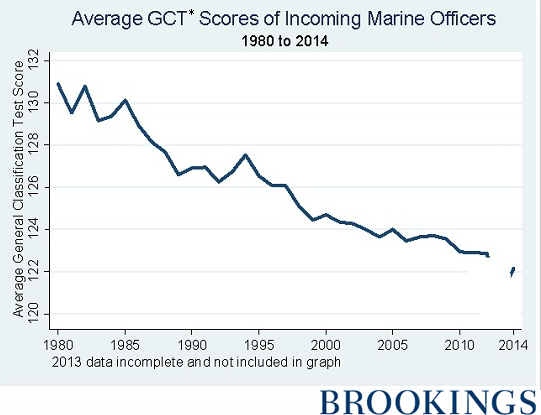
Declining Quality of U.S. Marine Corps Officers, 1980-2014


The GCT has a mean of 100 and a standard deviation of 20. A score of 120 is roughly equivalent to an IQ of 115.

I wonder what the IQ scores of the Chinese officer class look like? 


"Through a Freedom of Information Act (FOIA) request to the Marine Corps, Klein and Cancian received data on the GCT scores of all officers—46,000 altogether—from Fiscal Year 1980 to Fiscal Year 2014.
After analyzing the data, the authors uncovered a startling trend: A statistically significant decline in scores over the past 34 years, the magnitude of which, the authors say, “is relevant given the distribution of the scores.” 
Other key findings include:
  1. Eighty-five percent of those taking the test in 1980 exceeded a score of 120, which was the cut-off score for officers in World War II. In 2014, only 59 percent exceeded that score.
  2. At the upper end of the distribution, 4.9 percent of those taking the test scored above 150 in 1980 compared to 0.7 percent in 2014.
  3. Over 34 years, the average score decreased by 6.6 percent, from 130.9 to 122.1.
  4. Taken together, the 8.2-point drop in average score represents 80 percent of an entire standard deviation’s decline (from 10.5 in 1980 to 9.6 in 2014). In other words, today’s Marine officers scored nearly an entire standard deviation worse, on average, than their predecessors 34 years ago.Klein and Cancian stress the importance of acknowledging and reversing the decline in officer quality as measured by the GCT score not just for the short-term impacts it has. The junior officers of today will become the generals of tomorrow; if the military does not receive the intelligent young leaders today that it used to receive in the past, it will not have high quality generals in the future.
What has been the impact of this drop in quality on the effectiveness of the military? Answering this question is beyond the scope of this paper. Given the myriad studies associating performance with intellect, however, it is hard to imagine anything other than a seriously deleterious impact on the quality of officers and, by extension, on the quality and efficacy of the military,” say the authors.


Monday, December 19, 2016

"Disgraced" former U.S. general to receive pension of $80,000/year for life

Image result for haight general
So what do we learn from this? We  now live in a country in which the surest path to success is a job with the federal government (much like China under the Mandarins). Commission as an officer at age 22, retire at 52 with a fat pension.


USA Today
"WASHINGTON — The Army has stripped Maj. Gen. David Haight of three ranks, Army Secretary Eric Fanning said Friday, following revelations contained in documents and interviews of Haight's decade-long extramarital affair and “swinger lifestyle.
A board of his peers called for Haight to be busted to lieutenant colonel, a demotion that will cost him nearly $43,000 per year in pension pay. Fanning, in an interview, said he had accepted the recommendation after a panel of three officers reviewed Haight's conduct — and his secret second life — and determined that lieutenant colonel was the last rank in which he had served satisfactorily.
Fanning spent hours discussing the case with other general officers and read the investigative report twice before accepting the recommendation, he said.
"He’s going to be retired as a lieutenant colonel," Fanning said. "Pretty big drop."
...
Haight, a decorated infantry soldier and Army Ranger, had served as the director of operations for U.S. European Command until the spring. An Army investigation determined that he had had an 11-year long affair with Jennifer Armstrong, a government employee, and had misused his government cellphone to stay in contact with her.
The Army reprimanded Haight — effectively ending his career — and hauled him back to Washington. He was placed in a job with few responsibilities while the board determined his rank for retirement. Haight had been allowed to maintain his clearance to view classified material until the day after USA TODAY published the story about his secret life, and had raised questions about his susceptibility to espionage.
...
If Haight had been allowed to retire as a two-star general with 30 years of service, he would have been paid about $122,800. Retirement as a lieutenant colonel drops that pension to about $79,800."


Friday, December 16, 2016

Larry Colburn, hero of My Lai, RIP

Hugh Thompson is in the center, and Larry Colburn is on the right. How many of you learned about these men in school? I wonder why not.


NYT

"Larry Colburn, who became an 18-year-old American hero when he intervened with two comrades to halt the massacre of unarmed Vietnamese civilians by United States soldiers in 1968, elevating an innocuous hamlet named My Lai into a watchword for the horrors of war, died on Tuesday at his home in Canton, Ga. He was 67.
The cause was liver cancer, his wife, Lisa, said.
Mr. Colburn was the last surviving member of a three-man helicopter crew that was assigned to hover over My Lai on Saturday morning, March 16, 1968, to identify enemy positions by drawing Vietcong fire.
Instead, the men encountered an eerie quiet and a macabre landscape of dead, wounded and weaponless women and children as a platoon of American soldiers, ostensibly hunting elusive Vietcong guerrillas, marauded among defenseless noncombatants.
The crew dropped smoke flares to mark the wounded, “thinking the men on the ground would come assist them,” Mr. Colburn told Vietnam Magazine in 2011.
“When we would come back to those we marked,” he said, “we’d find they were now dead.”
Audaciously and on his own initiative, the pilot, Chief Warrant Officer Hugh Thompson Jr., swooped down and landed the copter.
“Mr. Thompson was just beside himself,” Mr. Colburn recalled in an interview in 2010 for the PBS program “The American Experience.” “He got on the radio and just said, ‘This isn’t right, these are civilians, there’s people killing civilians down here.’ And that’s when he decided to intervene. He said, ‘We’ve got to do something about this, are you with me?’ And we said, ‘Yes.’ ”
Mr. Thompson confronted the officer in command of the rampaging platoon, Lt. William L. Calley, but was rebuffed. He then positioned the helicopter between the troops and the surviving villagers and faced off against another lieutenant. Mr. Thompson ordered Mr. Colburn to fire his M-60 machine gun at any soldiers who tried to inflict further harm.
“Y’all cover me!” Mr. Thompson was quoted as saying. “If these bastards open up on me or these people, you open up on them. Promise me!”
“You got it boss,” Mr. Colburn replied. “Consider it done.”
Mr. Thompson, Mr. Colburn and Glenn Andreotta, the copter’s crew chief, found about 10 villagers cowering in a makeshift bomb shelter and coaxed them out, then had them flown to safety by two Huey gunships. They found an 8-year-old boy clinging to his mother’s corpse in an irrigation ditch and plucked him by the back of his shirt and delivered him to a nun in a nearby hospital.
Crucially, they reported what they had witnessed to headquarters, which ordered a cease-fire. By then, as many as 500 villagers had been killed."


Thursday, December 15, 2016

Dorie Miller, hero of Pearl Harbor -- Navy Cross citation

Missing in action and presumed dead, November 24, 1943, after his ship, the USS Liscombe, sunk by Japanese torpedo.

 
Navy Cross Medal
to
MESS ATTENDANT SECOND CLASS DORIS MILLER
UNITED STATES NAVY
for services as set forth in the following:

CITATION: "For distinguished devotion to duty, extraordinary courage and disregard for his own personal safety during the attack on the Fleet in Pearl Harbor, Territory of Hawaii, by Japanese forces on December 7, 1941. While at the side of his Captain on the bridge, Miller, despite enemy strafing and bombing and in the face of a serious fire, assisted in moving his Captain, who had been mortally wounded, to a place of greater safety, and later manned and operated a machine gun directed at enemy Japanese attacking aircraft until ordered to leave the bridge."


Image result for dorie miller


Wednesday, December 14, 2016

Among recent veterans, the suicide rate is much worse than the "22 a day" slogan implies

Image result for veteran suicide
Among recent veterans, the suicide rate is much worse than the "22 a day" slogan implies. Photo from Buzzfeed.


WaPo Factchecker
"A new study funded by the Army shows the suicide rate for veterans who served in recent wars is much lower than 22 a day. [This might be so, but it is also irrelevant; it's the rates per 100,000 that matter, Ed.]  The study, published in the February 2015 Annals of Epidemiology, is the first large population-based study of post-service suicide risk among this population. Researchers used veteran records from two Defense Department databases, verified Social Security information and used the CDC’s National Death Index Plus. They studied 1.3 million veterans who were discharged between 2001 and 2007. Among deployed veterans in this report, 32.6 percent were born in 1978-1981 and 30 percent were born in 1982-1990.
Between 2001 and 2009, there were 1650 deployed veterans and 7703 non-deployed veteran deaths. Of those, 351 were suicides among deployed veterans and 1517 were suicides among non-deployed veterans. That means over nine years, there was not quite one veteran suicide a day.
This is not to say, however, that suicide is not a concern among that population. One in two veterans of Iraq and Afghanistan wars say they know a fellow service member who attempted or committed suicide, according to a Washington Post-Kaiser Health poll."


So, who will check the Fact Checkers? The study cited above reported 1,868 suicide deaths out of 1.3 million veterans discharged between 2001 and 2007. That's a suicide death rate of 143.7 out of every 100,000 people in that recent veteran population (rate/100,000 persons is the standard way to report suicide rates). That's a huge and alarming number. Essentially, recent veterans are dying by suicide at about seven-times the rate of other American males.

For comparison sake, the suicide death rate for American males is 21.1, and for White Males, the most at-risk demographic for death by suicide, it is 24.1. White Males account for 82 of the 117 deaths by suicide each day in the United States (70%).

My problem with the "22 veteran suicides a day" claim is that that it conflates veterans of various eras. I would prefer to see reported rates for veterans of the Iraq/Afghanistan era (e.g., 143.7/100,000), First Gulf War, Vietnam, Korea, and World War II.

If the 22 a day statistic is accurate, that means 8,030 veteran suicide deaths a year. According to the VA, there are 21,368,156 American veterans, so that would mean a suicide death rate of 37.6 per 100,000. (8,030 divided by 21,368,156, and then multiplied by 100,000.)

Given that, according to the CDC, the suicide death rate is 38.8 per 100,000 for males aged 75 and older, 26.6 for males aged 65-74, and 29.7 for males aged 45-64, the "the 22 a day" claim does not seem outrageous to me.

We should probably brace ourselves for yet further increases in suicide deaths, as the "peak Vietnam generation" (age 20 in 1968) are only 68 years old and have seven more years until they reach the deadliest suicide age range.

Here's a table I created, using #veterans by age group, multiplied by three suicide rates (Males, White Males, 22/day Veterans). It assumes that the rates are the same across age group, which they doubtless are not.

US Males White Males Veterans
Age Groups #Veterans 21.1 24.1 37.6
< 20 5,793 1.28 1.40 2.18
20-24 231,391 51.14 55.77 87.00
25-29 761,053 168.19 183.41 286.16
30-34 1,005,899 222.30 242.42 378.22
35-39 1,145,089 253.06 275.97 430.55
40-44 1,187,405 262.42 286.16 446.46
45-49 1,555,295 343.72 374.83 584.79
50-54 1,758,347 388.59 423.76 661.14
55-59 1,915,263 423.27 461.58 720.14
60-64 1,956,181 432.32 471.44 735.52
65-69 2,767,254 611.56 666.91 1040.49
70-74 2,531,807 559.53 610.17 951.96
75-79 1,636,010 361.56 394.28 615.14
80-84 1,377,425 304.41 331.96 517.91
85+ 1,533,944 339.00 369.68 576.76
Grand Total 21,368,156 4722.36 5149.73 8034.43
Per Day 12.94 14.11 22.01


Thursday, December 1, 2016

"We shall never surrender" -- Winston Churchill

Image result for spitfires 1940
Spitfires, 1940


We Shall Fight on the Beaches

"I have, myself, full confidence that if all do their duty, if nothing is neglected, and if the best arrangements are made, as they are being made, we shall prove ourselves once again able to defend our Island home, to ride out the storm of war, and to outlive the menace of tyranny, if necessary for years, if necessary alone. At any rate, that is what we are going to try to do. That is the resolve of His Majesty's Government-every man of them. That is the will of Parliament and the nation. The British Empire and the French Republic, linked together in their cause and in their need, will defend to the death their native soil, aiding each other like good comrades to the utmost of their strength. Even though large tracts of Europe and many old and famous States have fallen or may fall into the grip of the Gestapo and all the odious apparatus of Nazi rule, we shall not flag or fail. We shall go on to the end, we shall fight in France, we shall fight on the seas and oceans, we shall fight with growing confidence and growing strength in the air, we shall defend our Island, whatever the cost may be, we shall fight on the beaches, we shall fight on the landing grounds, we shall fight in the fields and in the streets, we shall fight in the hills; we shall never surrender, and even if, which I do not for a moment believe, this Island or a large part of it were subjugated and starving, then our Empire beyond the seas, armed and guarded by the British Fleet, would carry on the struggle, until, in God's good time, the New World, with all its power and might, steps forth to the rescue and the liberation of the old."