Showing posts with label religion. Show all posts

Wednesday, April 12, 2017

Our buffered selves are closed to both the divine and the demonic

Rather than "The Enlightenment" perhaps it should be called "The Disenchantment."


New Atlantis

"When asked by the editors of the website The Immanent Frame to summarize the key concerns of his vastly ambitious book A Secular Age (2007), Charles Taylor wrote,
Almost everyone can agree that one of the big differences between us and our ancestors of five hundred years ago is that they lived in an “enchanted” world, and we do not; at the very least, we live in a much less “enchanted” world. We might think of this as our having “lost” a number of beliefs and the practices which they made possible. But more, the enchanted world was one in which these forces could cross a porous boundary and shape our lives, psychic and physical. One of the big differences between us and them is that we live with a much firmer sense of the boundary between self and other. We are “buffered” selves. We have changed.
As Taylor makes clear, the shift from a porous to a buffered self involves a complex series of exchanges. But to put that shift in simple terms, a person accepts a buffered condition as a means of being protected from the demonic or otherwise ominous forces that in pre-modern times generated a quavering network of terrors. To be a pre-modern person, in Taylor’s account, is to be constantly in danger of being invaded or overcome by demons or fairies or nameless terrors of the dark — of being possessed and transformed, or spirited away and never returned to home and family. Keith Thomas’s magisterial Religion and the Decline of Magic (1971) specifies many of these dangers, along with the whole panoply of prayers, rites, amulets, potions, chants, spells, and the like, by which a person might seek protection from the otherwise irresistible. It is easy, then, to imagine why a person — or a whole culture — might, if it could, exchange this model of a self with highly permeable boundaries for one in which the self feels better protected, defended — impermeable, or nearly so.
The problem with this apparently straightforward transaction is that the porous self is open to the divine as well as to the demonic, while the buffered self is closed to both alike. Those who must guard against capture by fairies are necessarily and by the same token receptive to mystical experiences. The “showings” manifested to Julian of Norwich depend upon exceptional sensitivity, which is to say porosity — vulnerability to incursions of the supernatural. The portals of the self cannot be closed on one side only. But the achievement of a safely buffered personhood — closed off from both the divine and the demonic — is soon enough accompanied by a deeply felt change in the very cosmos. As C. S. Lewis notes in The Discarded Image (1964), the medieval person who found himself “looking up at a world lighted, warmed, and resonant with music” gives way to the modern person who perceives only emptiness and silence. Safety is purchased at the high price of isolation, as we see as early as Pascal, who famously wrote of the night sky, “Le silence éternel de ces espaces infinis m’effraie” (“The eternal silence of these infinite spaces frightens me”)."


Monday, April 10, 2017

"We are in this fairyland on sufferance." -- G.K. Chesterton

Related image


Fairy Tales (1915)

"If you really read the fairy tales, you will observe that one idea runs from one end of them to the other—the idea that peace and happiness can only exist on some condition. This idea, which is the core of ethics, is the core of the nursery-tales. The whole happiness of fairyland hangs upon a thread, upon one thread. Cinderella may have a dress woven on supernatural looms and blazing with unearthly brilliance; but she must be back when the clock strikes twelve. The king may invite fairies to the christening, but he must invite all the fairies or frightful results will follow. Bluebeard's wife may open all doors but one. A promise is broken to a cat, and the whole world goes wrong. A promise is broken to a yellow dwarf, and the whole world goes wrong. A girl may be the bride of the God of Love himself if she never tries to see him; she sees him, and he vanishes away. A girl is given a box on condition she does not open it; she opens it, and all the evils of this world rush out at her. A man and woman are put in a garden on condition that they do not eat one fruit: they eat it, and lose their joy in all the fruits of the earth.
This great idea, then, is the backbone of all folk-lore—the idea that all happiness hangs on one thin veto; all positive joy depends on one negative. Now, it is obvious that there are many philosophical and religious ideas akin to or symbolised by this; but it is not with them I wish to deal here. It is surely obvious that all ethics ought to be taught to this fairy tale tune; that, if one does the thing forbidden, one imperils all the things provided. A man who breaks his promise to his wife ought to be reminded that, even if she is a cat, the case of the fairy-cat shows that such conduct may be incautious. A burglar just about to open some one else's safe should be playfully reminded that he is in the perilous posture of the beautiful Pandora: he is about to lift the forbidden lid and loosen evils unknown. The boy eating some one's apples in some one's apple tree should be a reminder that he has come to a mystical moment of his life, when one apple may rob him of all others. This is the profound morality of fairy tales; which, so far from being lawless, go to the root of all law. Instead of finding (like common books of ethics) a rationalistic basis for each Commandment, they find the great mystical basis for all Commandments. We are in this fairyland on sufferance; it is not for us to quarrel with the conditions under which we enjoy this wild vision of the world. The vetoes are indeed extraordinary, but then so are the concessions. The idea of property, the idea of some one else's apples, is a rum idea; but then the idea of there being any apples is a rum idea. It is strange and weird that I cannot with safety drink ten bottles of champagne; but then the champagne itself is strange and weird, if you come to that. If I have drunk of the fairies' drink it is but just I should drink by the fairies' rules. We may not see the direct logical connection between three beautiful silver spoons and a large ugly policeman; but then who in fairy tales ever could see the direct logical connection between three bears and a giant, or between a rose and a roaring beast? Not only can these fairy tales be enjoyed because they are moral, but morality can be enjoyed because it puts us in fairyland, in a world at once of wonder and of war."


Thursday, April 6, 2017

"Beauty Will Save the World"


Crisis
"A popular quote we often hear but find hard to understand is “beauty will save the world.” How will beauty save the world? The line comes from Dostoevsky’s novel, The Idiot, attributed to the main character, Prince Myskin. The prince, an epileptic Russian nobleman, serves as a Christ-like figure, who stands apart for his innocence and even naiveté. Out of the mouth of this idiot comes a clearer vision of beauty and reality than those around him, his clarity heightened even in the midst of his sickness.
The saving power of beauty in the prince’s life could not overcome his sickness, but nonetheless illumined his vision: “What matter though it be only disease, an abnormal tension of the brain, if when I recall and analyze the moment, it seems to have been one of harmony and beauty in the highest degree—an instant of deepest sensation, overflowing with unbounded joy and rapture, ecstatic devotion, and completest life?” In the midst of his suffering, he glimpsed, though in a paradoxical manner, the heart of reality.
Are the prince’s words on beauty the words of a mad idiot or of a prophet?
In Solzhenitsyn’s Nobel lecture, he notes that after dismissing the quote for years, he realized that “Dostoevsky’s remark, ‘Beauty will save the world,’ was not a careless phrase but a prophecy. After all he was granted to see much, a man of fantastic illumination. And in that case art, literature might really be able to help the world today?” 
If that is not enough, Pope John Paul II quoted the line in his Letter to Artists, under the heading “The Saving Power of Beauty”:
People of today and tomorrow need this enthusiasm [of wonder] if they are to meet and master the crucial challenges which stand before us. Thanks to this enthusiasm, humanity, every time it loses its way, will be able to lift itself up and set out again on the right path. In this sense it has been said with profound insight that “beauty will save the world” (§16).
Can the words of an idiot set the tone for our response to the modern world? In a mad world, maybe only the idiot is sane."


Tuesday, March 7, 2017

Was Benjamin Franklin an atheist? Doubtful.


First Things
"On the boat back from London, in addition to speculating about the causes of the Gulf Stream, making astronomical observations, and studying the ontogeny of crustaceans, [Benjamin] Franklin busied himself with devising four commandments for his life (be frugal, speak the truth, work hard, speak ill of no man), and twelve cardinal virtues necessary to keeping them (temperance, order, sincerity, justice, etc.). Number twelve was “Chastity,” to which he appended the explanation, “Rarely use venery but for health or offspring; never to dullness, weakness, or the injury of your own or another’s peace or reputation.” Chastity in moderation, so to speak. A Quaker friend who examined the list said, to Franklin’s surprise, that some people thought him proud, so he added a thirteenth: “Humility. Imitate Jesus and Socrates.” While he was almost perpetually involved in plans of self-improvement—at least until the later years when he laid back to enjoy his celebrity—he also thought it advisable that he accept limited imperfections in himself lest he be accused of “a kind of foppery in morals.”
There was that smugness and complacency to which so many have reacted negatively. Having narrowly escaped from the Mathers of Boston, he was determined to live above the world of certainties and the contentiousness that too often attends them. His was the open-minded and universal view befitting the “scientific” disposition of an age of Enlightenment. He evidenced, writes Brands, “an equipoise that nearly everyone who knew him noticed and that many remarked upon. It could make him seem smug or shallow; while others agonized upon life’s deep issues, Franklin contented himself with incomplete answers, maintaining an open mind and seeming to skate upon life’s surface.” The penchant for the scientific could lead him to the silliness of devising a complex system in which he weighed the pros and cons before making an important decision, assigning a certain mathematical weight, positive or negative, to each item and then arriving at the optimal decision by what he called “moral or prudential algebra.”
The General and Particular Government of the Universe
Franklin’s was a very superior mind, and he knew it. Because it was so very superior, most others did not mind his knowing it but, rather, took pleasure in celebrating his gifts, which were also theirs, for this was an age caught up in an exhilarating dream of progress of which genius was the engine. His discoveries about fire and heat led to the invention of a new kind of fireplace, the Franklin stove, which, as with his other inventions, he did not patent. He thought the invention should be free, being among his gifts to the age. He made his living as a printer, and everything else was gratis. He was not, says Brands, “what the modern age would call a true intellectual.” He did have an endlessly inquisitive mind, and it was aimed at what might make life easier, more productive, or happier. “His view of science mirrored his view of religion. Where faith was sterile if it failed to produce good works, so science was sterile—even if interesting—if it failed to produce good inventions.” Although the term would not come into philosophical use for more than a century, he was, in short, a pragmatist.
The same Franklin, however, cultivated a lifelong friendship with the celebrated British revivalist George Whitefield, who drew vast throngs by his rhetorical powers that could, it was said, reduce listeners to tears simply by uttering the word “Mesopotamia.” Franklin organized the building of an arena in Philadelphia for Whitefield’s rallies, since he was barred from the local pulpits. Franklin thought competition in religion a good thing, although there may have been more to it than that. In 1768 Franklin wrote Whitefield of his worries about British policies toward the colonies, a worry made more distressing by his deep devotion to Britain and aversion to the thought of conflict. In his letter he continued their theological debate of thirty years. “I see with you that our affairs are not well managed by our rulers here below; I wish I could believe with you that they are well attended to by those above.” But, “though the general government of the universe is well administered, our particular little affairs are perhaps below notice, and left to take the chance of human prudence or imprudence, as either may happen to be uppermost.” In the midst of anxieties, however, he wrote to another friend, “Take one thing with another, and the world is a pretty good sort of world; and ‘tis our duty to make the best of it and be thankful.” But to whom, or Whom, is it our duty to give thanks?
Franklin certainly flirted with atheism at times in his life, and still today is usually described as a Deist. When he was an old man, Ezra Stiles of Connecticut asked him about his religious convictions, in response to which Franklin penned what he called his creed. “I believe in one God, creator of the universe. That He governs it by His providence. That He ought to be worshiped. . . . That the soul of man is immortal, and will be treated with justice in another life respecting its conduct in this.” As for Jesus, “his system of morals and his religion [are] the best the world ever saw or is likely to see. . . . I have, with most of the present Dissenters in England, some doubts as to his divinity; though it is a question I do not dogmatize upon, having never studied it, and think it needless to busy myself with it now, when I expect soon an opportunity of knowing the truth with less trouble.” Franklin asked Stiles not to publish this letter, since it might scandalize the orthodox. One may suggest that its approximation of orthodoxy might rather scandalize the many, then and now, who assume that Franklin was a closet atheist who pretended in public to be a Deist."


Monday, November 16, 2015

René Girard, RIP


Real Clear Religion
"René Girard, one of the most influential Catholic philosophers in the world, died last week at the age of 91. Born in Avignon and a member of the illustrious Academie Francaise, Girard nevertheless made his academic reputation in the United States, as a professor at Indiana University, Johns Hopkins University, and Stanford University.
There are some thinkers that offer intriguing ideas and proposals, and there is a tiny handful of thinkers that manage to shake your world. Girard was in this second camp.
In a series of books and articles, written across several decades, he proposed a social theory of extraordinary explanatory power. Drawing inspiration from some of the greatest literary masters of the West-Dostoevsky, Shakespeare, Proust among others -- Girard opined that desire is both mimetic and triangular. He meant that we rarely desire objects straightforwardly; rather, we desire them because others desire them: as we imitate (mimesis) another's desire, we establish a triangulation between self, other, and object.
If this sounds too rarefied, think of the manner in which practically all of advertising works: I come to want those gym shoes, not because of their intrinsic value, but because the hottest NBA star wants them. Now what mimetic desire leads to, almost inevitably, is conflict. If you want to see this dynamic in the concrete, watch what happens when toddler A imitates the desire of toddler B for the same toy, or when dictator A mimics the desire of dictator B for the same route of access to the sea.
The tension that arises from mimetic desire is dealt with through what Girard called the scapegoating mechanism. A society, large or small, that finds itself in conflict comes together through a common act of blaming an individual or group purportedly responsible for the conflict. So for instance, a group of people in a coffee klatch will speak in an anodyne way for a time, but in relatively short order, they will commence to gossip, and they will find, customarily, a real fellow feeling in the process.
What they are accomplishing, on Girard's reading, is a discharging of the tension of their mimetic rivalry onto a third party. The same dynamic obtains among intellectuals. When I was doing my post-graduate study, I heard the decidedly Girardian remark: "the only thing that two academics can agree upon is how poor the work of a third academic is!" Hitler was one of the shrewdest manipulators of the scapegoating mechanism. He brought the deeply divided German nation of the 1930's together precisely by assigning the Jews as a scapegoat for the country's economic, political, and cultural woes. Watch a video of one of the Nuremberg rallies of the mid-thirties to see the Girardian theory on vivid display.
Now precisely because this mechanism produces a kind of peace, however ersatz and unstable, it has been revered by the great mythologies and religions of the world and interpreted as something that God or the gods smile upon. Perhaps the most ingenious aspect of Girard's theorizing is his identification of this tendency. In the founding myths of most societies, we find some act of primal violence that actually establishes the order of the community, and in the rituals of those societies, we discover a repeated acting out of the original scapegoating. For a literary presentation of this ritualization of society-creating violence, look no further than Shirley Jackson's masterpiece "The Lottery."
The main features of this theory were in place when Girard turned for the first time in a serious way to the Christian Scriptures. What he found astonished him and changed his life. He discovered that the Bible knew all about mimetic desire and scapegoating violence but it also contained something altogether new, namely, the de-sacralizing of the process that is revered in all of the myths and religions of the world. The crucifixion of Jesus is a classic instance of the old pattern. It is utterly consistent with the Girardian theory that Caiaphas, the leading religious figure of the time, could say to his colleagues, "Is it not better for you that one man should die for the people than for the whole nation to perish?" In any other religious context, this sort of rationalization would be valorized. But in the resurrection of Jesus from the dead, this stunning truth is revealed: God is not on the side of the scapegoaters but rather on the side of the scapegoated victim. The true God in fact does not sanction a community created through violence; rather, he sanctions what Jesus called the Kingdom of God, a society grounded in forgiveness, love, and identification with the victim. Once Girard saw this pattern, he found it everywhere in the Gospels and in Christian literature. For a particularly clear example of the unveiling process, take a hard look at the story of the woman caught in adultery.
In the second half of the 20th century, academics tended to characterize Christianity -- if they took it seriously at all -- as one more iteration of the mythic story that can be found in practically every culture. From the Epic of Gilgamesh to Star Wars, the "mono-myth," to use Joseph Campbell's formula, is told over and again. What Girard saw was that this tired theorizing has it precisely wrong. In point of fact, Christianity is the revelation (the unveiling) of what the myths want to veil; it is the deconstruction of the mono-myth, not a reiteration of it -- which is exactly why so many within academe want to domesticate and de-fang it.
The recovery of Christianity as revelation, as an unmasking of what all the other religions are saying, is René Girard's permanent and unsettling contribution."


Friday, September 25, 2015

What we talk about when we talk about assisted suicide


RealClear Religion
"It was revealed this week that, for the first time in its history, Harvard University, which had been founded for religious purposes and named for a minister of the Gospel, has admitted a freshman class in which atheists and agnostics outnumber professed Christians and Jews.
Also this week, the House and the Senate of California passed a provision that allows for physician assisted suicide in the Golden State. As I write these words, the governor of California is deliberating whether to sign the bill into law. Though it might seem strange to suggest as much, I believe that the make-up of the Harvard freshman class and the passing of the suicide law are related.
I suppose we shouldn't be too surprised that non-believers have come to outnumber believers among the rising cohort of the American aristocracy. For the whole of their lives, these young people have been immersed in the corrosive acids of relativism, scientism, and materialism. Though they have benefitted from every advantage that money can afford, they have been largely denied what the human heart most longs for: contact with the transcendent, with the good, true, and beautiful in their properly unconditioned form....
.... The denial of God -- or the blithe bracketing of the question of God -- is not a harmless parlor game. Rather, it carries with it the gravest implications. If there is no God, then our lives do indeed belong to us, and we can do with them what we want. If there is no God, our lives have no ultimate meaning or transcendent purpose, and they become simply artifacts of our own designing. Accordingly, when they become too painful or too shallow or just too boring, we ought to have the prerogative to end them. We can argue the legalities and even the morality of assisted suicide until the cows come home, but the real issue that has to be engaged is that of God's existence.
The incoming freshman class at Harvard is a disturbing omen indeed, for the more our society drifts into atheism, the more human life is under threat. The less we are willing even to wrestle with God, the more de-humanized we become."


Sunday, February 8, 2015

Thomas Merton's prayer

Thomas Merton (1915-1968) was an American Catholic writer and mystic. A Trappist monk of the Abbey of Gethsemani, Kentucky, he was a poet, social activist, and student of comparative religion.


My Lord God, I have no idea where I am going.  
I do not see the road ahead of me.  
I cannot know for certain where it will end.  
Nor do I really know myself, and the fact that I think that I am following your will does not mean that I am actually doing so.  
But I believe that the desire to please you does in fact please you.  
And I hope I have that desire in all that I am doing.  
I hope that I will never do anything apart from that desire.  
And I know that if I do this you will lead me by the right road though I may know nothing about it.  
Therefore will I trust you always though I may seem to be lost and in the shadow of death.  
I will not fear, for you are ever with me, and you will never leave me to face my perils alone.

(From Thoughts in Solitude)


Monday, September 1, 2014

C.S. Lewis: Mere Christianity


"Put it this way. Imagine three men who go to war. One has the ordinary natural fear of danger that any man has and he subdues it by moral effort and becomes a brave man. Let us suppose that the other two have, as a result of things in their sub-consciousness, exaggerated, irrational fears, which no amount of moral effort can do anything about. Now suppose that a psychoanalyst comes along and cures these two: that is, he puts them both back in the position of the first man. Well it is just then that the psychoanalytical problem is over and the moral problem begins. Because, now that they are cured, these two men might take quite different lines. The first might say, "Thank goodness I've got rid of all those doodahs. Now at last I can do what I always wanted to do-my duty to the cause of freedom." But the other might say, "Well, I'm very glad that I now feel moderately cool under fire, but, of course, that doesn't alter the fact that I'm still jolly well determined to look after Number One and let the other chap do the dangerous job whenever I can. Indeed one of the good things about feeling less frightened is that I can now look after myself much more efficiently and can be much cleverer at hiding the fact from the others." Now this difference is a purely moral one and psychoanalysis cannot do anything about it. However much you improve the man's raw material, you have still got something else: the real, free choice of the man, on the material presented to him, either to put his own advantage first or to put it last. And this free choice is the only thing that morality is concerned with.

The bad psychological material is not a sin but a disease. It does not need to be repented of, but to be cured. And by the way, that is very important. Human beings judge one another by their external actions. God judges them by their moral choices. When a neurotic who has a pathological horror of cats forces himself to pick up a cat for some good reason, it is quite possible that in God's eyes he has shown more courage than a healthy man may have shown in winning the V.C. [Victoria Cross] When a man who has been perverted from his youth and taught that cruelty is the right thing, does some tiny little kindness, or refrains from some cruelty he might have committed, and thereby, perhaps, risks being sneered at by his companions, he may, in God's eyes, be doing more than you and I would do if we gave up life itself for a friend.

It is as well to put this the other way round. Some of us who seem quite nice people may, in fact, have made so little use of a good heredity and a good upbringing that we are really worse than those whom we regard as fiends. Can we be quite certain how we should have behaved if we had been saddled with the psychological outfit, and then with the bad upbringing, and then with the power, say, of Himmler? That is why Christians are told not to judge.

We see only the results which a man's choices make out of his raw material. But God does not judge him on the raw material at all, but on what he has done with it. Most of the man's psychological make-up is probably due to his body: when his body dies all that will fall off him, and the real central man. the thing that chose, that made the best or the worst out of this material, will stand naked. All sorts of nice things which we thought our own, but which were really due to a good digestion, will fall off some of us: all sorts of nasty things which were due to complexes or bad health will fall off others. We shall then, for the first tune, see every one as he really was. There will be surprises."


Monday, May 12, 2014

"Why Science Does Not Disprove God" (Book Review)


A useful reminder that there isn't any evidence for "multiverses," minds are nowhere near ready for "uploading," and that no biologist has ever been able to create life from non-life.


WSJ
In the 1850s, Darwin's theory of evolution removed the need for a god to have designed all living things. Then a century of brilliant scientists cracked the mysteries of physics, cured feared diseases and explained inheritance through DNA. Science was on a roll and, to atheists, must have seemed to be on the verge of finishing off religious belief. By the 1950s, life, it was said, was about to be made in a test tube, artificial intelligence in computers was just around the corner, and the mind would be fully accounted for by behaviorist psychology and brain chemistry. It must have seemed that the Sea of Faith was enduring, as Matthew Arnold feared, its "melancholy, long, withdrawing roar."
Then the going got tough for the atheists. While the amount of successful science done increased enormously, the spectacular breakthroughs of the previous century dried up. That was especially so in the areas that were supposed to make the world uninhabitable for religious belief or for any non-materialist view of humanity. The process of making life from nonlife, which was believed to have happened by chance near the beginning of the earth's history, could not be replicated in the laboratory even in the most favorable conditions. Artificial intelligence has remained rudimentary; even its signature success— victory over the world chess champion in 1997—was mostly a demonstration of the uniqueness of human intelligence. The computer Deep Blue played chess by searching hundreds of millions of moves a second, assisted by rules cloned from human experts. It could not think about the game like a human. The programmers' inability to make computers imitate understanding, that most human of mental activities, exploded our naïve and simplistic views of the mind.
To make matters worse, physics unexpectedly created trouble. (Physics? Et tu, Brute?) Physics is the science of matter itself, the foundational science for all the other natural sciences. In the 1960s and 1970s, it gradually became clear that the universe was very "fine-tuned" for the existence of life. If the basic physical constants, like the strength of gravity, had been very slightly different, the universe would be unable to support life. The fine-tuning is very, very fine: for the strength of gravity, perhaps one part in 10 to the power of 40. In the physicist Freeman Dyson's words, "it almost seems as if the Universe must in some sense have known that we were coming."
For those who prefer not to have a Divine Engineer tuning the dials, the alternatives are unpalatable. The most natural are multiverse theories, according to which all possible universes exist simultaneously and we simply find ourselves in the one that makes our existence possible. This is not out of the question, but there is no actual evidence for it. It is just an "atheism of the gaps," calling imaginary entities from the vasty deep to plug a theoretical hole. The postulation probably involves gods, too—maybe not the omnipotent creator of the Abrahamic religions, but surely some unlikely combination of quantum fluctuations could produce Zeus and his colorful activities? Zeus is just a very big superman (physically, of course, not morally) up on Olympus and thus something that physics could manage to account for. The other possibility is to hope that there is some unknown mathematical reason why the constants are locked in as they are—again, a possibility, but one for which there is currently no other evidence.
...
The book will be quite satisfactory as a generally reliable introduction for readers who know nothing about the subject. But those who are prepared to try something more nuanced would be wise to consider three recent books by serious philosophers: "There Is a God" by the former noted atheist Antony Flew; Ronald Dworkin's "Religion Without God"; and Thomas Nagel's "Mind and Cosmos." They reach similar conclusions to Mr. Aczel's, but the authors are all top-flight (yet generally accessible) philosophers. None of their arguments make revealed religion any more likely. But the days of triumphalist scientism are over.


Sunday, April 27, 2014

Holiness is being no less than who you are


WSJ (Fr. James Martin, S.J.)

One of the most insidious stereotypes about the saints is their terrible sameness....
But each saint was unique, called by God to be himself or herself. For holiness means being who you are—no more but (more important) no less. In his journals, Angelo Roncalli recognized this when he mused on the life of another saint, a 16th-century Jesuit: "I am not St. Aloysius, nor must I seek holiness in his particular way, but according to the requirements of my own nature, my own character and the different conditions of my life.… If St. Aloysius had been as I am, he would have become holy in a different way."

Not inconsistent with Carl Rogers, Victor Frankl, or Albert Camus.


Wednesday, April 23, 2014

Canonization of John Paul II

 
"The future begins today, not tomorrow."
 

WSJ
This son of Poland was, at the same time, a man of global vision with a deeply humanistic soul, forged by what he regarded as the crisis of modernity: a crisis in the very idea of the human person. That crisis, he believed, was not confined to communism's materialist reduction of the human condition, which he tenaciously fought as a university chaplain, a professor of ethics, a charismatic priest and a dynamic bishop. The crisis could also be found in those Western systems that were tempted to measure men and women by their commercial utility rather than by the innate and inalienable dignity that was their birthright.
John Paul II's conviction, biblically rooted and philosophically refined, was that every human life is of infinite value, at every stage and in every condition. This was the basis of his priestly ministry for almost six decades; it was the conviction that forged his unique moral analysis of world politics; and it was the ground from which he could inspire men and women from a staggering variety of cultures.
 
"Every day of our lives
is lived in the
dramatic tension
between
who we are and
who we should be."
 
He could also touch those lives because of his dramatic soul. As a young man, he confessed in a memoir later in life, he was "obsessed" with the theater. And while he took some useful skills from those experiences on stage— John Gielgud once commented on John Paul II's "perfect" sense of timing, as Alec Guinness marveled at the resonance of his voice—he also developed a dramatic view of the human condition. We all live, he believed, in a quotidian, yet deeply consequential, moral drama. Every day of our lives is lived in the dramatic tension between who we are and who we should be.
John Paul II intuited this on stage; he refined that intuition as a philosopher. And it was deepened by his Christian conviction that the drama of every human life is playing within a cosmic drama in which the God of the Bible is producer, director, scriptwriter and protagonist. That Christian conviction, in turn, was what allowed him to say, a year after he was shot in St. Peter's Square in 1981, "In the designs of Providence there are no mere coincidences."


Thursday, August 8, 2013

What did you do during your summer vacation?


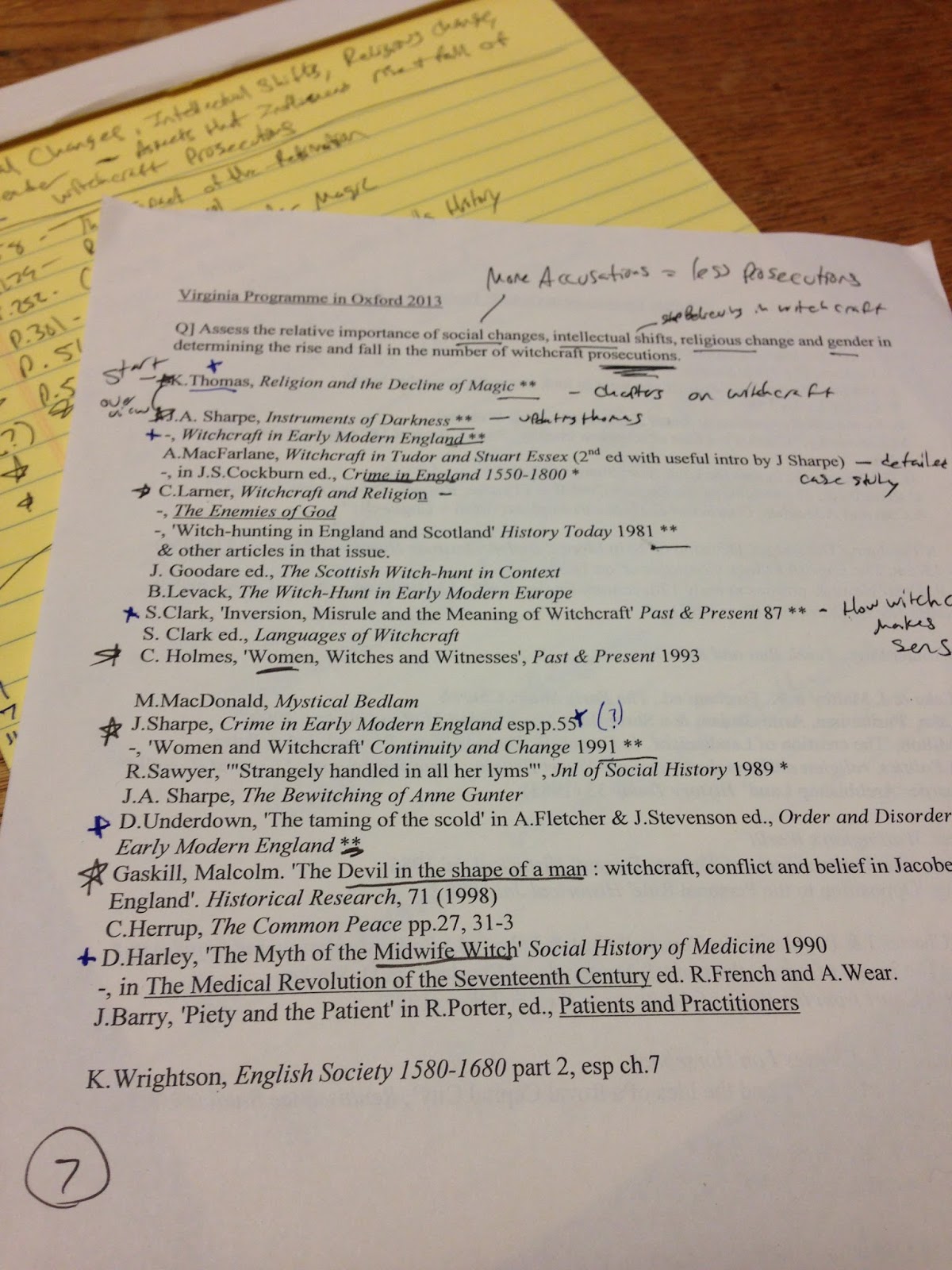
This snapshot was sent to me by a student of mine who is completing a summer program at Oxford University. This is the reading list for ONE WEEK of class.

Here are a few of the books that the students were expected to have familiarized themselves with: Instruments of Darkness; Religion and the Decline of Magic; The Witch-Hunt in Early Modern Europe; Mystical Bedlam looks pretty awesome, as does The Bewitching of Anne Gunter, just in case anyone out there wants to get me an early Christmas present.


Friday, July 19, 2013

Tibetan Sand Mandalas

[image]

I very much enjoyed reading this article on Tibetean Buddhist sand mandalas, exhibitions of which are now touring the U.S.

Until relatively recently, if you were not a monk in the Tibetan Buddhist tradition, the chances of seeing a sand mandala were slim. Today, however, opportunities abound. In July alone, monks from the Atlanta-based Mystical Arts of Tibet will create shimmering, colorful sand mandalas in New York, California, Pennsylvania and Virginia. As I discovered earlier this year at the Mattie Kelly Arts Center of Northwest Florida State College in Niceville, even more entrancing than the end result is the three-to-five-day process: A slow-paced feast of religious ritual, symbolism, performance and temporal art.
It begins with sound: Preternaturally low, vibrating notes energizing the air like the complex tones of a pipe organ. They emanate from nine Tibetan Buddhist monks dressed in dark red and golden saffron, eyes lowered. Punctuated by the wail of horns and the clash of cymbals, their rhythmic chanting dispels harmful spirits and invites the blessing of the Buddha—for it is here that they will build him a palace.
When the senior monk, or vajra master, steps forward, he visualizes the symbolic rendering of that divine abode. The chanting then drops away, the horns, cymbals and drums are stored, and the monks embark on a transfixing exercise in memory, precision and what Buddhists refer to as mindfulness, a state of being present in the moment.
Each manifestation of the Buddha has its own particular design, and they always begin by drawing the axes in the four cardinal directions using chalked string that has been blessed. With large wooden compasses, small metal calipers, and lots of rulers and pencils, they then create an explosion of radiating spokes, overlapping circles, concentric squares and parallel lines. Just when the confusion seems overwhelming, a monk wipes away the excess chalk guides, and an elegant blueprint of the mandala emerges.

 
Next come slender metal funnels and pots of finely ground marble sand. White, salmon red, blue and black, orange and yellow—symbolizing the elements of water, fire, air and earth, as well as the four directions. Along with pots of green, the colors also represent the five aspects of our lives, Vajra Master Chungstan Rinpoche explains. The aspects are form, sensation, perception, response and consciousness, and "when they are in balance," he adds, "we are healthy."
The best way to appreciate the mandala is to stop in every day and linger. At first you notice the basic technique. The monks scoop up sand with the broad end of a funnel that has a ridged strip running down its length. When they're ready to "paint," they rub the strip with a thin metal rod, producing vibrations that cause a trickle of sand. When four monks are working together, it's like listening to a chorus of crickets.
At the Mattie Kelly Arts Center, a clever curator set up a table in another room where visitors could practice. Brilliant. It makes you appreciate the skill involved—monks typically need five years to master the technique and memorize designs. And the repetitive task makes you realize that some meditation is no more esoteric than bypassing the voices in your head in pursuit of the task at hand.
As the work progresses, note the symbols the monks paint around the central Buddha figure, how the background colors form a harmonious balance and denote cardinal directions. When they draw the palace walls, try in your mind's eye to see the T-shaped outcroppings as tall gates—the mandala may appear flat, but it represents a tall, multistory structure. Watch, too, how the design grows increasingly complex, how different colors interact, and how the layering of sand gives the surface three-dimensionality, like decorative frosting on a cake. And watch the monks: There is much to be learned from their teamwork.

For centuries, only the initiated were allowed to see such mandalas, just as only those with the requisite preparation can receive communion in the Roman Catholic Church. But in 1988, almost three decades after Chinese troops marched into Tibet, the Dalai Lama broke with tradition. He sent four monks to make a sand mandala at the American Museum of Natural History in New York as part of an effort to raise awareness about the culture, religion and plight of Tibet.
The ritual monks perform today is removed though not unmoored from its religious meaning and context. At initiations, the opening ceremony alone can last up to three hours. Here the opening lasts 30 minutes, and instead of being out of sight, the monks work like artists in an open studio: people wander in and out, snapping photos and exchanging comments. "We talk about creating mandalas for different purposes," says Rinpoche who, like all teachers, is traditionally addressed by his honorific alone. "This one is for cultural sharing," he explains, likening it to retreats; some are in isolation and silent, others communal and less strict. Truncated or not, however, this remains a spiritually charged activity. Monks always "follow the steps in the proper way," Rinpoche adds. "We believe that by seeing the mandala people will receive its blessing."
Once completed, the monks chant to invite the Buddha to enter. This is when, Tibetan Buddhists believe, the mandala is most powerful and beneficial. But, says Geshe Yeshi of the Mystical Arts of Tibet, "we don't ask the deity to stay forever." At a monastery, monks meditate upon it for several days, using it to explore the teachings of the enlightened mind. Here, it rarely lives more than an hour. Amid more chants that deconsecrate the mandala, the vajra master scores it, then another monk sweeps the sand into a swirl reminiscent of a galaxy: the Tibetan symbol of primordial energy and unity.
Later, as the master pours what is now just a grayish mix of sand into a nearby river, the mandala ritual yields its final lesson: The perceiving of impermanence, the Buddha taught, "removes and abolishes all conceit of 'I am.'"


 Carl Jung was a big fan of the mandala.

Thursday, July 11, 2013

Escape from Freedom -- Erich Fromm


"Most psychiatrists take the structure of their own society so much for granted that to them the person who is not well adapted assumes the stigma of being less valuable. On the other hand, the well-adapted person is supposed to be the more valuable person in terms of a scale of human values. If we differentiate the two concepts of normal and neurotic, we come to the following conclusion: the person who is normal in terms of being well adapted is often less healthy than the neurotic person in terms of human values. Often he is well adapted only at the expense of having given up his self in order to become more or less the person he believes he is expected to be. All genuine individuality and spontaneity may have been lost. On the other hand, the neurotic person can be characterized as somebody who was not ready to surrender completely in the battle for his self. To be sure, his attempt to save his individual self was not successful, and instead of expressing his self productively he sought salvation through neurotic symptoms and by withdrawing into a phantasy life. Nevertheless, from the standpoint of human values, he is less crippled than the kind of normal person who has lost his individuality altogether."
 
 
A lot of people use Orwell's 1984 in order to try and explain the modern age. In my opinion, Fromm's Escape from Freedom would be a far more appropriate book to turn to. And if you are like me and have never admired Martin Luther or John Calvin, you are in for a treat.
 
That's quite a blurb from the Washington Post on the front cover: "Fromm's thought merits the critical attention of all concerned with the human condition and its future."


Saturday, June 22, 2013

Sheep May Safely Graze -- Bach

Lame video but I like the orchestral arrangement. Aria 4 of Cantata 208.


Sunday, May 26, 2013

Lincoln's Second Inaugural Address

This is well worth committing to memory and reciting weekly.

Fellow-Countrymen:

AT this second appearing to take the oath of the Presidential office there is less occasion for an extended address than there was at the first. Then a statement somewhat in detail of a course to be pursued seemed fitting and proper. Now, at the expiration of four years, during which public declarations have been constantly called forth on every point and phase of the great contest which still absorbs the attention and engrosses the energies of the nation, little that is new could be presented. The progress of our arms, upon which all else chiefly depends, is as well known to the public as to myself, and it is, I trust, reasonably satisfactory and encouraging to all. With high hope for the future, no prediction in regard to it is ventured.
 
1
On the occasion corresponding to this four years ago all thoughts were anxiously directed to an impending civil war. All dreaded it, all sought to avert it. While the inaugural address was being delivered from this place, devoted altogether to saving the Union without war, insurgent agents were in the city seeking to destroy it without war—seeking to dissolve the Union and divide effects by negotiation. Both parties deprecated war, but one of them would make war rather than let the nation survive, and the other would accept war rather than let it perish, and the war came.
 
2
One-eighth of the whole population were colored slaves, not distributed generally over the Union, but localized in the southern part of it. These slaves constituted a peculiar and powerful interest. All knew that this interest was somehow the cause of the war. To strengthen, perpetuate, and extend this interest was the object for which the insurgents would rend the Union even by war, while the Government claimed no right to do more than to restrict the territorial enlargement of it. Neither party expected for the war the magnitude or the duration which it has already attained. Neither anticipated that the cause of the conflict might cease with or even before the conflict itself should cease. Each looked for an easier triumph, and a result less fundamental and astounding. Both read the same Bible and pray to the same God, and each invokes His aid against the other. It may seem strange that any men should dare to ask a just God's assistance in wringing their bread from the sweat of other men's faces, but let us judge not, that we be not judged. The prayers of both could not be answered. That of neither has been answered fully. The Almighty has His own purposes. "Woe unto the world because of offenses; for it must needs be that offenses come, but woe to that man by whom the offense cometh." If we shall suppose that American slavery is one of those offenses which, in the providence of God, must needs come, but which, having continued through His appointed time, He now wills to remove, and that He gives to both North and South this terrible war as the woe due to those by whom the offense came, shall we discern therein any departure from those divine attributes which the believers in a living God always ascribe to Him? Fondly do we hope, fervently do we pray, that this mighty scourge of war may speedily pass away. Yet, if God wills that it continue until all the wealth piled by the bondsman's two hundred and fifty years of unrequited toil shall be sunk, and until every drop of blood drawn with the lash shall be paid by another drawn with the sword, as was said three thousand years ago, so still it must be said "the judgments of the Lord are true and righteous altogether."
 
3
With malice toward none, with charity for all, with firmness in the right as God gives us to see the right, let us strive on to finish the work we are in, to bind up the nation's wounds, to care for him who shall have borne the battle and for his widow and his orphan, to do all which may achieve and cherish a just and lasting peace among ourselves and with all nations.


Monday, May 6, 2013

"Finding our way through is what we are called to do."

The Hero's Journey (Joseph Campbell)

From Peggy Noonan in the Wall Street Journal, December 23, 2012:

Many religious people and leaders have come forward to try to speak of the meaning of [the Newtown, Connecticut elementary school shootings], and the answers to it, but the most powerful words came from the psychologist and former priest Eugene Kennedy, professor emeritus at Loyola University of Chicago.

...

Newtown, like 9/11, reminds us of "the mystery of being alone in the world as it is and as we are." The world is imperfect, broken, "with cracks running through it." A central fact of our lives, said Mr. Kennedy, is that "We are all vulnerable. Anything can happen to anybody at any time." We have to understand and recognize our vulnerability "as humans on the earth." We see and experience it every day, "from small disappointments . . . to blows of the heart." And Newtown is a blow of the heart.

But, again like 9/11, Newtown contained within it "the ongoing fact of revelation." Both 9/11 and Newtown were marked by a revealing of "the goodness of normal people, which is seldom celebrated" but is central to the balance of the world. When the teachers tried to shield the children—as when on 9/11 people who knew they were about to die called someone to say they loved them—that was "a revelation of their goodness." It is important in part because "by the light of the goodness of others—by that light we can see ourselves."

We attempt to respond to tragedies politically. We try to take actions that will make our world safer, and this is understandable. But there is no security from existence itself. The only answer is to "plunge into" life. "We have to engage in life and take it on with all the risks it entails, or we won't be alive at all."

He added: "It is better to suffer pain than to live in a world in which you don't allow yourself to be close enough to anybody to have the experience that's bound to give you suffering." And "love guarantees suffering."

"We're all on a hero's journey," said Mr. Kennedy, from where we began to where we will end. The hero faces challenges along the way. We are like King Arthur's knights, entering the forest each day without a cut path, and "finding our way through is what we are called to do."


Tuesday, April 9, 2013

Martin Luther on Suicide


"I don't share the opinion that suicides are certainly to be

damned. My reason is that they do not wish to kill themselves

but are overcome by the power of the devil. They are

like a man who is murdered in the woods by a robber.

However, this ought not be taught to the common people,

lest Satan be given an opportunity to cause slaughter, and I

recommend that the popular custom be strictly adhered to

according to which it [the suicide's corpse] is not carried

over the threshold, etc. Such persons do not die by free

choice or by law, but our Lord God will dispatch them as

He executes a person through a robber. Magistrates should

treat them quite strictly, although it is not plain that their

souls are damned. However, they are examples by which

our Lord God wishes to show that the devil is powerful and

also that we should be diligent in prayer. But for these

examples we would not fear God. Hence He must teach us

in this way."


Martin Luther, "Suicides Are Not Necessarily Damned"

(April 7, 1532, No. 222), Luther's Works: American

Edition, ed. Jaroslav Pelikan and Helmut T. Lehmann, 55

vols. (S 1, Louis: Concordia Publishing House; Minneapolis:

Fortress Press, 1955-1986)' 54, ed. and trans. by Theodore

G. Tappert (Philadelphia: Fortress Press, 1967), p. 29.


Got it? God randomly executes people by suicide in order to 1) teach us to fear Him; 2) give us an appreciation of the power of Satan; and, 3) keep us diligent in prayer. The victims of suicide are blameless, but we should act as if they are sinners in order to keep people on the right path.
 
Let's hope that Pastor Rick Warren and his family find solace in something other than Luther's writings.
 

Tuesday, April 2, 2013

Do atheists really believe in God?

Here's a fun little study that combines physiological measurements with the infliction of mild distress on research volunteers. Great title, too:

Atheists become emotionally aroused when daring God to do terrible things

Abstract

We examined whether atheists exhibit evidence of emotional arousal when they dare God to cause harm to themselves and their intimates. In Study 1, the participants (16 atheists, 13 religious individuals) read aloud 36 statements of three different types: God, offensive, and neutral. In Study 2 (N = 19 atheists), ten new stimulus statements were included in which atheists wished for negative events to occur. The atheists did not think the God statements were as unpleasant as the religious participants did in their verbal reports. However, the skin conductance level showed that asking God to do awful things was equally stressful to atheists as it was to religious people and that atheists were more affected by God statements than by wish or offensive statements. The results imply that atheists' attitudes towards God are ambivalent in that their explicit beliefs conflict with their affective response.

 
I might quibble that the atheists became physiologically aroused when reading the statements (the researchers are inferring a corresponding emotional arousal). [N.B. I have not read the entire journal article.] Note also that no one can tell what (if any) emotions are being aroused. Increased sweatiness (skin conductance level) when reading the statement, "I wish that God would cause someone to murder my parents cruelly" (these Finnish researchers are a tough lot) could imply belief in God and fear that you are tempting Him (the researchers' suggestion), or it could imply belief in God and excitement that He might murder your parents for you.

The point of this study, however, is that the self-avowed atheists had greater physiological arousal when saying, "I wish God would kill my parents" than when saying "I wish someone would kill my parents." It is possible that the atheists were simply having a strong physiological response to the word, "God." After all, if you self-identify as an atheist, you do have a lot invested in the concept of God. Every mention of God is a potential threat to your identity. What if you encounter an argument for the existence of God that causes you to doubt your current position? You would have to be on guard at all times.

It is an entirely different situation from that of a person who is utterly indifferent to, say, professional sports. Hook him up to some GSR sensors and rattle off the names of the most recent Super Bowl champs, interspersed with the names of some recently poor performing teams, and you won't see any difference in physiological response. All the same to him. And if his friends say that they are headed off to the Big Game, he wishes them well with a smile and a wave, and retires to his study with his Haydn, Montaigne, and Calvados.

My suggestion is that self-identified atheists care about God a lot more than people who are indifferent to professional sports care about sports. Atheists are not indifferent to God -- His non-existence is a central aspect of their constructed identities. Similiarly, vegetarians are not indifferent to meat (they are more often phobic towards meat). A large part of their identity is centered around meat. (Yes, vegetarians have a "meat-based" identity, just as atheists have a "God-centric" identity.) As much as I delight in the phenomenon of ambivalence, I would be cautious about asserting that self-avowed atheists have hidden religious faith based on a study such as this.


Now if you like this sort of thing, this is a classic.