Showing posts with label suicide. Show all posts

Friday, April 7, 2017

Work finally begins on Golden Gate Bridge suicide barrier!

Call me cautiously optimistic.


WaPo

In 2016, 39 people died jumping off the [Golden Gate] bridge, considered one of the top suicide magnets in the world. Another 184 came to the bridge intending to harm themselves but were stopped.
The deaths have scarred the bridge’s reputation and prompted local officials, lawmakers and families of those who died to call for the construction of barriers to deter people from jumping off the 220-foot-tall bridge.
...
For about a decade, officials have debated constructing such an obstacle, confronting a question that has been researched and scrutinized around the world: Do barriers to suicide stop people from taking their lives? Or will suicidal people simply find another alternative?
A wealth of studies and findings have supported an optimistic view. And the years-long effort finally culminated Thursday in an official launch of the construction of a $200 million stainless steel net along the bridge. The suicide deterrent system will span 1.7 miles of roadway on each side and will be located 20 feet down from the sidewalk, extending 20 feet out over the water. It will be built over four years, with an expected completion date in 2021.
...
Officials hope the net, made of thick steel cables, will deter people from jumping in the first place. If they jump, they’re likely to survive but with injuries. The net, suspended from posts, will have a slightly upward slope, and will collapse a bit if someone lands in it, making it difficult for the jumper to climb out, The San Francisco Chronicle reported. The bridge district would use a retrieval device to pluck jumpers from the net.
Similar deterrent systems have been used successfully in various locations around the world, but never on this scale, bridge officials said in a news release. In support of such suicide deterrents, many have cited a breakthrough 1978 study at the Golden Gate Bridge showing that 90 percent of those stopped from jumping did not later die by suicide or other violent means. More broadly, a Harvard School of Public Health article reviewing numerous studies showing that nine out of 10 people who attempt suicide and survive will not go on to die by suicide at a later date.
Other studies linked the installation of barriers to reductions in suicides at hotspots such as the Muenster Terrace in Bern, Switzerland, and the Memorial Bridge in Augusta, Maine. But as Keith Humphreys, professor of psychiatry at Stanford University, noted in The Post, a major study in Toronto raised doubt, noting that after the installation of a barrier at Bloor Street Viaduct, suicides there dropped but increased by a comparable amount at other bridges and buildings in Toronto.
A later study from the University of Melbourne, however, combined findings across all prior studies and found that the net benefit of a suicide barrier is a 28 percent decrease in suicides by jumping per year."


Friday, March 17, 2017

MG Dana Pittard reduced suicides at Fort Bliss, but his initiatives were abandoned by the US Army

Image result for dana pittard


Politico

"[US Army MAJ GEN Dana] Pittard says he never thought about suicide while in combat or at West Point. Both were stressful environments where he felt he was expected to fail—in Iraq because of the difficulty of the mission, and at West Point because he was one of the few black cadets. “I didn’t want to give people the satisfaction,” he says. “Whatever enemy we’re fighting, they’re going to have to kill me.”
But he wonders if his time in Iraq left him too comfortable with death, even numb to it. On April 29, 2004, north of Baghdad, an IED intended for Pittard exploded moments after his truck passed by, hitting the Humvee behind him and killing 20-year-old Specialist Martin Kondor. The soldier was one of thousands to serve under Pittard during the war, but Pittard can still recall Kondor’s name, hometown — York, Pennsylvania — and the date of the bombing. He says details like these stick in his mind. “Stuff like that kind of haunts me.”
Suicides haunt him, too. One of the soldiers in his brigade in Iraq committed suicide, alone in his room with the door locked. He didn’t leave a note. “We all lived so close together,” Pittard recalls. “To this day, I’m not sure why.”
After Kondor’s death, Pittard says, there came a point when he felt sure he was going to be killed in Iraq. He says he stopped worrying about his safety, a feeling he described as “empowering” and “liberating.”
“Of course I thought about my family, but I knew they’d be taken care of. They just wouldn’t have me physically there,” says Pittard.
Although Pittard insists he didn’t feel suicidal, Dr. Ritchie says that the fatalism he experienced is common among soldiers and often results in increased risk taking — driving too fast or drinking too much. In those cases, she says, it can lead to suicide.
Soldiers who have deployed multiple times, like Pittard, are most at risk when they get home. Pittard returned from Iraq in August 2007, and was stationed in California. In 2009, he moved to Virginia, where he was named deputy commander of the agency that runs the Army’s training programs. It was here that he sought psychological counseling. At first, he went with his family, and the purpose of the visits was to help one of his sons. Then, he started going alone. For the first time in his life, he wanted to talk to someone about his depression.
One evening in early 2010, driving on the Monitor-Merrimac Bridge over the James River on his way home from work, he had visions of crashing his car over the short cement guardrail and into the water 20 feet below. It was the nearest he’d ever come to suicide.
At the time, Pittard didn’t tell anyone in the Army that he was going to counseling. He was living off-base, and he went to a private psychologist, not a military doctor. “I wasn’t concerned that anyone would find out,” says Pittard, “but I didn’t think anyone would ever find out.”
They have good reason to be concerned. Some Department of Defense policies still create career penalties for people who seek mental health care. The deployment-eligibility requirements for Central Command and Africa Command, for example, “disqualify or require waivers for individuals who have received a mental or behavioral health diagnosis.” That culture of silence extends to the top leadership of the military. In July, Major General John Rossi, a former neighbor of Pittard’s, became the highest-ranked soldier ever to take his own life. For months, the Army refused to acknowledge his death was a suicide."


Wednesday, March 15, 2017

Nightmares as predictors of suicide

Nightmare. Henry Fuselli (1781)

Nightmares as predictors of suicide.
Tanskanen, Antti; Tuomilehto, Jaakko; Viinamäki, Heimo; Vartiainen, Erkki; Lehtonen, Johannes; Puska, Pekka
Sleep: Journal of Sleep and Sleep Disorders Research, Vol 24(7), Nov 2001, 844-847.

Examined the relationship between the frequency of nightmares and the risk of suicide. A prospective follow-up study in a general population of Finland starting in 1972. A total of 36,211 Ss (17,700 men and 18,511 women aged 25–64 yrs at baseline. The study included self-administered questionnaire (mainly questions on socioeconomic factors, medical history, health behavior, and psychosocial factors) and health examination at the local primary healthcare center. The frequency of nightmares was estimated. The Ss were followed until Dec. 31, 1995, or death. Information on deaths caused by suicide or other self-inflicted injury was obtained from the National Death Register by computerized record linkage using the national personal identification code assigned to every Finnish resident. Using the Cox proportional hazards regression model we controlled for several potential confounding factors. The frequency of nightmares was directly related to the risk of suicide. Among Ss having nightmares occasionally the adjusted relative risk of suicide was 57% higher, and among those reporting frequent nightmares 105% higher compared with Ss reporting no nightmares at all.


Friday, March 3, 2017

"Suicide is an action of the most unqualified and sordid egotism"


GIACOMO LEOPARDI (1798-1837)


Ethics of Suicide

"Whether suicide be reasonable, or our compromise with life unreasonable, the former is certainly a horrible and inhuman action. It were better to follow Nature, and remain man, than act like a monster in following Reason. Besides, ought we not to give some thought to the friends, relatives, acquaintances, and people with whom we have been accustomed to live, and from whom we should thus separate for ever? And if the thought of such separation be nothing to us, ought we not to consider their feeling? They lose one whom they loved and respected; and the atrocity of his death enhances their grief. I know that the wise man is not easily moved, nor yields to pity and lamentation to a disquieting extent; he does not abase himself to the ground, shed tears immoderately, nor do other similar things unworthy of one who clearly understands the condition of humanity. But such fortitude of soul should be reserved for grievous circumstances that arise from nature, or are unavoidable; it is an abuse of fortitude to deprive ourselves for ever of the society and conversation of those who are dear to us. He is a barbarian, and not a wise man, who takes no account of the grief experienced by his friends, relations, and acquaintances. He who scarcely troubles himself about the grief his death would cause to his friends and family is selfish; he cares little for others, and all for himself. And truly, the suicide thinks only of himself. He desires nought but his personal welfare, and throws away all thought of the rest of the world. In short, suicide is an action of the most unqualified and sordid egotism, and is certainly the least attractive form of self-love that exists in the world. 
Finally, my dear Porphyrius, the troubles and evils of life, although many and inevitable, when, as in your case, unaccompanied by grievous calamity or bodily infirmity, are after all easy to be borne, especially by a wise and strong man like yourself. And indeed, life itself is of so little importance, that man ought not to trouble himself much either to retain or abandon it; and, without thinking greatly about it, we ought to give the former instinct precedence over the latter. 
If a friend begged you to do this why should you not gratify him? 
Now I earnestly entreat you, dear Porphyrius, by the memory of our long friendship, put away this idea. Do not grieve your friends, who love you with such warm affection, and your Plotinus, who has no dearer nor better friend in the world. Help us to bear the burden of life, instead of leaving us without thought. Let us live, dear Porphyrius, and console each other. Let us not refuse our share of the suffering of humanity, apportioned to us by destiny. Let us cling to each other with mutual encouragement, and hand in hand strengthen one another better to bear the troubles of life. Our time after all will be short; and when death comes, we will not complain. In the last hour, our friends and companions will comfort us, and we shall be gladdened by the thought that after death we shall still live in their memory, and be loved by them."


Friday, February 24, 2017

Buprenorphine decreases suicidal ideation?

It's amazing what clinicians will do just to avoid entering into a therapeutic relationship with their suicidal patients (especially the borderlines). I really wish they had a control condition in which the hospitalized suicidal patients had daily individual sessions with an empathic therapist (the same therapist they would get to see on a weekly basis after their release). This study would have to replicated, of course. And we should keep in mind that there are other ways to reduce pain and suicidal ideation that don't involve drugs, such as building physical endurance in high-risk suicidal patients through mountain hiking. Seriously, check it out.


Scientific American
"Could mental pain be treated like physical pain, and would a reduction in suicidal thoughts follow?  A surprising new study by Yovell and colleagues in Israel addressed that question in a randomized, placebo-controlled trial of very low doses of an opioid, buprenorphine, in severely suicidal subjects
The authors looked to the concept of “separation distress” to justify the trial of buprenorphine.  All young animals, including humans, are distressed when separated from the attachment figures on whom their physical and emotional well-being depends.  Very low doses of opioids have been known to ameliorate that distress since the 1970s. The authors of the current study drew on attachment literature which established that endogenous opioids—the ones that occur naturally in our brains—help us feel good when we are with loved ones.  When we separate from loved ones, internal opioid levels drop, and we experience mental pain—the human version of separation distress. 
Neurobiological studies have suggested that separation distress overlaps with pain circuitry in the brain in a general “neural alarm system” when an animal, or a person, is under threat.  A trial of opioid painkillers, which might quiet that neural alarm system, seemed reasonable.
It was also necessary.  There are currently no medications to quickly relieve suicidal thoughts.  Antidepressants can take a month or longer to ease depression, and many psychiatrists today, like Shneidman, believe that depression and suicidal ideation are separate conditions.  Treating depression might not even address suicidal thinking.  A medication that specifically targets suicidal ideation—quickly—could be lifesaving.
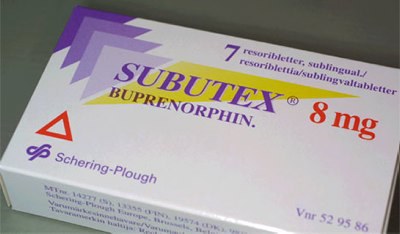
Buprenorphine, sold as Subutex in pure form and as Suboxone when combined with naloxone (which decreases its abuse potential) is an unusual opioid in that it stimulates some, but not all, of the brain’s opioid receptors.  It causes less euphoria than opioids like hydrocodone, the active ingredient in Vicodin, and hydromorphone, the active ingredient in Dilaudid, but relieves pain and withdrawal symptoms; in fact, it was developed as a treatment for opioid addiction.  Because it is less pleasurable, it is less likely to be abused, and because it is weaker, it is safer in overdose.  Individuals who do abuse buprenorphine get high by crushing the tablets and injecting a solution made from the powder.  The investigators used a gelatin-based lozenge that dissolves under the tongue to make that impossible. 
Yovell and colleagues recruited patients from four hospitals in Israel and assigned them to receive tiny doses of buprenorphine or placebo.  At the outset, the subjects were quite ill; the majority had made suicide attempts in the past, and 57% met criteria for borderline personality disorder, which is characterized by chronic suicidal ideation and rejection-sensitivity—meaning that mild slights can cause their mood to plunge.  The Beck Scale for Suicide Ideation was used to rate patients’ suicidality before, during, and after the intervention. 
The authors found a significant drop in suicidal thinking in the buprenorphine group versus the placebo group.  Buprenorphine had a positive effect on depression, but the impact on suicidal thinking was even greater. Further, patients who met criteria for borderline personality disorder benefited even more than patients with depression alone.  For the investigators, this finding closed a loop: extreme distress over real or perceived abandonment is a hallmark of borderline personality disorder.  In borderline patients, suicidal thoughts may emerge when their highly sensitive separation distress systems are activated, with a drop in endogenous opioids and subsequent mental pain.  The robust improvements in suicidal ideation in borderline patients suggested that buprenorphine treats the psychache associated with abandonment and rejection. 
The study could not prove that opioids treat mental pain—it wasn’t designed to do so—but it did show that buprenorphine decreases suicidal ideation.  Perhaps the study’s most important contribution is its implication that treatments that help us withstand mental pain may prevent suicide."


Wednesday, February 1, 2017

Suicide prevention in the gun shop

Image result for gun store
Must be strange, selling guns to people who are more likely to use them against themselves than against an intruder. Voluntarily, and temporarily, restricting access to firearms during a suicidal crisis shouldn't be a controversial position.


Science of Us
More than half of all suicides in the United States are carried out with a firearm, and gun suicides make up the majority of fatal shootings,” writes Ewing. “In 2015, nearly two-thirds of all gun-related deaths in the country were by the shooter’s own hand, according to an analysis by the Centers for Disease Control and Prevention.”
The NSSF and AFSP, whose collaboration was highlighted in a recent JAMA article, are focusing on people who are in the midst of mental-health crises. As a bunch of research has shown, suicide is a more impulsive act than many people realize — there are plenty of cases in which it really can be life-saving to temporarily cut someone off from access to a deadly tool like a gun. This initiative is “intended to educate gun shop owners and shooting range operators on the risk factors and warning signs of suicide, and to provide guidance for family members who wish to restrict access to firearms from a loved one in crisis.” Part of the hope is that word will then filter down from these trusted voices to gun owners themselves, making the entire gun-owning community safer and better informed.
The phrase “harm reduction” doesn’t come up in Ewing’s piece, but that’s exactly what this is: a measure designed to accept that we live in a flawed world that isn’t going to change anytime soon, and to improve public health to the extent possible given the constraints imposed by reality. “This initiative is starting with the reality that guns are in one-third of American homes so, given that, what can they do to keep someone safe?” Christine Moutier, chief medical officer for the American Foundation for Suicide Prevention, told Ewing. “We’re simply saying have that caring conversation that should include offering to help them secure their firearms temporarily if they’re having this crisis.” In other words: The best way to reduce gun suicides would be to have fewer guns floating around, but since that isn’t going to happen anytime soon (maybe ever, in this country), what else can be done to help keep people safe?"


Wednesday, December 14, 2016

Among recent veterans, the suicide rate is much worse than the "22 a day" slogan implies

Image result for veteran suicide
Among recent veterans, the suicide rate is much worse than the "22 a day" slogan implies. Photo from Buzzfeed.


WaPo Factchecker
"A new study funded by the Army shows the suicide rate for veterans who served in recent wars is much lower than 22 a day. [This might be so, but it is also irrelevant; it's the rates per 100,000 that matter, Ed.]  The study, published in the February 2015 Annals of Epidemiology, is the first large population-based study of post-service suicide risk among this population. Researchers used veteran records from two Defense Department databases, verified Social Security information and used the CDC’s National Death Index Plus. They studied 1.3 million veterans who were discharged between 2001 and 2007. Among deployed veterans in this report, 32.6 percent were born in 1978-1981 and 30 percent were born in 1982-1990.
Between 2001 and 2009, there were 1650 deployed veterans and 7703 non-deployed veteran deaths. Of those, 351 were suicides among deployed veterans and 1517 were suicides among non-deployed veterans. That means over nine years, there was not quite one veteran suicide a day.
This is not to say, however, that suicide is not a concern among that population. One in two veterans of Iraq and Afghanistan wars say they know a fellow service member who attempted or committed suicide, according to a Washington Post-Kaiser Health poll."


So, who will check the Fact Checkers? The study cited above reported 1,868 suicide deaths out of 1.3 million veterans discharged between 2001 and 2007. That's a suicide death rate of 143.7 out of every 100,000 people in that recent veteran population (rate/100,000 persons is the standard way to report suicide rates). That's a huge and alarming number. Essentially, recent veterans are dying by suicide at about seven-times the rate of other American males.

For comparison sake, the suicide death rate for American males is 21.1, and for White Males, the most at-risk demographic for death by suicide, it is 24.1. White Males account for 82 of the 117 deaths by suicide each day in the United States (70%).

My problem with the "22 veteran suicides a day" claim is that that it conflates veterans of various eras. I would prefer to see reported rates for veterans of the Iraq/Afghanistan era (e.g., 143.7/100,000), First Gulf War, Vietnam, Korea, and World War II.

If the 22 a day statistic is accurate, that means 8,030 veteran suicide deaths a year. According to the VA, there are 21,368,156 American veterans, so that would mean a suicide death rate of 37.6 per 100,000. (8,030 divided by 21,368,156, and then multiplied by 100,000.)

Given that, according to the CDC, the suicide death rate is 38.8 per 100,000 for males aged 75 and older, 26.6 for males aged 65-74, and 29.7 for males aged 45-64, the "the 22 a day" claim does not seem outrageous to me.

We should probably brace ourselves for yet further increases in suicide deaths, as the "peak Vietnam generation" (age 20 in 1968) are only 68 years old and have seven more years until they reach the deadliest suicide age range.

Here's a table I created, using #veterans by age group, multiplied by three suicide rates (Males, White Males, 22/day Veterans). It assumes that the rates are the same across age group, which they doubtless are not.

US Males White Males Veterans
Age Groups #Veterans 21.1 24.1 37.6
< 20 5,793 1.28 1.40 2.18
20-24 231,391 51.14 55.77 87.00
25-29 761,053 168.19 183.41 286.16
30-34 1,005,899 222.30 242.42 378.22
35-39 1,145,089 253.06 275.97 430.55
40-44 1,187,405 262.42 286.16 446.46
45-49 1,555,295 343.72 374.83 584.79
50-54 1,758,347 388.59 423.76 661.14
55-59 1,915,263 423.27 461.58 720.14
60-64 1,956,181 432.32 471.44 735.52
65-69 2,767,254 611.56 666.91 1040.49
70-74 2,531,807 559.53 610.17 951.96
75-79 1,636,010 361.56 394.28 615.14
80-84 1,377,425 304.41 331.96 517.91
85+ 1,533,944 339.00 369.68 576.76
Grand Total 21,368,156 4722.36 5149.73 8034.43
Per Day 12.94 14.11 22.01


Tuesday, December 13, 2016

Alcoholic narcissist murders his beautiful daughter to spite his wife

Image result for claire randall murder
Psychodynamic thinking is still going strong in forensic psychology. But I suspect that there are also some discreet theologians in the field. Sustained exposure to evil will do that to you.


 WaPo, 12/11/16
"Daniel Randall, a former pastor who once served as a chaplain in the Air Force, had just completed a 90-day program for alcohol abuse.
He left the Liberty Bay Recovery Center in Portland, Maine, at about 10 a.m. Thursday.
Then, police said, he bought a shotgun and drove to his home in Hebron, about 40 miles northwest of Portland.
Several hours later, a neighbor found the 56-year-old lying face down on the porch of his home. The words “VOW BREAKER” were spray-painted on the kitchen counter, Carroll Daggett, who lives a short distance away, told the Portland Press Herald.
Daggett called police.
Officers then found Randall’s 27-year-old daughter, Claire, dead in the bathroom. She died of multiple shotgun wounds, according to the state medical examiner’s office.
Maine State Police said Daniel Randall, who had been estranged from his family and didn’t have a key to the house, broke in through the garage and shot his daughter before shooting himself once in the head. Police said he spray-painted messages on the walls of the five rooms in the house.
Among them was a message to his wife, Anita, who had filed for divorce.
Anita, it’s all your fault” was written on one of the walls, according to WCSH 6."


Thursday, October 13, 2016

Did Feras Freitekh intentionally crash that plane in Connecticut?

Image result for Feras Freitekh
The wreckage of the twin-engine Piper that crashed in East Hartford, CT on October 11, 2016. Can't believe one of the people aboard survived. People really do kill themselves by means of airplanes; it's not just a terrorist thing.

NYT

"The Federal Bureau of Investigation has taken over the investigation into the crash of a small plane in Connecticut on Tuesday afternoon, looking into the possibility that the aircraft was deliberately downed by one of the two people on board, according to the authorities.
Lt. John Litwin of the East Hartford Police told reporters on Wednesday morning that he would not comment on specific details of the investigation, but confirmed that the F.B.I. was leading the inquiry.
“Although you can see the investigation is extremely active, it is still in its infancy,” Lieutenant Litwin said. “Nothing has been ruled out, including an accident.”
He said two people were on board the Piper PA-34 Seneca twin-engine plane at the time of the crash, although it is unclear who was at the controls.
The plane is equipped with two set of controls, so at any given point, either person could have been piloting the aircraft, Lieutenant Litwin said.
One person aboard was killed in the crash; he was identified as Feras M. Freitekh, 28, a Jordanian national. The other person escaped from the burning wreckage and is now at a hospital in Bridgeport being treated for his wounds, which were described as serious but not life-threatening. 
Lieutenant Litwin said that the survivor had been able to speak to investigators but would not comment on what he might have told them.
Four law enforcement officials familiar with the investigation told The New York Times on Tuesday that the survivor had said that the crash was not an accident."


Friday, October 7, 2016

63% increase in suicide among middle-aged American women


Image result for female suicide millais
Ophelia -- John Everett Millais (1852)


Centers for Disease Control


In 1999, 5,741 U.S. women died by suicide (rate per 100,000 = 4.0). In 2014, the female suicide rate increased to 5.8/100,000, involving 9,660 victims.


In the same time period (1999-2014), the suicide rate for middle aged U.S. women (ages 45-64) increased 63%, from 6.0 to 9.8, or, from 1,868 to 4,195 victims.


The rates for men increased 16% (all ages) and 43% (45-64).


What's changed from 1999 to 2014 and why is it causing such disastrous consequences?


Table. Number of deaths, death rates by age, and age-adjusted death rates for suicide, by Hispanic origin and race and sex: United States, 1999 and 2014

[Rates per 100,000 population estimated as of July 1]
Hispanic origin and race and age (years)FemaleMale
 
19992014Percent change in rate, 1999–201419992014Percent change in rate, 1999–2014
NumberRateNumberRateNumberRateNumberRate
All races1          
All ages25,7414.09,6605.84523,45817.833,11320.716
10–14500.51501.52001921.92752.637
15–245753.09904.6533,32616.84,08918.28
25–442,3595.53,0187.2319,21321.610,25724.313
45–641,8686.04,1959.8636,10920.812,09929.743
65–744204.18285.9442,05124.73,28226.68
75 and over4694.54774.0-112,54942.43,10638.8-8
Not stated*1**16*3**
Non-Hispanic white3          
All ages24,9144.78,0307.56019,62020.227,36825.828
10–14330.5941.72401402.11903.357
15–244143.46535.4592,41619.22,84222.417
25–441,9816.82,4019.8447,41525.27,86731.726
45–641,6787.03,71512.6805,389>23.410,61737.159
65–743804.67456.9501,86927.02,98330.714
75 and over4284.84214.5-62,38445.72,86544.0-4
Not stated-*1**6*3**
Non-Hispanic black3          
All ages22941.74552.1241,63010.51,8719.7-8
10–147*14**221.4392.579
15–24552.0912.73540814.842612.3-17
25–441422.51743.02078515.580615.0-3
45–64641.91432.7422789.84549.80
65–7416*221.6*7811.7827.7-34
75 and over10*10**5714.16311.0-22
Not stated-*-**2*-**
Non-Hispanic Asian or Pacific Islander3,4          
All ages21883.43503.534579.08048.9-1
10–141*4**6*6**
15–24354.1534.35829.516312.835
25–44763.81304.1820310.82859.9-8
45–64463.91044.31011811.525112.26
65–7414*304.6*2210.15810.98
75 and over16*296.3*2519.44112.7-35
Not stated-*-**1*-**
Non-Hispanic American Indian or Alaska Native3,5          
All ages2544.61188.78922219.834827.438
10–14-*7**2*4**
15–2413*3415.6*7739.18638.2-2
25–44298.25615.79110230.016848.060
45–6412*19**3014.97022.752
65–74-*-**9*11**
75 and over-*-**2*9**
Not stated-*-**-*-**
Hispanic6          
All ages22651.96622.5321,43010.32,58210.30
10–149*311.3*211.4351.40
15–24531.81573.4893389.956211.516
25–441212.32473.03067111.31,10112.612
45–64592.51853.54026311.864012.45
65–7410*282.4*6313.812713.2-4
75 and over13*14**7230.211720.6-32
Not stated-*-**2*-**
Difference in rates between 1999 and 2014 was significant at p < 0.05.
- Quantity zero. Missing values for age were not distributed prior to calculating rates.
* Figure does not meet standards of reliability or precision; based on fewer than 20 cases in the numerator.
1Includes Hispanic origin not stated.
2Age-adjusted using the direct method and the standard 2000 population.
3Race categories are consistent with the 1977 Office of Management and Budget (OMB) standards. In 2014, multiple-race data were reported by 46 states and the District of Columbia; see Technical Notes. The multiple-race data for these reporting areas were bridged to the single-race categories of the 1977 OMB standards for comparability with other reporting areas.
4Includes Aleuts and Eskimos.
5Includes Chinese, Filipino, Hawaiian, Japanese, and other Asian or Pacific Islander persons.
6Persons of Hispanic origin may be of any race.
NOTE: Suicide deaths are identified with underlying cause-of-death codes U03, X60–X84, and Y87.0 from the International Statistical Classification of Diseases and Related Health Problems, Tenth Revision.
SOURCE: National Vital Statistics System, Mortality, 1999 and 2014.
 

Wednesday, September 14, 2016

Suicide Attempts of both donor and recipient in first face transplant


Image result for labrador retriever
Not the actual dog. Mlle Dinoire died recently. RIP.


Wikipedia
"[Isabelle] Dinoire's dog mauled her face after she passed out from an overdose of sleeping pills.[5] Some reports following the initial surgery claim that her daughter said that the black Labrador cross (named Tania) was "frantically" trying to wake Dinoire after she took sleeping pills in a suicide attempt, and that Dinoire wrote about her suicidal feelings in her own memoir.[6] The hospital denied this,[7] saying that she said she had taken a pill to go to sleep after a family argument and was bitten by her labrador during the night.
In a statement made on 6 February 2006, Dinoire said that "after a very upsetting week, with many personal problems, I took some pills to forget ... I fainted and fell on the ground, hitting a piece of furniture."[8]
Dinoire's daughter reported that the family is sure that the dog, which was euthanized, mutilated Dinoire by accident.[9] They believe that the damage was caused when the dog, finding Dinoire wouldn't wake up, got more and more frantic, and began scratching and clawing her.[9][10] Dinoire was "heartbroken" when Tania was euthanized and kept a picture of the Labrador by her hospital bed;[11] she later adopted a different dog to aid in her recovery after surgery.[9]
Dinoire's injuries affected her nose, lips, chin, and cheeks.[5] She wore a surgical mask to cover the injuries on the lower part of her face, as the upper face was not affected.[9] 
Doctors and the media debated whether the donor and/or the recipient had attempted suicide, with reports stating that the donor had hanged herself.[11] The family of the donor told the funeral director who handled the donor's death that it had been accidental. Local French newspapers stated that Dinoire's daughter said that her mother had attempted suicide. Dubernard said that the recipient had not tried to kill herself. Olivier Jardé, an orthopedic surgeon from Amiens and a member of the French National Assembly, said that both the donor and the recipient had attempted suicide.[12] The Sunday Times, a British newspaper, stated that Dinoire had said in a telephone interview that she had tried to commit suicide.[12] In her 2007 memoir, Dinoire stated that the donor had killed herself, and this "gave Dinoire a feeling of sisterhood" with her.[6]"


Friday, September 9, 2016

The suicide of the chief scientist at Theranos

Image result for elizabeth holmesImage result for william gibbons theranos


Elizabeth Holmes, billionaire founder of Theranos, and her late chief scientist, Ian Gibbons.

Vanity Fair


"One of [Theranos founder Elizabeth] Holmes’s first major hires, thanks to an introduction by Channing Robertson, was Ian Gibbons, an accomplished British scientist who had a slew of degrees from Cambridge University and had spent 30 years working on diagnostic and therapeutic products. Gibbons was tall and handsome, with straight reddish-brown hair and blue eyes. He had never owned a pair of jeans and spoke with a British accent that was a combination of colloquial and posh. In 2005, Holmes named him chief scientist.
Gibbons, who was diagnosed with cancer shortly after joining the company, encountered a host of issues with the science at Theranos, but the most glaring was simple: the results were off. This conclusion soon led Gibbons to realize that Holmes’s invention was more of an idea than a reality. Still, bound by the scientific method, Gibbons wanted to try every possible direction and exhaust every option. So, for years, while Holmes put her fund-raising talents to use—hiring hundreds of marketers, salespeople, communications specialists, and even the Oscar-winning filmmaker Errol Morris, who was commissioned to make short industrial documentaries—Gibbons would wake early, walk his dogs along a trail near his home, and then set off for the office before seven A.M. In his downtime, he would read I, Claudius, a novel about a man who plays dumb to unwittingly become the most powerful person on earth.
While Gibbons grew ever more desperate to come up with a solution to the inaccuracies of the blood-testing technology, Holmes presented her company to more investors, and even potential partners, as if it had a working, fully realized product. Holmes adorned her headquarters and Web site with slogans claiming, “One tiny drop changes everything,” and “All the same tests. One tiny sample,” and went into media overdrive. She also proved an effective crisis manager. In 2012, for instance, Holmes began talking to the Department of Defense about using Theranos’s technology on the battlefield in Afghanistan. But specialists at the D.O.D. soon uncovered that the technology wasn’t entirely accurate, and that it had not been vetted by the Food and Drug Administration. ...
At around the same time, Theranos also decided to sue Richard Fuisz, an old friend and neighbor of Holmes’s family, alleging that he had stolen secrets that belonged to Theranos. As the suit progressed—it was eventually settled—Fuisz’s lawyers issued subpoenas to Theranos executives involved with the “proprietary” aspects of the technology. This included Ian Gibbons. But Gibbons didn’t want to testify. If he told the court that the technology did not work, he would harm the people he worked with; if he wasn’t honest about the technology’s problems, however, consumers could potentially harm their health, maybe even fatally.

Holmes, meanwhile, did not seem willing to tolerate his resistance, according to his wife, Rochelle Gibbons. Even though Gibbons had warned that the technology wasn’t ready for the public, Holmes was preparing to open “Theranos Wellness Centers” in dozens of Walgreens across Arizona. “Ian felt like he would lose his job if he told the truth,” Rochelle told me as she wept one summer morning in Palo Alto. “Ian was a real obstacle for Elizabeth. He started to be very vocal. They kept him around to keep him quiet.” Channing Robertson, who had brought Gibbons to Theranos, recalls a different conversation, noting, “He suggested to me on numerous occasions that what we had accomplished at that time was sufficient to commercialize.”
A few months later, on May 16, 2013, Gibbons was sitting in the family room with Rochelle, the afternoon light draping the couple, when the telephone rang. He answered. It was one of Holmes’s assistants. When Gibbons hung up, he was beside himself. “Elizabeth wants to meet with me tomorrow in her office,” he told his wife in a quivering voice. “Do you think she’s going to fire me?” Rochelle Gibbons, who had spent a lot of time with Holmes, knew that she wanted control. “Yes,” she said to her husband, reluctantly. She told him she thought he was going to be fired. Later that evening, gripped and overwhelmed with worry, Ian Gibbons tried to commit suicide. He was rushed to the hospital. A week later, with his wife by his side, Ian Gibbons died.
When Rochelle called Holmes’s office to explain what had happened, the secretary was devastated and offered her sincere condolences. She told Rochelle Gibbons that she would let Holmes know immediately. But a few hours later, rather than a condolence message from Holmes, Rochelle instead received a phone call from someone at Theranos demanding that she immediately return any and all confidential Theranos property."