Wednesday, August 14, 2013

Banning menthol cigarettes?


First this:

Former smokers earn higher wages than smokers and people who have never smoked, according to new research.
...
They determined that differences in the characteristics of smokers and nonsmokers, such as educational attainment, as well as unmeasured factors such as an employer’s tolerance to smoking behavior, are mostly driving the wage gap. They noted that education level was the largest contributing variable. Nonsmokers tend to be more educated, are less likely to have spouses who smoke and live in states where cigarette prices are higher than smokers.
The findings suggest that the characteristics of former smokers are more highly rewarded in the labor market than those of smokers and people who have never smoked. “It takes a special person to quit an addictive behavior, and there is a higher reward for smoking cessation than not ever starting it,” said Ms. Pitts. “I think the qualities of persistence, patience and everything else that goes along with being able to quit are valuable to employers.”

OK. Smokers aren't as smart as nonsmokers. People who used to smoke but quit have more positive qualities than those who have never smoked. Reminds me of Shedler and Block (1990), who found that marijuana experimenters were more likely to be well-adjusted than marijuana abstainers.


Here's a report on a study that found that among male recruits in the Israeli Defense Forces, smokers had a mean IQ of 94, versus 101 for non-smokers. (Please don't think that smoking lowered their IQ; they were already lower in IQ, so that made them more likely to take up smoking.)

"People on the lower end of the average IQ tend to display poorer overall decision-making skills when it comes to their health," says Prof. Weiser. He adds that his finding can help address a serious concern among health counsellors at grade and high schools. Schoolchildren who have been found to have a lower IQ can be considered at risk to begin the habit, and can be targeted with special education and therapy to prevent them from starting or to break the habit after it sets in.
"People with lower IQs are not only prone to addictions such as smoking," Prof. Weiser adds. "These same people are more likely to have obesity, nutrition and narcotics issues."
Here's an American study from 1962 that showed the same thing. High school students who smoke have lower IQs than those who don't, and heavy smokers had lower IQs than lighter smokers. Unfortunately, over the past few decades most researchers have ignored IQ and instead only measure correlates of IQ -- socioeconomic status and/or educational attainment. It's a real shame.


And then there's this:

The Food and Drug Administration said Tuesday that menthol-flavored cigarettes likely pose a greater health risk than regular cigarettes, and signaled it is considering regulatory action that could restrict sales, a move that could take years.
In a preliminary assessment of the possible health effects of menthol cigarettes, the federal agency said current data don't show such cigarettes are more toxic or increase the risk of smoking-related diseases compared with regular cigarettes.
But the FDA found that menthol in cigarettes likely increases smokers' addiction, and that menthol smokers "are less likely to successfully quit smoking."

If menthol smokers are less likely to quit smoking than non-menthol smokers, why does that make mentholization more "addictive"? The FDA is doing what B.F. Skinner warned against -- they are observing a behavior (not quitting), labeling it with an adjective (addictive), and transforming the adjective into a noun (addiction) in order to "explain" the behavior.

"He does not quit smoking. That is addictive behavior. He has an addiction. The addiction keeps him from quitting."

("He hits other children on the playground. That behavior is aggressive. He has a lot of aggression. His aggression makes him hit other children.")

It seems to me more probable that the reason menthol smokers don't quit at the same rates as non-menthol smokers is not because menthol is "more addictive" but because menthol smokers are different from non-menthol smokers in some significant way (e.g., intelligence, delay gratification, impulse control, earlier age of onset of cigarette smoker, higher ADHD rates, comorbid substance use, etc.). Remember that smokers are not randomly assigned to smoke menthols or non-menthols, so pre-existing differences between the groups must be in play.


This 2010 study from the journal Addiction is one of the sources for the FDA's claim of the increased addictiveness of menthol cigarettes. They looked at quit rates among Black and White smokers of menthol and non-mentholated cigarettes. Here's the data:


Quit rates (%)
Whites
Blacks
Non-mentholated
50
49
Menthols
52
34


First of all, White and Black smokers of non-menthols quit at the same rates. White smokers of menthols or non-menthols quit at the same rates. The only difference is for Black smokers of menthols, who are less likely to quit than Black smokers of non-menthols. So, if the FDA is going to say that menthols are "more addictive,"  they should actually say that they are "more addictive for Blacks, but not for Whites." Here's another study that found that "menthol smoking can lead to poorer cessation outcomes, but only for non-white smokers."

Just to make things even more complicated, this study found that Black smokers of menthols smoke fewer cigarettes per day than Black smokers of non-menthols -- so banning menthols might increase cigarette consumption! Further, while menthols are no more likely than non-menthols to contribute to lung cancer (according to this study), forcing menthol smokers to smoke non-menthols, and hence consume more cigarettes per day might actually increase lung cancer rates.

The crazy thing is that the tobacco companies will defend against the proposed menthol ban by calling the FDA racist, because 80% of Black smokers smoke menthols (versus 20% of White smokers). They will say it is like how prosecutors go harder against crack cocaine than against powder cocaine.

The European Union just banned menthol cigarettes, by the way. Clove cigarettes and other (non-menthol) cigarettes have been banned in the U.S. since 2009. That ban resulted in the increased popularity of flavored cigars and cigarillos. Ah, the Law of Unintended Consequences -- the bane of the social engineer.


Tuesday, August 13, 2013

"Siri, I want to kill myself."

Extremely Mean Phone-Robot Siri Doesn't Want You to Kill Yourself 

Good news for suicidal iPhone users.

Last week, when Siri was still an unfeeling monster, had you told her, "I want to kill myself," the service would have performed a web search. Had you said, "I want to jump off a bridge," she would have directed you to the nearest one. Like I said: unfeeling monster. Siri probably thought the VICE female author photo shoot was in good taste.
"If you are thinking about suicide, you may want to speak with someone at the National Suicide Prevention Lifeline," Siri now responds if you voice a suicidal thought; she then asks if you would like her to call the lifeline's number. If you don't reply for a short period of time, Siri will automatically provide a list of local suicide prevention centers.
John Draper, the director of the National Suicide Prevention Lifeline Network, affirms that increasing the accessibility of suicide services is of high importance. Though he recognizes that a lot of what's said to Siri is done in a joking manner (with the notable exception of "Siri, show me a goat tree"), he thinks the option is meaningful. "You would be really surprised. There are quite a number of people who say very intimate things to Siri or to computers. People who are very isolated tend to converse with Siri."

About that last sentence: No doubt.


Monday, August 12, 2013

Ave atque vale -- Yale classics professor Donald Kagan


The New Criterion has posted the text of a remarkable address by retiring Yale classics professor Donald Kagan.

I have posted about Kagan before; see this post, which includes a link to his free online course on Ancient Greece.

In evaluating the performance of major American universities in meeting the various goals of liberal education sought over the centuries, I came to conclusions that surprise me. It seems to me that the education provided at a typical liberal arts college today comes closest to achieving the goals sought by English gentlemen in the eighteenth century. To be sure, success in that world did not require any particular set of studies or any specialization. If it had done so, I am sure the training then would have contained some equivalent of our modern departmental major. In most other respects, our curricula today—with their lack of any collection of works or even subjects studied in common, the absence of agreement on any particular method of training the mind, the lack of a culminating examination testing the acquisition of a fixed body of knowledge, the emphasis on well-roundedness (defined only as the opposite of narrowness and achieved by taking a few courses in some specified number of different fields)—fit the model nicely. If we examine the full reality rather than only the formal curriculum, the similarities seem even greater. I submit that in America today the most important social distinction, one almost as significant as the old one between gentle and simple, is whether or not one has a college education. Within the favored group, finer distinctions place a liberal education, as opposed to a vocational or merely professional one, at the top of the social pyramid. Graduates of the better liberal arts colleges are most likely to marry the most desired partners and hold the best positions and appointments in business, their professions, and government. That this is true and widely understood is shown by the fact that each year there are great numbers of applicants for every place in the freshman classes of such colleges at a cost of perhaps $60,000 each year, a phenomenon otherwise inexplicable. Apart from any pre-professional training they may obtain, successful applicants gain about the same advantages as those sought by young Englishmen from their somewhat less formal eighteenth-century education. They sharpen useful skills in writing and speaking, they pick up enough of subjects thought interesting in their circle and the style of discussing them to permit agreeable and acceptable conversation. They learn the style and manner, political opinions and prejudices to make them comfortable in a similarly educated society. They have excellent opportunities to make friends who may be advantageous to them in later life. This education, of course, is purely secular. There is, moreover, no attempt to shape good character, for the better universities lead the country in the direction of a kind of relativism, even nihilism. The message that seems to get through is: “Do your own thing, and demand that everyone else in the world behave according to the strictest possible moral code (as it is currently understood in the halls of the most favored colleges).” No doubt, the absence of religion and the failure to shape character would disappoint an eighteenth-century gentlemen, but in other respects I think he would not be dismayed by what is called a liberal education today.
...
It might be thought, at least, that those values produced by the study of the natural sciences, of research, and of scientific method flourish in today’s version of liberal education; I mean the rigorous training of the mind, the inculcation of a “truth-loving habit,” and the universal triumph of the scientific method. I am inclined to think otherwise. In liberal arts colleges today, the study of mathematics and the natural sciences is separated from other studies in important ways. The study of the hard sciences is committed to rigorous training of the mind in a single method, the scientific one. Teachers of science continue to believe in the cumulative and progressive character of knowledge and in the possibility of moving toward truth. Students who major in these subjects are likely to acquire the method and to share these beliefs. Though teachers and students are interested in the practical uses of science, I think many of them come to value learning and knowledge as good in themselves. But only a minority of students in liberal arts colleges major in mathematics or natural science. In some programs, students who do not major in these subjects are required to study neither; in others, there is a minimal requirement that rarely achieves the desired goals.
But hasn’t the scientific method made its way into other disciplines, and can’t its benefits be obtained through them? Where the attempt has been made most seriously, in the social sciences, it has been a failure. It is increasingly obvious that trying to deal with human beings, creatures of independent will and purpose, as if they were objects like atoms, molecules, cells, and tissues, produces unsatisfactory results. The social sciences, far from producing a progressive narrowing of differences and a growing agreement on a common body of knowledge and of principles capable of explanation and prediction, like the natural sciences, has seen each generation undermine the beliefs of its predecessors rather than building on and refining them. What we see is a war of methodologies within and between fields. In fact, the fundamental idea of the whole enterprise, the attempt to remove values from the consideration of human behavior and simply to apply the scientific method, now seems most implausible.
To me, however, the greatest shortcoming of most attempts at liberal education today, with their individualized, unfocused, and scattered curricula, is their failure to enhance the students’ understanding of their role as free citizens of a free society and the responsibilities it entails. Every successful civilization must possess a means for passing on its basic values to each generation. When it no longer does so, its days are numbered.
In the first paragraph, that is a damning summation of what a student can expect to learn at the very best American colleges. With regard to the second paragraph, I am perhaps a bit less sanguine than he that STEM majors come to value learning for its own sake. The third paragraph absolutely nails the state of contemporary "psychological science." And of course, the fourth paragraph reflects one of the great benefits of studying history: acquiring the awareness that civilizations rise and fall, and that none have lasted forever.


Sunday, August 11, 2013

Disabled -- Wilfred Owen


He sat in a wheeled chair, waiting for dark,
And shivered in his ghastly suit of grey,
Legless, sewn short at elbow. Through the park
Voices of boys rang saddening like a hymn,
Voices of play and pleasure after day,
Till gathering sleep had mothered them from him.
 About this time Town used to swing so gay
When glow-lamps budded in the light-blue trees
And girls glanced lovelier as the air grew dim,
— In the old times, before he threw away his knees.
Now he will never feel again how slim
Girls' waists are, or how warm their subtle hands,
All of them touch him like some queer disease. There was an artist silly for his face,
For it was younger than his youth, last year.
Now he is old; his back will never brace;
He's lost his colour very far from here,
Poured it down shell-holes till the veins ran dry,
And half his lifetime lapsed in the hot race,
And leap of purple spurted from his thigh.
One time he liked a bloodsmear down his leg,
After the matches carried shoulder-high.
It was after football, when he'd drunk a peg,
He thought he'd better join. He wonders why . . .
Someone had said he'd look a god in kilts. That's why; and maybe, too, to please his Meg,
Aye, that was it, to please the giddy jilts,
He asked to join. He didn't have to beg;
Smiling they wrote his lie; aged nineteen years.
Germans he scarcely thought of; and no fears
Of Fear came yet. He thought of jewelled hilts
For daggers in plaid socks; of smart salutes;
And care of arms; and leave; and pay arrears;
Esprit de corps; and hints for young recruits.
And soon, he was drafted out with drums and cheers.
Some cheered him home, but not as crowds cheer Goal.
Only a solemn man who brought him fruits
Thanked him; and then inquired about his soul.
Now, he will spend a few sick years in Institutes,
And do what things the rules consider wise,
And take whatever pity they may dole.
To-night he noticed how the women's eyes
Passed from him to the strong men that were whole.
How cold and late it is! Why don't they come
And put him into bed? Why don't they come?


Friday, August 9, 2013

John Rosemond license -- Just what makes a psychologist, anyway?

Kentucky Board of Examiners of Psychology Seal

The Kentucky Board of Psychology has asked John Rosemond, a parenting advice columnist, to stop identifying himself as a "psychologist" in his byline. Mr. Rosemond is currently licensed as a "psychological associate" in the state of North Carolina. It looks to me that "psychological associate" is the term used in North Carolina for someone with a masters-level degree, which Rosemond has. In North Carolina, such people are allowed to call themselves "psychologists." The problem is that in Kentucky, you have to be doctoral-level (e.g., Ph.D.) to call yourself a psychologist.

It seems like this problem would go away if Rosemond would simply stop identifying himself as a psychologist. People seem to want this case to be about free speech but it is about professional identity. Many people give "legal advice" and it is not against the law to do so. For example, I warn my students that when a police officer is talking to you, he is gathering evidence which he hopes will be used by the state's attorney to convict you. He is not "just trying to find out what happened here." He is talking to you because you are the one he is about to arrest and he wants you to make a self-incriminating statement before he has to remind you of your right not to make self-incriminating statements. If you have been arrested, you are not going to get yourself unarrested by blabbing to the police. Now, my right to offer such advice is protected by the First Amendment. However, the First Amendment does not entitle me to call myself an attorney.

Any schmo off the street can offer parenting tips or other psychological advice, for free or for pay, in print or face-to-face. But in Kentucky, and in many other states, there are many conditions concerning who gets to call himself a "psychologist." Rosemond doesn't qualify, so, in my amateur legal opinion, he should knock it off.

Excerpts from a piece by Rosemond's lawyers in the Wall Street Journal:

"Can occupational-licensing laws—which require the government's permission to work—trump free speech? Some government licensing boards, which function increasingly as censors, certainly think the answer is yes.
Consider the facts of this particular case, which involves an advice columnist named John Rosemond, who is also a licensed family psychologist based in North Carolina and the best-selling author of more than a dozen books on parenting. Since 1976, Mr. Rosemond has written a column on parenting that is syndicated in more than 200 newspapers across the country, including some in Kentucky.
In February, Mr. Rosemond wrote a column responding to a question from parents about their 17-year-old son, whom they described as a "highly spoiled underachiever." Mr. Rosemond, who believes that children need clear boundaries and discipline, wrote that their son was in "dire need of a major wake-up call" and advised that they suspend his privileges until he shapes up.

The day after Mr. Rosemond's column ran in the Lexington Herald-Leader, a retired Kentucky psychologist contacted the Kentucky Board of Examiners of Psychology to complain. Astonishingly, the Kentucky attorney general and the board sent Mr. Rosemond a letter ordering him to stop publishing his column in the state.
Kentucky's theory is that one-on-one advice about parenting—even if it is published in a newspaper—is the practice of psychology. Because Mr. Rosemond is licensed in North Carolina, but not Kentucky, the state government thinks his advice constitutes the unlicensed practice of a profession and is not protected by the First Amendment. The state also told Mr. Rosemond that it is illegal for him to call himself a psychologist in the byline of his column—even though he is one—because he is not a Kentucky-licensed psychologist."

Here's the North Carolina Board of Psychology's definition of the practice of psychology:


Practice of psychology. -- The observation, description,

evaluation, interpretation, or modification of human behavior by

the application of psychological principles, methods, and

procedures for the purpose of preventing or eliminating

symptomatic, maladaptive, or undesired behavior or of

enhancing interpersonal relationships, work and life adjustment,

personal effectiveness, behavioral health, or mental health. The

practice of psychology includes, but is not limited to:

psychological testing and the evaluation or assessment of

personal characteristics such as intelligence, personality,

abilities, interests, aptitudes, and neuropsychological

functioning; counseling, psychoanalysis, psychotherapy,

hypnosis, biofeedback, and behavior analysis and therapy;

diagnosis, including etiology and prognosis, and treatment of

mental and emotional disorder or disability, alcoholism and

substance abuse, disorders of habit or conduct, as well as of the

psychological and neuropsychological aspects of physical

illness, accident, injury, or disability; and psychoeducational

evaluation,, therapy, remediation, and consultation.

Psychological services may be rendered to individuals,

families, groups, and the public. The practice of psychology

shall be construed within the meaning of this definition

without regard to whether payment is received for services

rendered.

If Kentucky's definition is similar (which it probably is), then Rosemond certainly does seem to be "practicing psychology" in Kentucky without a license to do so. He evaluated human behavior for the purpose of eliminating undesired behavior, to use their terms. It will be interesting to see how this plays out in court. Where does advice-giving end and the provision of state-regulated clinical services begin? "Portability" of licensure across state lines is a whole different mess and one that probably won't be fixed with this case.

I am all for strict rules that regulate who can call himself or herself a psychologist. I think that North Carolina does the profession a disservice by allowing masters-level practitioners (who have less than half the education and training of doctoral-level practitioners) to call themselves psychologists. Personally, I think that only clinical psychologists who provide direct clinical services need be licensed by state boards of psychology. It seems silly to license organizational/industrial psychologists who work for corporations. Also, academic psychologists are unlikely to harm the public during the course of their work. But there are a lot of bozos out there offering quasi-psychological services to the public who are a real danger. Licensure is one way for the public to discern the docs from the quacks.

I think that Rosemond's byline should read, "Mr. Rosemond is a licensed psychological associate." (Mine would read, "Dr. Sullivan is a licensed clinical psychologist.")


Thursday, August 8, 2013

What did you do during your summer vacation?


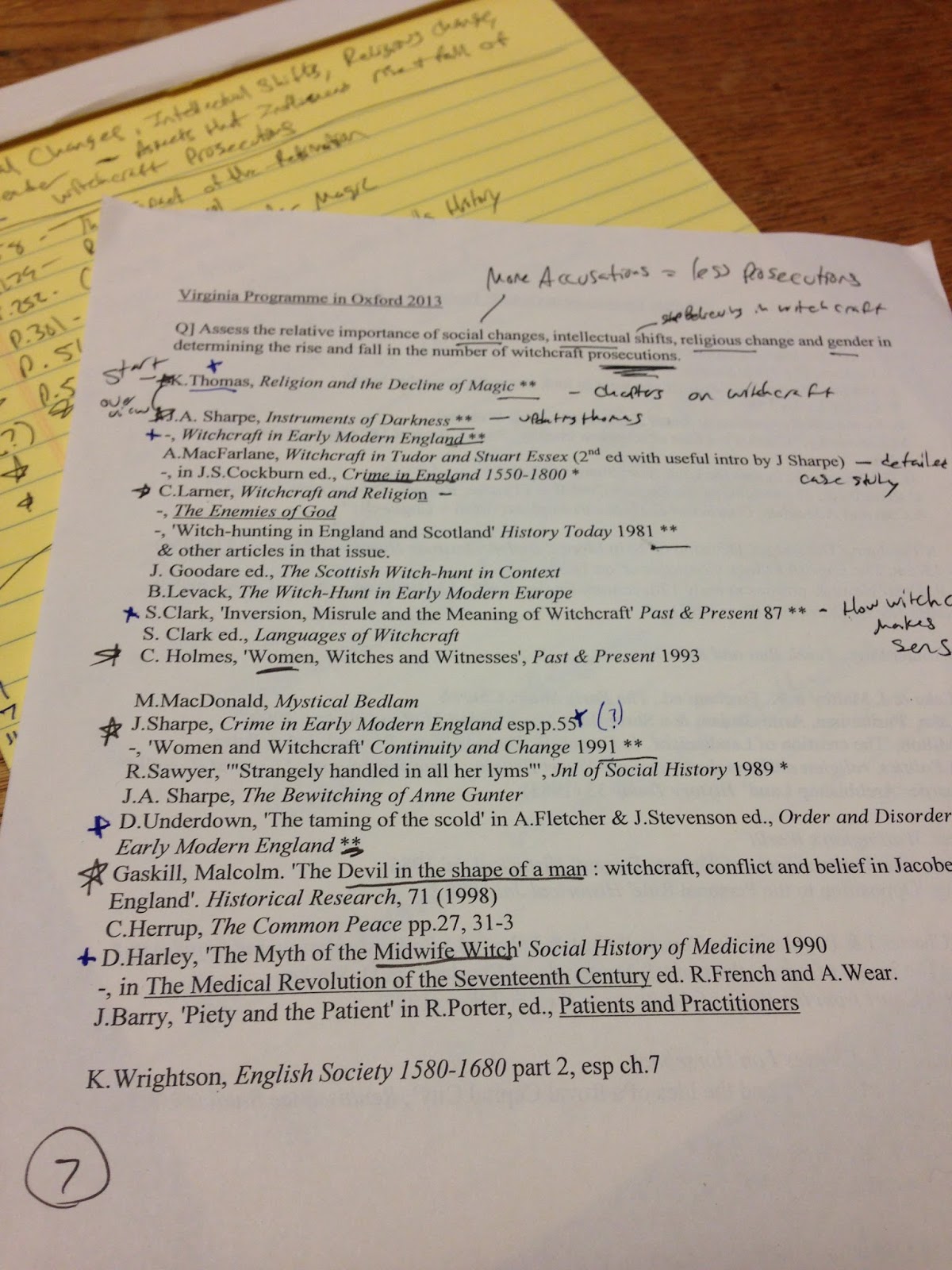
This snapshot was sent to me by a student of mine who is completing a summer program at Oxford University. This is the reading list for ONE WEEK of class.

Here are a few of the books that the students were expected to have familiarized themselves with: Instruments of Darkness; Religion and the Decline of Magic; The Witch-Hunt in Early Modern Europe; Mystical Bedlam looks pretty awesome, as does The Bewitching of Anne Gunter, just in case anyone out there wants to get me an early Christmas present.