Saturday, September 13, 2014

Let's Go Get Stoned -- Ray Charles (1966)


Let's go get stoned
yeah oh
let's go get stoned
Everybody
let's go get stoned
Oh, let's go get stoned
 
now wait a minute
You know my baby,
she won't let me in
I've got a few pennies,
I'm gonna buy myself a bottle of gin
I'm gonna call my buddy on the telephone
And say let's go get stoned
 
Now listen
you know I work so hard, all day long
Everything I try to do, seem to always turn out wrong
That's why I wanna stop by on my way home and say
Let's go get stoned
 
Now let me tell ya one more thing
Ain't no harm to have a little taste
But don't lose your cool
And start messing up a man's place
 
Ain't no harm to take a little nip
But don't ya fall down and bust your lip

 Mmm, no, no let's go get stoned
Oh, let's go get stoned
 
I think everybody ought to come on and go with me
Let's go get stoned oh let's go get stoned

 I'm gonna tell ya one more time what I'm gonna do
Let's go get stoned, oh, let's go get stoned

Songwriters
SIMPSON, VALERIE / ASHFORD, NICKOLAS / ARMSTEAD, JOSEPHINE
 
That's right -- Ashford and Simpson! He was 25 and she was 20.


Friday, September 12, 2014

Thomas Jefferson: "Go on long walks with your gun"

Yeah, it was probably a good idea to take a gun on any long walk in Virginia in 1785, even though the last Indian massacre in Virginia was in 1763.

In a letter to his nephew, Peter Carr...

1785 Aug. 19
"Encourage all your virtuous dispositions, and exercise them whenever an opportunity arises, being assured that they will gain strength by exercise as a limb of the body does, and that exercise will make them habitual...Give about two of them [hours] every day to exercise; for health must not be sacrificed to learning. A strong body makes the mind strong. As to the species of exercise, I advise the gun. While this gives a moderate exercise to the body, it gives boldness, enterprize [sic], and independance [sic] to the mind. Games played with the ball and others of that nature, are too violent for the body and stamp no character on the mind. Let your gun therefore be the constant companion of your walks. Never think of taking a book with you. The object of walking is to relax the mind. You should therefore not permit yourself even to think while you walk. But divert your attention by the objects surrounding you. Walking is the best possible exercise. Habituate yourself to walk very far. The Europeans value themselves on having subdued the horse to the uses of man. But I doubt whether we have not lost more than we have gained by the use of this animal. No one has occasioned so much the degeneracy of the human body. An Indian goes on foot nearly as far in a day, for a long journey, as an enfeebled white does on his horse, and he will tire the best horses. There is no habit you will value so much as that of walking far without fatigue. I would advise you to take your exercise in the afternoon. Not because it is the best time for exercise for certainly it is not: but because it is the best time to spare from your studies; and habit will soon reconcile it to health, and render it nearly as useful as if you gave to that the more precious hours of the day. A little walk of half an hour in the morning when you first rise is adviseable also. It shakes off sleep, and produces other good effects in the animal oeconomy."[3]


Thursday, September 11, 2014

Rick Rescorla: 9/11 hero

 
New Yorker

This is a great profile of Rick Rescorla: Cornwall-born, naturalized American citizen, infantry officer in Vietnam, head of security at Morgan Stanley on 9/11/01, credited with saving hundreds of lives before dying in the collapse of the towers.

Rick, always wearing his suit jacket and tie despite sweating profusely, kept people marching down the right side of the dark staircase, singing into his bullhorn, as firemen and rescue personnel raced up. At one point, he had nearly been overcome by the heat, and had to sit down on the stairs. But he kept singing or speaking reassuringly. “Slow down, pace yourself,” he told one group. “Today is a day to be proud to be an American.”
Susan learned that at some point he had used his cell phone to report that all Morgan Stanley employees were out of the building. But one of the last to leave, Bob Sloss, told her that, just ten minutes before the building collapsed, he had seen Rescorla on the tenth floor. When Sloss reached him, he told Rescorla to get out himself. “I will as soon as I make sure everyone else is out,” Rescorla replied. Then he began climbing back up into the building.

... 

[Dan] Hill and Rescorla had met in Northern Rhodesia two years before. Hill was originally from Chicago, and had been in Rhodesia as a mercenary, fighting a Communist-backed insurgency there. The two men, who met at a rugby match, had felt an instant rapport. Rescorla introduced Hill to the works of Rudyard Kipling, especially “The Man Who Would Be King.” Kipling’s accounts of British heroism struck a chord. Rescorla had worked for British military intelligence and fought in Cyprus; Hill had been active in various capacities in Hungary in 1956 and in Lebanon in 1958, and in training exercises for the Bay of Pigs operation, in 1961.
After the Rhodesian conflict ended, with the British withdrawal from Northern Rhodesia, Hill persuaded Rescorla to join him in the United States Army. He argued that the next major fight against Communism was shaping up in Vietnam.
Both Hill and Rescorla were fanatics about fitness and about survival skills. Rescorla may have told Susan that he was running barefoot as research for a play, but he had already been running barefoot in Africa, and then at Fort Dix, toughening his soles to the point where he could extinguish a fire with his bare feet. He told Hill that if he lost his boots in combat it wouldn’t matter. This was something he’d absorbed from his years in Africa. “You should be able to strip a man naked and throw him out with nothing on him,” he told Hill. By the end of the day, the man should be clothed and fed. By the end of the week, he should own a horse. And by the end of a year he should own a business and have money in the bank.
At Fort Dix, the two were immediately promoted to acting sergeant. They spent weekends together, with Hill’s wife and two children. In their free time, they went on picnics and visited Revolutionary War battlefields. Hill considered himself something of a military historian, but he was no match for Rescorla, who, although he hadn’t been to college, had read all fifty-one volumes of the Harvard Classics. He had memorized long stretches of Shakespeare and often quoted Churchill. When Rescorla became an American citizen, in 1967, Hill was at his side.
Both men were chosen for Officer Candidate School, and when they graduated, in 1965, Hill was assigned to the 101st Airborne Division, Rescorla to the Seventh Air Cavalry. Units of the two divisions were among the first ordered to Southeast Asia. Rescorla arrived in September; Hill followed in December. Rather than spend his first week of R. and R. in Hong Kong or Honolulu with the rest of his brigade, Hill opted to go straight to the Vietcong-controlled Central Highlands to fight with Rescorla, who was leading a mobile combat platoon.
The remote Ia Drang Valley, less than ten miles from the Cambodian border, was a Communist stronghold and a supply route for North Vietnamese forces in the south. In November of 1965, the American military command ordered Rescorla’s unit, Bravo company of the Seventh Air Cavalry’s 2nd Battalion, to the center of a hostile area to support a battalion surrounded by three regiments of hardened enemy troops—more than two thousand soldiers. Rescorla directed his men to dig foxholes and establish a defense perimeter. Exploring the hilly terrain beyond the perimeter, he came under enemy fire. After nightfall, he and his men endured waves of assault. To keep morale up, Rescorla led the men in military cheers and Cornish songs throughout the night.
The next morning, Rescorla took a patrol through the battlefield, searching for American dead and wounded. As he looked over a giant anthill, he encountered an enemy machine-gun nest. The startled North Vietnamese fired on him, and Rescorla hurled a grenade into the nest. There were no survivors.
Rescorla and Bravo company were evacuated by helicopter. The rest of the battalion marched to a nearby landing zone. On the way, they were ambushed, and Bravo company was again called in for relief. Only two helicopters made it through enemy fire. As the one carrying Rescorla descended, the pilot was wounded, and he started to lift up. Rescorla and his men jumped the remaining ten feet, bullets flying at them, and made it into the beleaguered camp. As Lieutenant Larry Gwin later recalled the scene, “I saw Rick Rescorla come swaggering into our lines with a smile on his face, an M-79 on his shoulder, his M-16 in one hand, saying, ‘Good, good, good! I hope they hit us with everything they got tonight—we’ll wipe them up.’ His spirit was catching. The enemy must have thought an entire battalion was coming to help us, because of all our screaming and yelling.”


Wednesday, September 10, 2014

People quicker to shoot white suspects (really?)

Gun
 
 
A new study in the Journal of Experimental Criminology finds in an experiment measuring the reactions of participants to various threatening situations that people tended to pull the trigger faster when confronted by armed white suspects. This sounds counterintuitive to most people (including me). A 2001 Bureau of Justice Statistics report (latest available) analyzed justifiable homicides and noted:
Felons justifiably killed by police represent a tiny fraction of the total population. Of the 183 million whites in 1998, police killed 225; of the 27 million blacks, police killed 127. While the rate (per million population) at which blacks were killed by police in 1998 was about 4 times that of whites, the difference used to be much wider: the black rate in 1978 was 8 times the white rate.
The BJS study also found that black suspects were also as likely to shoot at police as be shot at.
In the deadly force experiments participants (85 percent white) face a life-sized HD video screen on which the stance, clothing, hand motions, objects being held, and race of suspects can all be modified. The subjects are hooked up to brain wave measuring devices and can respond using a laser gun. The press materials from Washington State University detailing the results report:
Participants in an innovative Washington State University study of deadly force were more likely to feel threatened in scenarios involving black people. But when it came time to shoot, participants were biased in favor of black suspects, taking longer to pull the trigger against them than against armed white or Hispanic suspects...
[WSU researcher Lois] James’ study is a follow-up to one in which she found active police officers, military personnel and the general public took longer to shoot black suspects than white or Hispanic suspects. Participants were also more likely to shoot unarmed white suspects than black or Hispanic ones and more likely to fail to fire at armed black suspects. 
“In other words,” wrote James and her co-authors, “there was significant bias favoring blacks where decisions to shoot were concerned.” 
When confronted by an armed white person, participants took an average of 1.37 seconds to fire back. Confronted by an armed black person, they took 1.61 seconds to fire and were less likely to fire in error. The 240-millisecond* difference may seem small, but it’s enough to be fatal in a shooting.
This hesitation occurred even though the electroencephalograph generally identified brain wave patterns indicating significantly greater threat responses against black suspects than white or Hispanic suspects. So then why the difference?
James and her team speculate:
This behavioral ‘counter-bias’ might be rooted in people’s concerns about the social and legal consequences of shooting a member of a historically oppressed racial or ethnic group.


COMMENT: That should say "shooting" a member of a historically (and currently) oppressed racial group. No one actually got shot during this experiment -- because it was an experiment, in a laboratory, without real guns, or real criminals. That EEG finding is pretty interesting, isn't it? Armed black suspects seemed to make the "shooters" more afraid than armed white or Hispanic suspects. (I haven't read the original article, but I'm willing to bet that the black "shooters" were also more afraid of the armed black suspects.) So why did the "shooters" hold their fire for 240 milliseconds longer? Maybe because they figured out the hypothesis of the study and didn't want the experimenters to think that they were racist. BUT THE EEG FINDINGS SUGGEST THAT IN THE REAL WORLD THEY WOULD HAVE FIRED FASTER IN ORDER TO SAVE THEIR LIVES.

The term to know here is DEMAND CHARACTERISTICS (or DEMAND EFFECTS). Put simply, people don't always behave the same way when they are participating in an experiment as when they are out in the real world. Some folks try to please the experimenter and get him or her the expected results. For instance, if you are given a survey that clearly measures depression symptoms, and then the experimenter has you meditate for 30 minutes, you might, when given the same depression survey to complete a second time, figure that the study has something to do with the effects of meditation on depression. You want to be a good guy, so you give yourself lower scores (less depression) the second time around. Alternately, some people (particularly children) might behave in ways that they would not otherwise, since there are "no rules" in a psychology experiment (unlike at home or in school). See Bandura's Bobo the Fighting Clown study for an example of kids behaving according to demand effects.


Tuesday, September 9, 2014

Creepy baby gifs by Hayden Zezula

Wonderfully Creepy GIFs of Deformed Monster Babies

Wired

If you ever thought it might be cool to have visual hallucinations such as those associated with schizophrenia, maybe these gifs will change you mind.


Monday, September 8, 2014

Theodore Dalrymple on Tattoos and Criminality

 
City Journal

The cause of criminality among the white population of England is perfectly obvious to any reasonably observant person, though criminologists have yet to notice it. This cause is the tattooing of the skin.
A slow-acting virus, like that of scrapie in sheep, is introduced into the human body via the tattooing needle and makes its way to the brain, where within a few years it causes the afflicted to steal cars, burgle houses, and assault people.
I first formulated my viral theory of criminality when I noticed that at least nine out of ten white English prisoners are tattooed, more than three or four times the proportion in the general population. The statistical association of crime with tattooing is stronger, I feel certain, than between crime and any other single factor, with the possible exception of smoking. Virtually all English criminals are smokers, a fact that sociologists have also unaccountably overlooked.
 
...
 
A surprisingly large number of auto-tattooists choose for the exercise of their dermatographical art the chief motto of British service industries, namely FUCK OFF. Why anyone should want these words indelibly imprinted in his skin is a mystery whose meaning I have not yet penetrated, though my researches continue, but I recall a patient who had the two words tattooed in mirror writing upon his forehead, no doubt that he might read them in the bathroom mirror every morning and be reminded of the vanity of earthly concerns.
...
 
Often a tattoo acts as a membership badge. For example, a little blue spot on one cheekbone indicates that the bearer has been to Borstal, a correctional institution for wayward youth named after a village in Kent, the garden of England, site of the first such institution. The blue badge of rebellion is worn in the manner of the old school tie, that Old Borstalians may recognize one another—and be recognized. For in the circles in which they move, the meaning of the blue spot is well known and understood: Noli me tangere.
But like those peculiar moths and butterflies about which naturalists delight to tell us, which imitate the colorful plumage of poisonous species without being poisonous themselves, that potential predators on lepidoptera might leave them alone, so do certain young people tattoo themselves with the blue spot without ever having been to Borstal. They wear the spot both as protection and as a means of gaining the admiration of their peers; but, to change the metaphor slightly, the coinage is soon debased, and what was once a sign of considerable value is now almost emptied of it.
And thus the study of a seemingly minor social phenomenon such as tattooing affords us a little glimpse into the Hobbesian moral world inhabited by a section of the population with whom we normally have little contact: they actually want to be considered psychopathic. Not their eyes but their tattoos are the windows of their souls.
Another popular pattern—though it makes one shudder to think of the process by which it is inscribed upon the skin, or the consequences if a mistake is made—is the spider's web on the side of the neck. Occasionally, this is spread over the whole of the face, even over the scalp. At first I assumed this design must have a symbolic meaning, but having inquired of many bearers of it, and having been assured by them that there is no such meaning, I am now satisfied that it is its intrinsic beauty, and a certain vaguely sinister connotation attached to spiders' webs, that attracts people to the design and induces them to adorn themselves with it. Moreover, I vividly recall the scene at a murder trial in which I testified. The judge and counsel were embroiled in a learned discussion of the finer points of mens rea, watched by the prisoner in the dock and his family in the public gallery—all of whom, down to the nth generation, had spiders' webs prominently tattooed on their necks. Never was the class basis (as the Marxists used to call it) of British justice more clearly visible: two classes separated by, among other things, a propensity on the part of one of them to self-disfigurement.
A considerable number of the auto-tattooed inject themselves with swastikas. At first I thought this was profoundly nasty, a reflection of their political beliefs, but in my alarm I had not taken into consideration the fathomless historical ignorance of those who do such things to themselves. People who believe (as one of my recent patients did) that the Second World War started in 1918 and ended in 1960—a better approximation to the true dates than some I have heard—are unlikely to know what exactly the Nazis and their emblem stood for, beyond the everyday brutality with which they are familiar, and which they admire and aspire to.
...
When asked why they inflict these marks of Cain upon themselves, the tattooed cite pressure from their peers and boredom. Perhaps the pain of it reassures them they are alive: it hurts, therefore I am.
"I was bored," said one man whose hands were covered in scores of such tattoos, and who claimed that they had kept him unemployed for many years. "It was either tattooing myself, or going out robbing."
No other possibility presented itself to his ill-furnished mind; but in any case, the distraction caused by the tattooing soon wore off, and he went out robbing just the same.

Sunday, September 7, 2014

The End of the World -- Archibald MacLeish

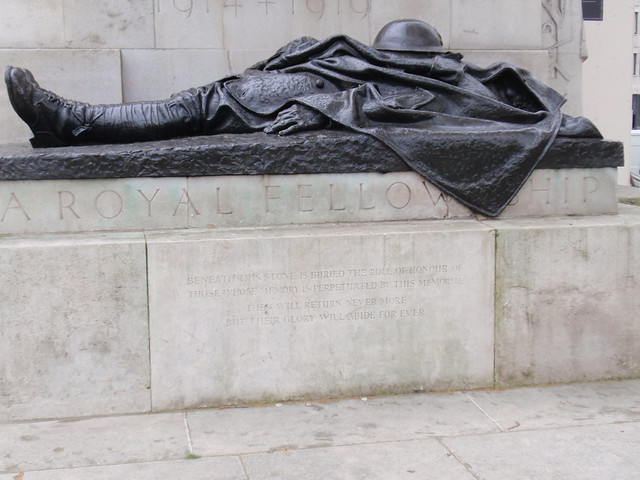
"Here was a Royal Fellowship of Death" -- Royal Artillery Memorial, London


Quite unexpectedly, as Vasserot
The armless ambidextrian was lighting
A match between his great and second toe,
And Ralph the lion was engaged in biting
The neck of Madame Sossman while the drum
Pointed, and Teeny was about to cough
In waltz-time swinging Jocko by the thumb
Quite unexpectedly the top blew off:

And there, there overhead, there, there hung over
Those thousands of white faces, those dazed eyes,
There in the starless dark, the poise, the hover,
There with vast wings across the cancelled skies,
There in the sudden blackness the black pall
Of nothing, nothing, nothing -- nothing at all.