"[Painter, poet and World War I veteran David] Jones often wrote about “the Break”, the cultural moment somewhere around the beginning of modernity when the European world-view shifted decisively. Instead of a world where things were unique but linked by an unimaginable density of connection and cross-reference, we had created one in which things were unconnected but endlessly repeatable and where everything could be exchanged in the market for an agreed equivalent: above all, for money. Jones saw his work – both as a visual artist and as a poet – as a sustained protest against the Break and an effort to show that the older picture could, after all, be brought to life.
Born in 1895, he had family roots that helped to shape his interests from the beginning. His mother’s father had been a London shipwright and his father’s origins were in North Wales. Both Wales and London kept a central place in his imagination throughout his life. It was not surprising that when the First World War broke out, he enlisted in the 1st London Welsh Battalion of the Royal Welch Fusiliers. His 1937 masterpiece, the astonishing book-length poem In Parenthesis, describes the experience of foot soldiers in the First World War, revisiting his own experiences up to and including the disastrous engagement at Mametz Wood in July 1916. Jones was wounded in the leg during the battle (a wound described by the medical orderly as “a beautiful blighty” – serious enough to get him off the front line, yet not life-threatening). But he was back in the trenches in a matter of months.
The traumas of war stayed with him to the end. In Parenthesis, which he struggled with painfully over many years, is one of the most unsparing accounts of the life of infantry soldiers in the trenches and of the horrors of the Somme; but at the same time it meditates on any number of connections – echoes of conflict, from Troy to the struggles of the British against the Saxons in the 6th century to Malory’s Arthurian narratives, and, woven through it all, the founding act of bloodshed that is the death of Christ. Jones was raised an Anglican, but by the time he wrote In Parenthesishe was a Catholic, and believed passionately that the Church’s sacramental theology was what made sense of a world of symbolic connection, where nothing existed as an atom but where everything enriched the perception of everything else. For him, all art rested on the conviction that God had made a world of endless cross-reference, and that humanity was most fully human when it acknowledged this. Art was humanity doing what only humanity could do."
"CHARLESTON, S.C. — After three tours in Iraq and Afghanistan, C. J. Hardin wound up hiding from the world in a backwoods cabin in North Carolina. Divorced, alcoholic and at times suicidal, he had tried almost all the accepted treatments for post-traumatic stress disorder: psychotherapy, group therapy and nearly a dozen different medications.
“Nothing worked for me, so I put aside the idea that I could get better,” said Mr. Hardin, 37. “I just pretty much became a hermit in my cabin and never went out.”
Then, in 2013, he joined a small drug trial testing whether PTSD could be treated with MDMA, the illegal party drug better known as Ecstasy.
“It changed my life,” he said in a recent interview in the bright, airy living room of the suburban ranch house here, where he now lives while going to college and working as an airplane mechanic. “It allowed me to see my trauma without fear or hesitation and finally process things and move forward.”
Based on promising results like Mr. Hardin’s, the Food and Drug Administration gave permission Tuesday for large-scale, Phase 3 clinical trials of the drug — a final step before the possible approval of Ecstasy as a prescription drug.
If successful, the trials could turn an illicit street substance into a potent treatment for PTSD."
Not take any benzodiazepines (e.g., Xanax, Ativan).
Eat more healthy than I ever have (probably full paleo).
Not take any sleep medications (e.g., Ambien, Lunesta).
Ask everyone I know for the name of a really, really good psychotherapist. Not a marriage counselor. Not a "life coach." Not a substance abuse counselor. Someone who treats people with serious mental health problems, every day. Someone whose caseload usually includes suicidal patients. Someone who calls them "patients" and not "clients." Probably, somebody I address as "Doctor." Probably, somebody who dresses for work better than I do. Most definitely, somebody who reads Dostoevsky, Tolstoy, Shakespeare, and Homer. Somebody who has read plenty of Freud, and Jung, and Frankl. Someone much more likely to interpret a dream than to assign me homework in which I identify my "cognitive distortions."
After a few sessions, if I don't like this therapist or don't feel that he or she understands me or is not putting my best interests ahead of their own, then I would find someone else.
Once I find the right psychotherapist (with the right office -- I'm partial to Oriental rugs and leather armchairs), I'd settle in for twice-weekly sessions for the next six months.
If I didn't see any improvement after two months of twice-weekly psychotherapy, I would consider antidepressants. If I was still having trauma-related nightmares more than twice a week, I would consider prazosin. But I would probably end up not taking any psychiatric medications.
Throughout the therapy, I would be trying a multitude of live-enhancing activities, e.g., hiking, oil painting, learning a new language, bricklaying, meeting new people, etc.
That's what I would do. I suspect that many other mental health professionals would do something similar. What I wouldn't do is go knocking at the door of a VA hospital, begging to be let into one of their Cognitive Processing Therapy groups.
By the way, those 48 sessions of individual psychotherapy, at $150 per, cost $7,200 (if I don't have insurance). It seems like a lot, until you consider the economic impact of having PTSD (i.e., how it reduces your earning capacity).
So, ladies and gentlemen, why don't we give each of our combat-PTSD veterans a voucher worth $7,200 for psychotherapy from a quality independent practitioner of their choice? Such an initiative would cost a lot less than giving them lifelong disability pensions of over $2,000 a month.
The only problem I have with Cognitive Processing Therapy is that I wouldn't seek it out if I had PTSD.
So the results of this clinical trial have been published. A total of 268 combat veterans with PTSD were randomly assigned to receive either individual (one-on-one) or group CPT. At the end of 12 sessions, the veterans in the individual arm showed more improvement that those in the group arm (although half of them still had PTSD).
This study is certainly going to go onto the pile of evidence which supports the use of CPT with this patient population. It might do a little to reduce the VA's usual practice of placing 8 to 10 veterans in a room for 90 minutes with a masters-level therapist, versus the vastly more costly, but clinically superior approach of matching individual patients to highly skilled therapists. But I doubt it.
One problem, however, is just how weak this study actually is. Look at the main outcome measures -- the PCL and the BDI-2, two self-report checklists that patients can complete in under 5 minutes. You enter a study, take those two surveys, then do 12 sessions with a nice therapist, who has you then complete the same two surveys again. Even if you were mentally retarded or psychotic, you would know that your scores on those surveys are supposed to be lower than they were when you started. A huge part of the supposed efficacy in these studies are just demand effects -- giving the nice therapist a "tip," if you will.
There's an easy fix to this, and that is to use a real outcome measure, such as the MMPI-2 -- a 567 item True-False questionnaire that measures a wide range of psychopathology, not just explicit PTSD symptoms and obvious depression symptoms. The MMPI-2 also detects when patients are exaggerating or minimizing their symptoms, which you think would come in handy in a clinical trial. It measures PTSD and depression. About 90% of patients can complete it in 90 minutes or less.
So why not use it? Because there is absolutely no way that 12 sessions of CPT or any other "evidence-based" cognitive therapy is going to show any serious effect on combat PTSD veterans' MMPI scores after just 12 sessions. No way. MMPI scores are vastly more reliable than PCL and BDI scores, i.e., they are more stable over time. MMPI scores are more reflective of how the patient is really doing, and are far less susceptible to demand effects.
I don't know of any clinical trials that have used the MMPI as an outcome measure. I will take a look and see if I can find any. Using just the PCL and BDI-2 renders the studies clinically useless, in my opinion. I could run a study today that shows that reading Chinese restaurant menus lowers PCL and BDI-2 scores. Why? Because study participants are nice people and they don't want the researchers to look like idiots/fail at their jobs, so they help them by giving themselves lower scores after the treatment. This is a lot harder to do on the MMPI because it is not at all obvious which of the 567 items are measuring PTSD. Even if you did know which items measured PTSD, you might not be able to figure out whether to answer them True or False in order to raise or lower your score.
Disabled in Iraq or Afghanistan? Good luck finishing your active duty military career. The military needs to jettison 80,000 troops by 2017 -- and guess who they are getting rid of? Medical discharges take a long time, and require paying medicals benefits for the veteran's lifetime. Kicking them out under Chapter 14 (Pattern of Misconduct) is a lot faster and cheaper.
"Staff Sgt. Coulter, another decorated three-tour soldier at Fort Carson, had a spotless record until he transferred to the 3rd Squadron, 61st Cavalry Regiment. The regiment began writing him up for minor infractions, sometimes several times a day, including showing up without gloves and being late to formation.
The unit used the list of infractions to charge Coulter with "a pattern of misconduct" and moved to kick him out of the Army.
Coulter walks with a limp from injuries related to three combat tours, and has been diagnosed with traumatic brain injury and has PTSD flashbacks that can make it hard for him to drive. But this spring when his battalion announced it would kick him out for his list of misconduct write-ups, medical records show that doctors said his injuries were not longer an issue and he did not have PTSD.
"It's a miracle. They say I have all these problems," Coulter said. "Then as soon as they want me out, there is nothing wrong."
When the battalion slated Coulter for discharge, it stopped him from seeing his civilian psychologist, then said it was not the Army but the civilian psychologist who canceled his treatment.
Contacted by The Gazette, the civilian psychologist, Judith Ray, said the statement was "absolutely untrue."
"I would never do such a thing," she said. "It goes against the ethics of our profession."
Asked why she thought Fort Carson officials stopped Coulter's treatment, she said, "Everybody knows they don't like to diagnose PTSD."
In May, after meeting with Coulter once for less than an hour, his Army psychologist, Kelly Moss, said the sergeant did not have PTSD or a TBI, he had "adjustment disorder,"a diagnosis with symptoms similar to PSTD that does not require the Army to provide benefits upon discharge — and he was cleared for discharge.
"It's just crazy, man," Coulter said. "But if they want you out, they're gonna get you out."
You know why these disability claims took off around 2005? It wasn't just the wars in Iraq and Afghanistan. In part it was because the Baby Boomer Vietnam Veterans realized that Social Security was not going to see them through a comfortable retirement.
“In every other clinical setting, PTSD is considered pretty easily treatable with a relatively short duration of exposure therapy. But in the VA, it’s disabling for life. We pay people to be sick, and to stay sick. If you wanted to create a perfect way to keep people from getting better, you’d invent the VA compensation system...
...Dr. Christopher Frueh (pronounced “Free”)...was a VA psychologist for fifteen years, from 1991 to 2006. He was quoted in a 2014 LA Times article about PTSD malingering...and has spoken out about massive fraud in the system for years.
The VA wasn’t too happy with Dr. Frueh. “I kept getting pushback for what I was saying about PTSD fraud,” Dr. Frueh said. “The VA even assigned a handler to monitor everything I said during interviews. Then they told me I couldn’t do interviews at all. Eventually, after fifteen years of trying to fix the problems and running into a brick wall, I left the VA.”
A big part of the VA’s anger at Frueh came from his accusation that the VA engages in “collusive lying” with veterans obviously faking PTSD. “Some veterans tell obvious lies, their documents don’t support their claimed trauma, their behavior doesn’t match their reported symptoms, their psychologist reports them as malingering, and the VA approves disability benefits anyway,” Frueh said. “Psychologists are ordered not to question even the most egregious fabrications. Nobody is willing to stand up to the uproar that would come from both political parties, and from VSOs, if we acknowledged what everyone already knows: a lot of veterans are lying about PTSD to get free money.”
Malingering causes real, measurable problems. Verified veterans with verified problems have stopped coming to treatment, especially group therapy, because they don’t want to be associated with the obvious posers. VA treatment programs can’t be measured for effectiveness because almost every patient, whether they’re getting better or not, claims their symptoms are worsening until their rating reaches 100%. According to one study, 82% of those who max out on disability then stop attending treatment. If their problem is so terrible they’re completely disabled, why suddenly stop getting help?
“The VA doesn’t want to face this,” Dr. Frueh said. “We’re employing very expensive PTSD treatments which our own stats say are ineffective. From clinical studies outside the VA, we know those [PTSD treatment] programs actually are effective. But within the VA, either these proven programs don’t work or patients are skewing the stats by lying about their symptoms. The VA doesn’t want to acknowledge that the treatment works, but a huge number of patients are lying.” Dr. Frueh discussed that problem in a 2014 Psychology Today article: “Another open secret among clinical trial investigators is that veterans often acknowledge to researchers that the treatment has helped them, but ask them not to document in the record for fear of losing disability.”"
"Kristofer Goldsmith was discharged from the Army at the height of the Iraq war because he was not on a plane to Baghdad for his second deployment. Instead, he was in a hospital after attempting suicide the night before.
Instead of screening Mr. Goldsmith for post-traumatic stress disorder, or PTSD, records show that the Army wrote him up for missing his flight, then forced him out of the military with a less-than-honorable discharge. When he petitioned the Army to upgrade his discharge, arguing that he missed his flight because of undiagnosed PTSD, it rejected his appeal.
In the years since, he has appealed twice more for an honorable discharge and has been denied both times.
...
Thomas Burke, 26, joined Mr. Goldsmith on his recent advocacy trip to Washington. Now a student at Yale Divinity School, in 2009 he was a Marine infantryman in Afghanistan, his second combat deployment in a year.
As he waited in a reception area to meet with a senator, he showed a picture on his phone of himself on patrol in Helmand Province: He was unshaven, with a dusty rifle in his hands, and 15 smiling Afghan boys were tagging behind him.
“These kids went everywhere with us; these are my kids,” he said. He smiled, lost in thought, then added, “I loved them.”
A few weeks after the photograph was taken, many of the boys were killed by an unexploded rocket-propelled grenade they found near their village. Mr. Burke and his squad were left to haul away the dismembered bodies.
Mr. Burke said he started smoking hash he bought from Afghans as an escape from stress and emotional exhaustion.
“The whole platoon pretty much did,” he said. “It was the only way we could get any sleep.” Another member of his platoon confirmed his account.
Mr. Burke was charged with misconduct for his drug use and was told he would be kicked out of the Marines. He tried to kill himself a few weeks later. “I though I could join the military and make the world a better place, and I had failed in every way,” he said. “I was so angry at God and so sad.”
The Marine Corps locked him in a psychiatric hospital, he said, and then gave him an other-than-honorable discharge without evaluating him for PTSD.
Soon after, he was told at a veterans’ hospital that he had PTSD. He applied for an honorable discharge in 2014 but was denied."
"There have been days when there are more military family members killed by their veteran on the home front than troops killed in action on the war front. March 23, 2012, was one of them. Kristy Huddleston wasn't a soldier who had already served multiple tours, or a combat veteran traumatized by war, but her husband was. That put her at a higher risk of experiencing potentially lethal domestic violence than virtually any other demographic in the nation. As Kristy lay on the kitchen floor, bleeding from a gunshot wound to the head, her 10-year-old son called 911. The murder trial of Bourne Huddleston, a veteran of Iraq and Afghanistan, is on the docket for April 7 in Jackson County, Oregon.
Combat veterans are responsible for almost 21 percent of domestic violence nationwide, linked to the development of post traumatic stress disorder. This is comparable to the fact that veterans alone account for 20 percent of U.S. suicides. We call the problem of veteran suicide an "epidemic," funding research, convening conferences, and creating new programs, hotlines and therapies aimed at prevention, intervention and reducing the stigma of seeking mental health care. But we don't talk about veteran intimate partner violence at all, effectively ensuring that the catastrophic consequences remain largely unacknowledged and unaddressed."
"Empirical studies have examined the relative influence of combat exposure versus PTSD
in predicting domestic violence. Petrik, Rosenberg, and Watson (1983) explored the
hypothesis that it is the military combat experience itself that makes men more prone to
general violent behavior. They investigated violent abuse toward 100 female partners of male
psychiatric inpatients (not necessarily PTSD) with and without combat experience. Fifty
percent of the combat veterans and 57% of the noncombat veterans reported using violence
against women. Results suggest that combat experience alone was not a strong influence on
reported use of violence. Carroll, Rueger, Foy, and Donahoe (1985) in their comparison of 60
treatment-seeking Vietnam veterans (21 PTSD; 18 non-PTSD, combat; and 21 minimal
combat exposure veterans) found that hostility and physical aggression discriminated
between the PTSD and non-PTSD group in the expected direction. There was no significant
difference in level of reported hostility and aggression between the PTSD and minimal
combat groups. No significant differences in verbal aggression emerged between any of the
groups. Finally, Jordan et al. (1992) compared 122 wives of PTSD veterans to 252 wives of
non-PTSD veterans and found that wives of PTSD-veterans reported more violence on the
part of the veteran and admitted to committing more violence themselves. These data suggest that it is the presence of PTSD, rather than combat exposure, that is associated with elevated
levels of hostility and physical violence."
"Anybody up for a little after dinner morally justified killing ?"
I think that this writer's views on Just War theory are deeply mistaken, especially as applied to PTSD treatment. It sounds like he would tell veterans, "Don't worry about killing those people, it was done in the service of justice." OMG, what a reaction that would get in a PTSD group. And, "Because the wars in Iraq and Afghanistan were only last resorts and conducted only in the interest of bringing about a just peace, your killings are morally good." That's another one sure to provoke bitter laughter. And, "It's not like you killed any non-combatants, right? Because that doesn't happen much during modern warfare, right?" Now the guy would probably be in physical danger. And, "It's not like the guy you killed was a fellow human being, with a family who loved him, and friends who counted on him, with his own hopes and dreams and struggles and flaws, just like you. No, it's not like that at all. He was an enemy combatant and you were morally justified in killing him. And morally justified killing is A-Okeleedokelee OK."
"It was him or me. When I first got back I was glad it was him. But now...I wish it had been me. He was just a kid. Like me."
-- WWII combat veteran, on his killing of an "enemy combatant" sixty years earlier
"There is another approach to Just War theory that avoids the “necessary evil” problem, and still articulates moral limits to killing. In opposition to the “presumption against killing” model, James Turner Johnson advocates a “presumption for justice.”
Johnson argues that rather than starting from a presumed duty not to kill and then looking for ways to override that duty, the classic Just War tradition (Augustine, Aquinas, Vitoria, etc.) begins from considerations of justice and what it requires in a particular situation. Justice, not a duty against killing, is the ever present demand and determines the morality of killing. In Johnson’s model, just killing is not a necessary evil, but a morally good act in service of justice.
One must be careful not to confuse “morally good” with “desirable.” In Johnson’s model, war is still a last resort, but not because there is a standing duty not to kill. It is a last resort because the goal of war is peace, and if a just peace can be achieved without violence, it ought to be. If war must be fought, however, it can be fought without committing intrinsically evil acts.
The difference between the two models becomes clearer with a side-by-side comparison. In both models, a soldier who kills an unarmed civilian is committing a morally evil act. However, a soldier who kills an armed, fighting enemy in combat looks very different in each model. In Childress’ model, he is still committing a morally evil act, but it is one that he is permitted to engage in because his duty not to kill has been overridden. He is allowed to use the evil means of killing to pursue a moral good. For Johnson, the soldier who kills an enemy combatant is committing a morally good act in service of justice.
The idea of killing as a moral good is an important one because it can help soldiers and military leaders understand their own moral actions in war. Killing always leaves psychological scars. For the soldier, the misguided view of just killing as a moral evil that one is allowed to “get away with” adds to that psychological distress. He sees himself as a murderer who deserves punishment, and when doesn’t receive that punishment, he tends to punish himself. That self-punishment is one cause of the high rates of depression, substance abuse, and suicide among veterans.
Johnson’s view of killing in service to justice, rather than in conflict with justice, will help soldiers understand that they are not doing anything morally wrong when they justly kill in combat. Nothing can erase the horrible experiences of war, but by understanding his actions morally, the soldier can find respect for himself."
So, do an fMRI study of 8 participants and you get publication and press attention. Do intensive psychotherapy with 80 traumatized patients and you get resolution of symptoms in the vast majority of your cases. Who do you think knows more about the effects of traumatic experiences on human beings? The psychotherapist or the neuroscientist?
"Neuroimaging data collected from a group of passengers who thought they were going to die when their plane ran out of fuel over the Atlantic Ocean in the summer of 2001 are helping psychology researchers better understand trauma memories and how they’re processed in the brain.
A total of eight passengers agreed to undergo fMRI scanning while they looked at video recreation of the Air Transat incident, footage of the 9/11 attacks, and a neutral event. The participants ranged in age from 30s to 60s; while some had a diagnosis of PTSD, most did not.
“This traumatic incident still haunts passengers regardless of whether they have PTSD or not. They remember the event as though it happened yesterday, when in fact it happened almost a decade ago (at the time of the brain scanning). Other more mundane experiences tend to fade with the passage of time, but trauma leaves a lasting memory trace,” said Daniela Palombo, the study’s lead author and currently a post-doctoral researcher at VA Boston Healthcare System and Boston University School of Medicine. “We’ve uncovered some hints into the brain mechanisms through which this may occur.”
The participants’ showed heightened responses in a network of brain regions known to be involved in emotional memory – including the amygdala, hippocampus, and midline frontal and posterior regions — when they recalled their experience on AT Flight 236 compared to when they remembered a neutral autobiographical memory.
The passengers showed a similar pattern of heightened brain activity in relation to the 9/11 terrorist attacks, another significant but less personal trauma that occurred just three weeks after the Air Transat incident. This enhancement effect was not evident in the brains of a comparison group of individuals when they recalled 9/11 during their fMRI scan.
According to Palombo, the “carryover effect” may indicate that the Air Transat flight scare changed the way the passengers process new information, possibly making them more sensitive to other negative life experiences.
“Research on highly traumatic memory relies on animal studies, where brain responses to fear can be experimentally manipulated and observed,” said Brian Levine, senior scientist at Baycrest Health Science’s Rotman Research Institute, Professor of Psychology at the University of Toronto, and senior author on the paper. “Thanks to the passengers who volunteered, we were able to examine the human brain’s response to traumatic memory at a degree of vividness that is generally impossible to attain.”
In the first phase of the study, published in 2014, the research team found that all of the passengers who participated remembered a remarkable amount of detail for the Air Transat incident, regardless of whether or not they had PTSD, although individuals with PTSD tended to veer off topic and recall additional information that was not central to the events assessed."
Palombo, D., McKinnon, M., McIntosh, A., Anderson, A., Todd, R., & Levine, B. (2015). The neural correlates of memory for a life-threatening event: An fMRI study of passengers from Flight AT236 Clinical Psychological Science. DOI: 10.1177/2167702615589308
"In the new piece on post-traumatic stress, [Sebastian] Junger [author of War and The Perfect Storm] suggests several ways of better reintegrating combat troops into American society, including a practice common among some Native American groups: the retelling of combat experiences by a warrior to his own community.
“We could achieve that on Veterans Day by making every town and city hall in the country available to veterans who want to speak publicly about the war,” he wrote. “The vapid phrase ‘I support the troops’ would then mean actually showing up at your town hall every Veterans Day to hear these people out.”
Veterans would display a variety of emotions, including pride, anger and grief, he predicted.
“It might also begin to re-assemble a society that has been spiritually cannibalizing itself for generations,” he wrote. “We keep wondering how to save the vets, but the real question is how to save ourselves. If we do that, the vets will be fine. If we don’t, it won’t matter anyway.”"
"“Nothing is as terrifying as war,” he began, before spending the next 90 minutes recounting his role in battles, from Japan’s early triumph at Pearl Harbor to its disastrous reversals at Midway and Guadalcanal. “I want to tell you my experiences in war so that younger generations don’t have to go through the same horrors that I did.”
...He recounted how in dogfights, he flew close enough to his opponents to see the terror on their faces as he sent them crashing to their deaths.
“I fought the war from the cockpit of a Zero, and can still remember the faces of those I killed,” said Mr. Harada, who said he was able to meet and befriend some of his foes who survived the war. “They were fathers and sons, too. I didn’t hate them or even know them.”
“That is how war robs you of your humanity,” he added, “by putting you in a situation where you must either kill perfect strangers or be killed by them.”
...
Mr. Harada’s talk was filled with vivid descriptions of an era when Imperial Japan briefly ruled the skies over the Pacific. During the Battle of Midway in 1942, he said, he shot down five United States torpedo planes in a single morning while defending the Japanese fleet. He described how he was able to throw off the aim of the American tail gunners by tilting his aircraft to make it drift almost imperceptibly to one side as he closed in for the kill.
He also described his defeats. He said he had to ditch his plane in the sea after Japan lost all four aircraft carriers it sent to Midway, the battle that turned the tide of the war in favor of the United States. Four months later, he was shot down over the island of Guadalcanal. He survived when his plane crashed upside down in the jungle, but his arm was so badly mangled that he never fought again. He spent the rest of the war training pilots back in Japan.
After Japan surrendered, he said, he hid from what he feared would be vengeful American occupiers. He worked for a time on a dairy farm, but found himself plagued by nightmares that made it tough to sleep. In his dreams, he said, he kept seeing the faces of the terrified American pilots he had shot down.
“I realized the war had turned me into a killer of men,” he said, “and that was not the kind of person I wanted to be.”
He said the nightmares finally ended when he found a new calling by opening a kindergarten in Nagano in 1965. He said he was able to alleviate the pangs of guilt by dedicating himself to teaching young children the value of peace. While he has now retired, he said he still visits the school every day he can to see the children’s smiling faces.""
So...the big question is...having worked in VA hospitals...would I recommend that a combat veteran friend of mine go seek treatment there for PTSD? Well...no.
"Morris served in the Marine Corps in the halcyon 1990s, so he experienced most of his trauma not in uniform but as a reporter in Iraq. When he was embedded during the 2007 surge in Baghdad, an IED buried in a trashpile rocked Morris’ Humvee. For several harrowing minutes, a wheel of the burning vehicle was stuck in the blast crater, and Morris was trapped.
That terrifying ordeal, followed by the turmoil precipitated by his trip to the cinema, led him to the San Diego VA for treatment. There, the young clinicians were caring but didn’t much help. Morris underwent a VA-approved treatment called prolonged exposure, which entails exposing patients to their most feared experience repeatedly over several months, until the situation no longer invokes panic. Morris found PE too anxiety provoking, and quit. (In the largest study of PE in veterans, a modest 55 percent had good outcomes.)
He also underwent cognitive processing therapy, a form of group therapy aimed at clearing up distortions in thinking (i.e., the world is a dangerous place; the war made me unlovable; I need alcohol to cope). Morris found it somewhat helpful but still incomplete, and too focused on the symptoms. A fuller reckoning with trauma, he found, required treating it as more than just a series of near-death nightmares, and instead as the transformative experience it really is. “Never was I invited to think of how my experiences might be converted into a kind of wisdom or moral insight. When I did so, on my own initiative, I was admonished for ‘intellectualizing.’” Many soldiers find war, Morris writes, “to be sublime, and more than a few of them ... were suddenly consumed by a need for answers to life’s greatest questions.”
Fortunately, VA clinicians are increasingly attuned to the existential dimensions of veterans’ needs. However, there are too few seasoned clinicians to go around, and newer mental health professionals—like the ones Morris saw—are assigned to conduct one-size-fits-all, protocol-driven treatments. There is a place for these treatments, but not at the expense of encouraging suffering veterans to see returning from war as a major existential project, a struggle to “make meaning out of chaos.” By “making meaning,” Morris means telling stories, a process with “tremendous healing power” for both the teller and the listener."
"Shortly before being slain, Chris Kyle, the Navy SEAL whose autobiography was turned into the hit movie "American Sniper," texted a friend next to him in a pickup truck that the man who moments later would shoot them both was "nuts," a defense lawyer said on Wednesday.
A Texas jury heard opening statements and the first witness in the trial of former U.S. Marine Eddie Ray Routh, 27. He is charged with murdering Kyle and Chad Littlefield, Kyle's friend and neighbor, in February 2013 at a shooting range about 70 miles (110 km) southwest of Fort Worth.
Routh was driven to the range by Kyle, who had been helping fellow veterans heal the mental scars stemming from combat.
As the three men sped over Texas country roads, Kyle, who was credited with the most kills of any U.S. sniper, sent a text to Littlefield that read: "This dude is straight up nuts," defense attorney Tim Moore told jurors.
...
Defense attorneys did not dispute that Routh shot the men but pressed their case that he should be found not guilty by reason of insanity. They said he was in a paranoid psychotic episode and did not know his actions were wrong when he shot the two men. They said Routh suffered from post-traumatic stress disorder, or PTSD, caused by overseas deployments.
...
Kyle's widow, Taya...said she knew something was amiss when she spoke by phone to Kyle at the shooting range,a scenic location he often visited to help fellow veterans trying to manage PTSD.
...
Taya Kyle said bonding over target practice helped her husband discuss difficult matters with veterans trying to adjust to life after battle.
"They can really talk and commiserate and get some healing done," she said of the outings.
Erath County District Attorney Alan Nash said Routh shot the two men multiple times in the back and stole the truck and weapons, knowing it was wrong.
Nash said Routh served as a weapons tech in a safe zone in Iraq. The defense told the jury that Routh was severely affected mentally by his earthquake relief efforts with the Marines in Haiti in 2010.
The trial is expected to take about two weeks. If Routh is convicted, prosecutors said they would seek a life sentence."
VR Therapy for PTSD looks like something that the Space Marines in Aliens would use. It's not what it seems, though, like EMDR. It might work, but not for any high-tech reason. It's just Prolonged Exposure therapy (PE) in disguise. They suit the patient up, program the computer, and have him talk about the worst day of his life, over, and over, and over again. Just like the protocol for PE. But traditional psychotherapy doesn't require computer nerds or nearly as much electricity.
Bent double, like old beggars under sacks,
Knock-kneed, coughing like hags, we cursed through sludge,
Till on the haunting flares we turned our backs
And towards our distant rest began to trudge.
Men marched asleep. Many had lost their boots
But limped on, blood-shod. All went lame; all blind;
Drunk with fatigue; deaf even to the hoots
Of tired, outstripped Five-Nines that dropped behind.
Gas! Gas! Quick, boys!—An ecstasy of fumbling,
Fitting the clumsy helmets just in time;
But someone still was yelling out and stumbling
And flound’ring like a man in fire or lime...
Dim, through the misty panes and thick green light,
As under a green sea, I saw him drowning.
In all my dreams, before my helpless sight,
He plunges at me, guttering, choking, drowning.
If in some smothering dreams you too could pace
Behind the wagon that we flung him in,
And watch the white eyes writhing in his face,
His hanging face, like a devil’s sick of sin;
If you could hear, at every jolt, the blood
Come gargling from the froth-corrupted lungs,
Obscene as cancer, bitter as the cud
Of vile, incurable sores on innocent tongues,—
My friend, you would not tell with such high zest
To children ardent for some desperate glory,
The old Lie: Dulce et decorum est
Pro patria mori.
The ex-wife of the man accused of scaling a security fence and charging the White House with knife says that he suffers from mental illness as a result of a "terrible" incident during a tour of duty in Iraq and needs treatment, not jail.
"I wish there was something I could have done to help him, he's not a bad guy," Samantha Murphy Bell, told Indianapolis NBC affiliate WTHR in a telephone interview on Monday. "He didn't go to the White House to hurt Obama."
Bell said she met her ex-husband, Omar Gonzalez, 42, in 2005 or 2006, and they were married in 2006. They separated in 2010 and were officially divorced in July of this year.
She said that life with Gonzalez — who is charged with unlawfully entering a restricted building or grounds while carrying a deadly or dangerous weapon — was fine until a second tour of duty where something bad happened in Iraq.
The Army says Gonzalez first enlisted from July 1997 to September 2003, then reenlisted in July 2005 and served until his retirement in late 2012, serving in Iraq from October 2006 to January 2008.
"It was his second tour and I noticed that he was doing a lot of things that were making me uncomfortable — I knew he would never harm me (but) I know whatever happened in Iraq, it affected him," said Bell.
She said it was difficult if not impossible to talk to Gonzalez about the traumatic incident that had scarred his psyche, but once she asked, how bad it was and, "he said, 'It was terrible.’ he said, ‘Sam, the only thing I could tell you is it involved little children.'"
Bell said that Gonzalez started walking around their home with a .45-caliber pistol on his hip at all times. "It never left him, and he had a gun or a shotgun behind every door," said Bell, who claimed that her ex had been diagnosed with obsessive-compulsive disorder, schizophrenia and post-traumatic stress disorder.
"He needs to get treatment," she said. "I think he needs to get proper help — throwing him in a jail is not helping him."
According to the affidavit from when Gonzalez was first detained after busting onto White House property on Friday, he told a Secret Service agent that "the atmosphere was collapsing and needed to get the information to the president of the United States so that he could get the word out to the people."
On Monday Gonzalez was ordered held without bail until Oct. 1. It was also revealed that he had been detained near the White House with weapons at least two other times in the past three months.
Poor guy. The march to keep the atmosphere from collapsing was in New York, not DC.
I doubt the schizophrenia diagnosis (onset is too late in life), but I wouldn't be surprised if he had been prescribed anti-psychotics such as Seroquel. A Google search would have shown him and his ex- that those meds are used to treat schizophrenia (as well as to help combat vets sleep).
Don't be too quick to dismiss the story about an incident involving "little children" as a product of mental illness.
It would be an egregious injustice to prosecute this guy. I guess we should be thankful that they didn't kill him, as cops in DC are wont to do to the mentally ill.
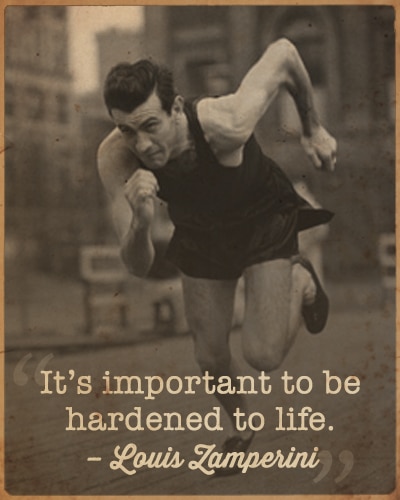
[Louis] Zamperini was the "Torrance Tornado," the tough kid turned track star who set a national high school record for running the mile. In 1936, he was known as "The Zamp," the 18-year-old USC standout who ran at the Berlin Olympics, where his roommate was Jesse Owens. In 1943, he was Lt. Zamperini, a bombardier on a B-24 Liberator, who, along with 10 other crew members, fell off the map on a May 27 mission over the Pacific.
When President Franklin D. Roosevelt sent his parents a formal condolence note in 1944, he had no idea that Zamperini was still alive and living a nightmare in a Japanese prison camp. For 47 days, Zamperini had drifted on a life raft, fighting off sharks and starvation with two other crew members, one of whom died. Picked up by a Japanese patrol boat, the two survivors were beaten, tortured and humiliated for more than two years.
How well can you predict your next mood swing? How well can anyone? It’s an existential dilemma for many of us but for the military, the ability to treat anxiety, depression, memory loss and the symptoms associated with post-traumatic stress disorder has become one of the most important battles of the post-war period.
Now the Pentagon is developing a new, innovative brain chip to treat PTSD in soldiers and veterans that could bring sweeping new changes to the way depression and anxiety is treated for millions of Americans.
With $12 million (and the potential for $26 million more if benchmarks are met), the Defense Advanced Research Projects Agency, or DARPA, wants to reach deep into your brain’s soft tissue to record, predict and possibly treat anxiety, depression and other maladies of mood and mind. Teams from the University of California at San Francisco, Lawrence Livermore National Lab and Medtronic will use the money to create a cybernetic implant with electrodes extending into the brain. The military hopes to have a prototype within 5 years and then plans to seek FDA approval.
DARPA’s Systems-Based Neurotechnology for Emerging Therapies, or SUBNETs, program draws from almost a decade of research in treating disorders such as Parkinson’s disease via a technique called deep brain stimulation. Low doses of electricity are sent deep into the brain in somewhat the same way that a defibrillator sends electricity to jumpstart a heart after cardiac arrest.
While it sounds high-tech, it’s a crude example of what’s possible with future brain-machine interaction and cybernetic implants in the decades ahead.
“DARPA is looking for ways to characterize which regions come into play for different conditions – measured from brain networks down to the single neuron level – and develop therapeutic devices that can record activity, deliver targeted stimulation, and most importantly, automatically adjust therapy as the brain itself changes,” DARPA program manager Justin Sanchez said.
...
“Little is understood of how the brain’s neural circuitry relates to anxiety and other neuropsychiatric disorders. This project will seek to markedly improve that understanding by obtaining maps of the brain’s electrical activity at higher resolution than has been previously possible. The ultimate impact on the treatment of major depression, anxiety disorders, and other conditions remains to be seen, but a more clear understanding of the basis of these disorders is badly needed,” Edward Chang, a neuroscientist at the University of California at San Francisco told Defense One.
The device would record what happens when a subject transitions into a state of anxiousness or depression from a more normal frame of mind. Today, observing brain activity that fine requires a bulky brain-monitoring system like the moderately inconvenient but rather imprecise EEG cap to the much more robust magnetoencephalograph, MEG, which can take very detailed readings of magnetic brain activity millisecond by millisecond. But commonly available MEG readers are enormous, require several gallons of liquid nitrogen to stay cool and can cost around $4 million.
“There is really no comparison between the vast amount of data you can get from an invasive deep brain implant (i.e. you cut open the skull and put one of more wires deep inside) versus the smeared slow trickle of information you can get from an EEG cap outside the skull. Chronic fMRI gives much more data, but is practically impossible on any longer time scales (even hours) due to the cost of using the machine and the required immobility of the subject,” University of Arizona neuroscientist Charles Higgins told Defense One.
If the DARPA program is successful, it will yield new brain-monitoring capabilities that are exponentially cheaper smaller, more useful and that collect data when the patient is most likely to actually encounter traumatic stimuli, not just when he or she is in a lab-making data collection much easier and the data more useful.
“With existing technology, we can’t really record anxiety level inside the brain. We can potentially record adrenaline and cortisol levels in the bloodstream to measure anxiety. However, if a deep brain implant is to be used (as proposed in this project), it might be possible to monitor activity in the amygdala, and this would be a direct way of monitoring anxiety,” said Higgins.
Using that data, the researchers hope to create models and maps to allow for a more precise understanding of the electrical patterns in the brain that signal anxiety, memory loss and depression. The data from devices, when they come online, will be made available to the public but will be rendered anonymous, so records of an individual test subject’s brain activity could not be traced back to a specific person.
In short, researchers will soon know much more about what causes anxiety and mood swings and will be able to predict those transitions in specific patients at specific times. They could then treat depression or anxiety, remotely via a device that pushes the brain to establish new circuits and areas outside of the traumatized regions. It may improve your mood in the future, even the thought of it is a bit distressing today.
First of all, how "voluntary" do you think this research is going to be, or will soldiers be compelled to participate? Secondly, is it really a good idea to make killing people (and watching your friends get killed) less traumatic? Thirdly, do you want white-coated technicians controlling your moods and anxiety levels via brain implants? Who thinks this is a good idea?