Showing posts with label politics. Show all posts

Wednesday, March 1, 2017

A Gentle Reminder that not all Conspiracies are Fantasies


The XX Committee, John R. Schindler

"Back in the spring of 1967, West Germany was enjoying a wave of student protests of the sort then causing annoyance across much of the Western world as the baby boomers came of age, crankily, and acted out in public. On the evening of June 2, a big demo in West Berlin protesting the visit of the Shah of Iran, who was in town that night seeing an opera, got out of hand. Police were jumpy and soon the demo was verging on something ugly. Then a twenty-six year old student named Benno Ohnesorg was shot in the back of the head by a policeman – for no reason, according to his friends. Ohnesorg died at this, his first demo, leaving behind a pregnant young wife.
Benno Ohnesorg: the victim
Benno Ohnesorg: the innocent victim
Outrage ensued, not least because the protestors claimed that the unarmed Ohnesorg had been murdered by the police without cause; no one under thirty believed the policeman when he said that he had seen a knife and had to defend himself. For a generation, the murder became “the shot that changed Germany.” It didn’t help matters that the killer, Karl-Heinz Kurras, was a middle-aged cop of thuggish inclinations who had served in Hitler’s army in the Second World War, and was almost a caricature of the “fascist mentality” that West German baby boomers who came of age in the 1960s so detested about their parents. Kurras was an ideal stand-in for the so-called “Auschwitz generation” that younger leftists reviled and wanted to junk on the ash heap of history as soon as possible.
For the hard Left, Ohnesorg was a welcome martyr, since his death confirmed all their dark fears about West Germany, which they asserted was objectively a fascist state, despite actually being a high-functioning democracy, not to mention a quite prosperous one, with exceptionally stringent protection of civil liberties and dissent. There soon arose the June 2 Movement, a terrorist group dedicated to Ohnesorg’s martyrdom. Next came the far more dangerous Red Army Faction, popularly known as the Baader-Meinhof Group, a terrorist movement dedicated to Ohnesorg’s memory that claimed to be fighting fascism, but whose leaders seemed mostly into fast cars, turgid ideological dissertations, and murder-as-self-actualization. It took the West German intelligence and police agencies over a decade to stamp out the RAF, even though the gang was small and not very adept, a longevity that, it turned out, had a lot to do with the RAF’s close relationship with the Stasi, East Germany’s notorious Ministry for State Security (MfS). The Stasi offered RAF fighters sanctuary, logistical support, training, even weaponry. (The support by East Bloc intelligence services for terrorist groups in the West was another issue dismissed as a “conspiracy theory” by mainstream thinkers in the 1970s and 1980s, but with the collapse of the Soviet empire and access to secret files – whoops – turned out to be quite true.)
...
Karl-Heinz Kurras: fascist cop, killer, secret Stasi star
By 2009, Karl-Heinz Kurras was an elderly pensioner and a mostly forgotten minor hate figure, yet that May he returned to the front pages in a sensational fashion when it was revealed that he had been for years a highly valued agent of the Stasi."

Wednesday, December 21, 2016

Here come 8 years of Trump, or some other Republican


Occupants of the U.S. Presidency, 1944-2016. See the simple pattern? Eight years of Democrats, followed by eight years of Republicans, followed by eight years of Democrats, etc. Death in office (FDR), assassination (JFK), resignation (Nixon), no matter.

The only exception is the singularly disastrous Carter presidency, on which the American people pulled the plug after only four years. Stagflation, gas lines, Iranian hostage crisis, Soviet invasion of Afghanistan, "killer" rabbits, Three Mile Island - there was only so much they could take. Indeed, one could think of the "extra" four years handed to the Republicans in 1988 as a bonus for the successful Reagan presidency, or as reflecting the reluctance of Americans to go back to the Carter years. The winning Republican campaign strategy in 1988 was not to equate Bush and Reagan, but rather to equate Dukakis and Carter.

In any case, given the historical track record, it shouldn't be quite so surprising that Trump defeated Clinton in 2016. It was either going to be him or some other Republican candidate. And the Republicans should hold the Presidency for the next eight years, barring a disaster of Carter-esque proportions.


Saturday, November 26, 2016

President-Elect Donald J. Trump Statement on the Death of Fidel Castro


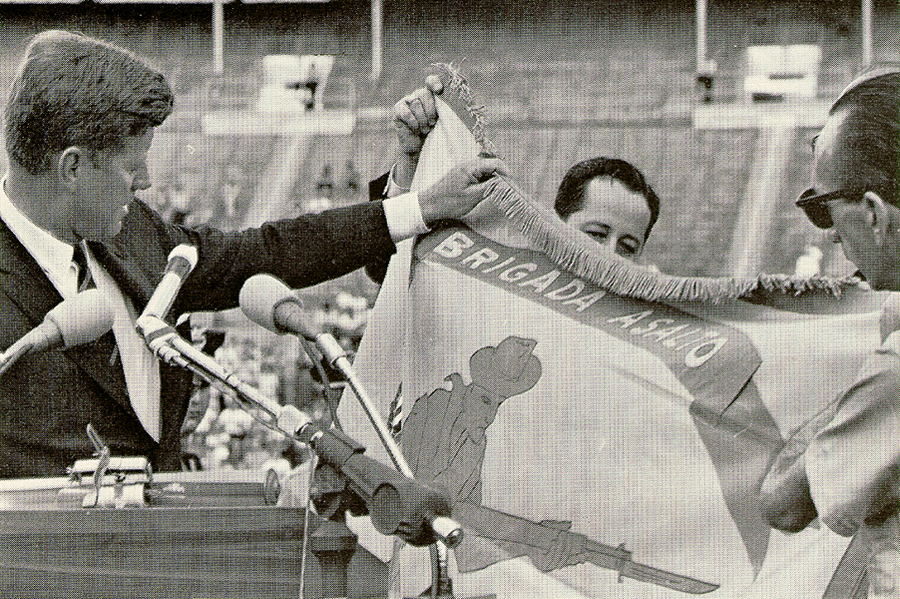
Image result for Brigade 2506 kennedy
December 29, 1962. President Kennedy promised to return the flag to the Brigade 2506 leaders in a "free Havana." I wonder where that flag is now?
"Today, the world marks the passing of a brutal dictator who oppressed his own people for nearly six decades. Fidel Castro’s legacy is one of firing squads, theft, unimaginable suffering, poverty and the denial of fundamental human rights
While Cuba remains a totalitarian island, it is my hope that today marks a move away from the horrors endured for too long, and toward a future in which the wonderful Cuban people finally live in the freedom they so richly deserve. 
Though the tragedies, deaths and pain caused by Fidel Castro cannot be erased, our administration will do all it can to ensure the Cuban people can finally begin their journey toward prosperity and liberty. I join the many Cuban Americans who supported me so greatly in the presidential campaign, including the Brigade 2506 Veterans Association that endorsed me, with the hope of one day soon seeing a free Cuba."


Monday, November 14, 2016

Why did veterans vote for Trump?

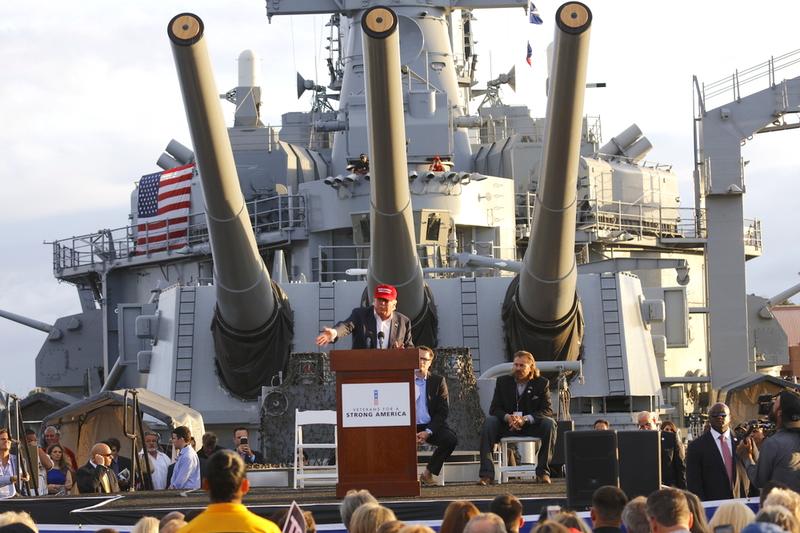
Image result for veterans for trump
President-Elect Trump knows more than a little bit about persuasion, apparently. The Washington Post neglects to mention that Trump promised to clean up and overhaul the VA healthcare system. Voting for Hillary was a vote for the VA status quo, which isn't great. Also, "going after" John McCain was smart not because McCain is a great hero of the Vietnam War (he is) but because he is the schmuck who lost to Obama back in 2008. And going after the Gold Star family who used their personal loss in order to boost Hillary's political chances? You'd have to be a Washington Post reporter to think that that would hurt Trump with his potential voters. As for the generals who have been mismanaging the wars in the Middle East over the past 15 years? Maybe Trump does know better. He can't do worse than they have.


WaPo

"Exit polls suggest veterans voted for Trump by about a 2 to 1 margin, reflecting the typical Republican bent of this group of voters. But the numbers also mean that a number of Trump’s controversial remarks on veterans and foreign policy did not significantly damage his support among military families. Trump said during his campaign that Sen. John McCain (R.-Ariz.) is not a war hero because he was captured during the Vietnam War, that he knew more about defeating the Islamic State militant group than U.S. generals, and also verbally attacked the parents of Army Capt. Humayun Khan, a U.S. soldier who was killed in Iraq, after they spoke at the Democratic National Convention against Trump."

Thursday, November 10, 2016

Veterans voted for Trump by a 2 to 1 margin

Image result for trump veterans


WaPo

"Swing-state counties with especially high numbers of veterans helped propel Donald Trump to the White House, suggesting that his attacks this summer on a Gold Star family did not dampen support for him in military communities.
In a number of counties in Ohio, North Carolina and Florida, Trump beat Hillary Clinton by wider margins than his Republican predecessors performed against Obama in the last two presidential races. All three swing states have rich military traditions and numerous counties in which thousands or tens of thousands of veterans live.
Exit polls suggest veterans voted for Trump by about a 2 to 1 margin, reflecting the typical Republican bent of this group of voters. But the numbers also mean that a number of Trump’s controversial remarks on veterans and foreign policy did not significantly damage his support among military families. Trump said during his campaign that Sen. John McCain (R.-Ariz.) is not a war hero because he was captured during the Vietnam War, that he knew more about defeating the Islamic State militant group than U.S. generals, and also verbally attacked the parents of Army Capt. Humayun Khan, a U.S. soldier who was killed in Iraq, after they spoke at the Democratic National Convention against Trump."


Wednesday, November 9, 2016

Well, that happened.

Image result for trump
Deus ex machina? Probably not. But at least it won't be Obama's third term.


"Donald Trump likely made history — winning the presidency only 17 months after entering politics, after being counted out time and again.
His win (assuming Clinton concedes today) is a decisive rejection of Hillary Clinton and a harsh repudiation of President Obama, who thought he could seize on the temporary lock on Congress (including a super-majority in the Senate) voters gave Democrats in the wake of the 2008 financial crisis to move the nation permanently to the left.
Instead, he opened the door to the mother of all populist push backs.
Trump’s victory is a punch in the face of the cultural elite, the Washington insiders and Wall Street, too."


Tuesday, November 8, 2016

Veterans are voting for Trump

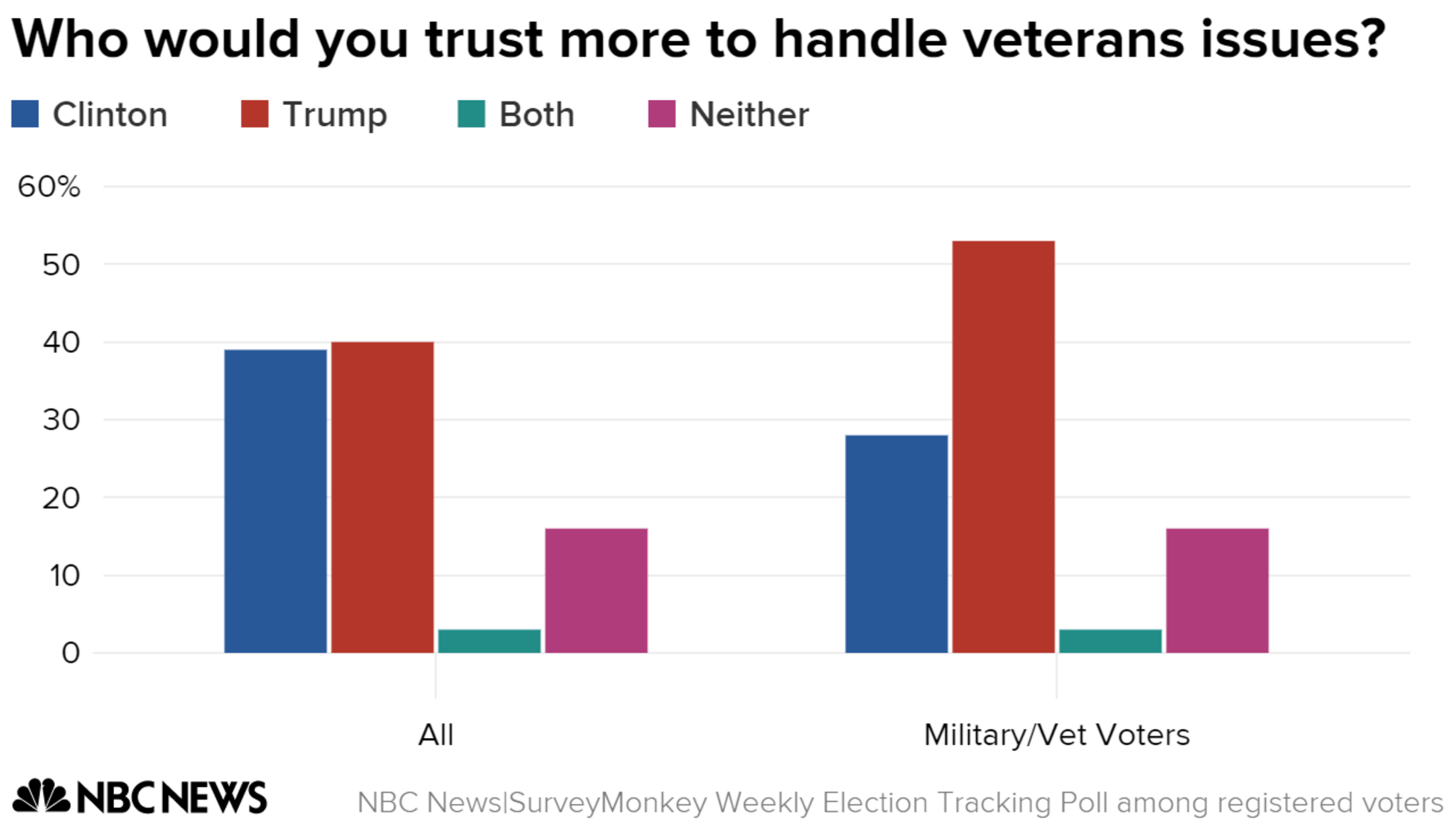
Image result for veterans poll trump
Count me among the Neithers; Gen Xer's don't "trust" anyone.


NYT
"There are 22 million living veterans in the United States, and many love or loathe Mr. Trump for the same reasons other Americans do. But polling, interviews with dozens of veterans and those who study their political views indicate a strong preference for Mr. Trump over Mrs. Clinton. He now leads Mrs. Clinton by 19 points among veterans registered to vote, while trailing her among all voters by three points, according to a Fox News poll released Oct. 18.
Veterans are more likely than other Americans to view Mr. Trump favorably, and less likely to rate Mrs. Clinton positively. In mid-October, 43 percent of veterans expressed a favorable view of him in a Gallup tracking poll, while just 30 percent saw Mrs. Clinton positively.
In interviews with more than three dozen veterans, many praised Mr. Trump for candidly criticizing the costs of war, an issue they see few politicians in either party taking on. And they are unconcerned with how or when he arrived at his positions.
The Iraq war was a disaster,” said Dustin Stewart, a former Army captain and Iraq veteran. “He is at least not trying to tiptoe around it. And I think some of the other Republicans were afraid of it.”"


Thursday, November 3, 2016

Socrates endorses Trump?

Image result for Socrates

Ancient and Modern Rhetoric (blog)
"In a long and fascinating segment of his written ‘memoirs’ about the philosopher Socrates (the Memorabilia), Xenophon recalls some conversations which Socrates supposedly had with various interlocutors on the subject of military and political leadership.   In one of them, a certain Nicomachides complains that the Athenians have elected a businessman called Antisthenes to a generalship rather than himself (3.4.1):
“Isn’t it like the Athenians? … they haven’t chosen me after all the hard work I have done, since I was called up, in the command of company or regiment, though I have been so often wounded in action” (and here he uncovered and showed his scars); “yet they have chosen Antisthenes, who has never served as a hoplite nor distinguished himself in the cavalry and understands nothing but money-making.”
Socrates points out that Antisthenes has often also been a choregos  (financier and impresario of dramatic and dithyrambic choruses in festival contests).  Antisthenes’ choruses have always won the contest the because he is philonikos (eager for victory). Surely this is a good trait for a general?   
Nicomachides doubts the cogency of any analogy between the handling of a chorus and of an army.  Socrates clarifies as follows  (3.4.4):
“But, you see,” said Socrates, “though Antisthenes knows nothing about music or chorus training, he showed himself capable of finding the best experts in these.”  
“In the army too, then,” said Nicomachides, “he will find other to command for him, and others to do the fighting. Do you mean to say, Socrates, that the man who succeeds with a chorus will also succeed with an army?”
“I mean that, whatever a man is a leader of (prostateuei), if he knows what he wants and can get it he will be a good leader (agathos prostates), whether he is leader of a chorus, an estate, a city or an army.”


Monday, September 26, 2016

Election 2016: The Silent Majority versus the Elites


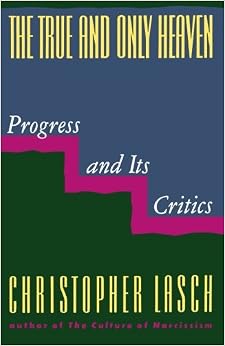
NYT, 1/27/91
"Lower-middle-class culture, Mr. Lasch argues, reflects an emphasis on the family, the church and the neighborhood. A community's continuity is valued more highly than individual advancement, social solidarity is favored over social mobility and the maintenance of existing ways takes precedent over mainstream ideals of success. Parents want their children to succeed in life, but they also want them to be considerate of their elders, to willingly bear their responsibilities and to show courage under adversity. "More concerned with honor than with worldly ambition, they have less interest in the future than do upper-middle-class parents, who try to equip their children with the qualities required for competitive advancement."
Mr. Lasch acknowledges the provincialism and narrowness of lower-middle-class culture, and he does not deny that "it has produced racism, nativism, anti-intellectualism, and all the other evils so often cited by liberal critics." But, he maintains, in their zeal to condemn such objectionable traits, liberals have failed to see the valuable features of petty-bourgeois culture -- what he calls moral realism, skepticism about progress, respect for limits and understanding that everything has its price."


Monday, May 2, 2016

Dennis Hastert and his ilk are why people find politics revolting


You think he's the only child molester among the rich and powerful in America?


Jeff Greenfield
"How did Hastert’s net worth leap from about $270,000 when he entered Congress to somewhere between $4 million and $17 million by the time he left Congress in 2007?... 
“By the mid-2000s, Hastert and two partners had amassed 138 acres of farmland outside Plano, Ill., several miles from the proposed site of the Prairie Parkway, a highway connector that would have cut through the northern Illinois countryside.
‘The then-House speaker’s ownership of the property was not a public record, as it was held under a blind land trust called the Little Rock Trust No. 225 … At the time, Hastert was championing the highway, which opponents said would tear up the farming region and hasten its suburbanization.
“Hastert eventually earmarked $207 million for the $1 billion parkway project in a federal transportation bill, which then-President George W. Bush signed during a trip to Hastert’s district in August 2005.
“Four months after the bill was signed, Hastert’s trust sold the land to a real estate developer who planned to build 1,700 homes on the parcel. Hastert’s share of the proceeds was worth more than $3 million…”
Get it? Hastert becomes the single most powerful member of the House. He uses that power to earmark money for a project that vastly increases the value of land he secretly owns. This gives him the millions he will need to buy silence from some he sexually abused as a youth, thus enabling him to stay in power for years."


Friday, April 22, 2016

Trump in a landslide

Get used to it.


I heard a social psych talk the other day that had something very interesting to say about leadership, with possible implications for the 2016 U.S. election. According to some theory (the name of which I don't recall), groups show preference for leaders who:


1) Are "one of us"
2) Do it for us (i.e., not their own self-interest)
3) Have a sense of us (understand us)
4) Give us meaning


So that means that voters are weighing (emotionally and intuitively, not rationally - because we rarely do anything rationally) these questions:


Which candidate is more like a prototypical American?


Which candidate wants to be President for our sake?


Which candidate better understands what it means to be an American?


Which candidate has a message that transports me beyond myself?


So I'll call it today, April 22, 2016:

Trump in a landslide.


(Not an endorsement: a theory-based prediction -- we'll see how it holds up.)


Thursday, December 17, 2015

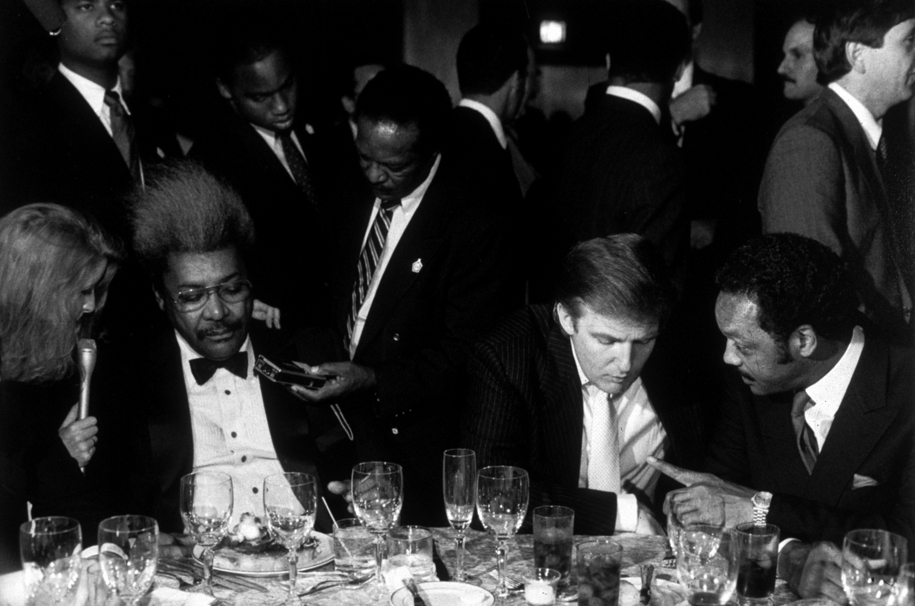
Is Donald Trump the Jesse Jackson of this campaign?

"Yes, it's a bit embarrassing that the press wants to talk to Don King and not us, especially since I'm running for president and you own this wonderful casino hotel. But listen -- just because you are a bloviating nincompoop doesn't disqualify you as a candidate. Look at me and all the idiotic things I say. Wait 20 years, maybe 25, and give it a whirl. It's fun -- you'll see. Just remember that you're running for President of the United States, not recipient of the Nobel Prize for Medicine. You don't have to be wise or good -- this is a democracy for Pete's sakes. Just be entertaining and let the people decide."


538
"Historically, in fact,7 there has been nearly a one-to-one correspondence between a candidate’s share of media coverage and his share of the vote in the polls. That is, other things held equal, a candidate earning 30 percent in national polls tends to get about 30 percent of the media coverage, while one polling at 10 percent will get 10 percent of it instead. It’s just that simple.8
Thus, we can readily compare a candidate’s share of media coverage to his polling average. Trump, for example, has received an average of 28 percent of the Republican vote in national polls since July, according to HuffPost Pollster. Prorate that number upward to exclude undecided voters and candidates who have exited the race, and you get him up to 32 percent. By comparison, Trump has received 54 percent of the media coverage of the GOP race, so his media coverage has exceeded his share in the polls by 22 percentage points.
That is a big gap, although not the largest on record. Instead, the record belongs to Jesse Jackson, who received 33 percent of the media coverage in the run-up to the 1984 Democratic primaries despite usually polling only in the high single digits.
Candidates with more support in media than in polls
CANDIDATERACESHARE OF MEDIAADJ. SHARE OF POLLSEXCESS MEDIA
Jesse Jackson1984 D33%9%+24%
Donald Trump2016 R54%32%+22%
Douglas Wilder1992 D40%19%+21%
Rick Perry2012 R37%18%+19%
Howard Dean2004 D40%21%+19%
Pat Robertson1988 R23%7%+16%
Hillary Clinton2016 D77%65%+12%
Mitt Romney2008 R24%13%+11%
It’s odd to compare Jackson and Trump, but their candidacies have some similarities: Both were nationally renowned (and controversial) figures before embarking on their campaigns, and their candidacies were strongly opposed by most members of their party establishment. Eventually, Jackson fared reasonably well, winning two states and 18 percent of the Democratic vote in the 1984 primaries and advancing political participation in the black community, although he never came close to winning the nomination."


Friday, December 11, 2015

Moynihan's Reading List for Nixon

Image result for nixon reading book


Anecdotal Evidence
"Early in his first term, [U.S. President Richard] Nixon named [future U.S. Senator Daniel Patrick] Moynihan – a liberal Harvard professor with close ties to the Kennedys – his urban affairs adviser. Hess calls them “the oddest...of all the odd couples in American political life.” 
In a chapter titled “Tutorial,” [author Stephen] Hess reports the president asked Moynihan for a list of his favorite political biographies, and quotes Nixon as writing in a memo to Moynihan: “As you know, I do quite a bit of evening reading, and I want to be sure that I’m reading the best!” One is touched by Nixon’s earnestness and eagerness to please his staff intellectual. Limiting himself to ten titles, Moynihan leaves out Erik Erikson on Gandhi, Arthur Link on Woodrow Wilson and Catherine Drinker Bowen on Oliver Wendell Holmes. Here is the list Moynihan gives Nixon: 
Autobiography, John Adams (1802)
Abraham Lincoln, Lord Charnwood (1917)
The Education of Henry Adams, Henry Adams (1918)
Talleyrand, Duff Cooper (1932)
Melbourne, David Cecil (1939)
Hitler: A Study in Tyranny, Alan Bullock (1952)
The Republican Roosevelt, John Morton Blum (1961)
Alexander Hamilton and the Constitution, Clinton Rossiter (1964)
Disraeli, Robert Blake (1966)
Zapata and the Mexican Revolution, John Womack Jr. (1969)" 
 
What my fellow blogger fails to mention is that Nixon shocked Moynihan not long afterwards by saying, "I've read them all, now let's discuss them." Moynihan himself had not read Disraeli, which is close to 900 pages.

I can't say that political biographies are really my thing. I didn't like Henry Adams, which apparently some people think is the greatest work of 20th century non-fiction in English. I have owned the Bowen, Bullock, Blum, and the Blake, but can't say I ever read them all the way through. I might take a look at Erikson on Gandhi. Duff Cooper's Tallyrand looks pretty fun. I feel a duty to read the Charnswood on Lincoln, which probably means I won't.

A chacun son gout.


Thursday, December 10, 2015

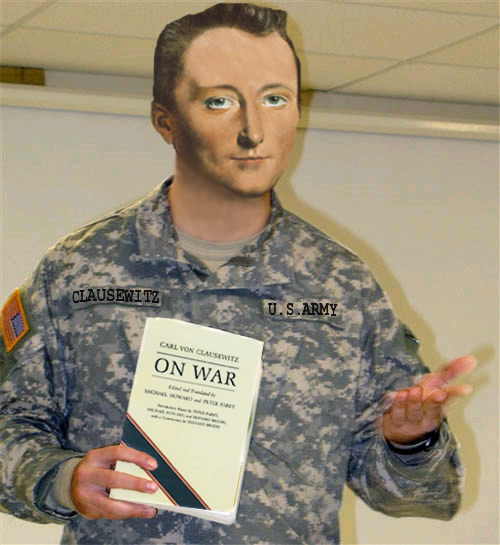
Clausewitz on ISIS

It's a shame that this book isn't required reading at more colleges.


RealClearDefense
"Clausewitz...views war as a subject that can be studied, understood and that, like engineering (say) or architecture, or any other discipline, improved on. It is possible to get good at killing, and if you’re better at it than your enemy — if you break your enemy’s will to resist (as he would say) — you’ll win. On War provides a slew of these undiluted but axiomatic understandings. Though Clausewitz was a civilized man who recognized war’s horrors, he issued these axioms with a stern warning: “Kind-hearted people might think there was some ingenious way to disarm or defeat an enemy without too much bloodshed,” he writes, “and might imagine this is the true goal of the art of war. Pleasant as it sounds, it is a fallacy that must be exposed: war is such a most dangerous business that the mistakes which come from kindness are the very worst . . . This is how the matter must be seen. It would be futile — even wrong — to try and shut one’s eyes to what war really is from sheer distress at its brutality.”
It is this unblinking ability to call war what it is that has given Clausewitz such a dedicated following that large numbers of military officers have worked to grasp his thinking, and vocabulary. “Clausewitz says that the purpose of war is to achieve a particular political end,” Stoker says. “He argues that the best route to doing this is to attack the enemy’s center of gravity, the center of his strength. That might seem obvious now, but many of the most important parts of our current military thinking were first identified by him.”
Of course much of what Clausewitz tapped into in On War was a reflection of what professional soldiers already knew, and know. Thus, Union General William Tecumseh Sherman issued his famously Clausewitzian statement on war without, apparently, ever having read him. “War is cruelty. There is no use trying to reform it,” he said. “The crueler it is, the sooner it will be over.” Sherman’s unflinching calculus (that true humanity consists in waging war unrelentingly, so as to end it sooner) is, in many ways, a perfect distillation of the U.S. military’s traditional mistrust of the narrative propounded by counterinsurgency advocates that the “center of gravity in a counterinsurgency is the protection of the population that hosts it.” That might have been true in western Iraq, but few would argue that it’s the case with ISIS — particularly after the attacks in Paris. “The Germans and Japanese were held in a vice grip by their leaders in World War Two,” Christopher Bassford says, “but that didn’t stop us from burning down their cities. If it’s safer to be with ISIS than against it, ISIS will retain its hold on the population it now controls.”
In fact, Bassford’s views reflect a growing consensus inside the U.S. military’s upper echelons that a cruel war against ISIS now, no matter how distasteful, will save the lives of many decent people — including many Americans — later.
...Clausewitz, Johnson notes, understood this problem. “To win you have to seize the initiative and keep it,” he says, “and right now we’re not doing that. Right now the tail is wagging the dog. ISIS kills and we respond. But you know, the dog’s supposed to be in charge, not the tail.”
Bassford too is skeptical of airpower alone. “These ISIS guys ultimately will have to be dug out of their holes and slaughtered to a man by fighters on the ground,” he says, then adds that it would be far better if those fighters were Muslim: “We need to help them wipe out the stain on Islam that ISIS represents, but it really has to be their fight.”
While neither Stoker, Bassford or Johnson cited the passage from On War that best reflects this view, it is well known to both military strategists and Clausewitz scholars, and is one of his earliest and most crucial maxims: “If one side uses force without compunction, undeterred by the bloodshed it involves, while the other side refrains,” Clausewitz wrote, “the first will gain the upper hand.” For a growing number of senior U.S. military officers, and particularly for those devotees of the Prussian’s masterpiece, the escalation marked by the Paris attacks requires a shift in U.S. strategy to seize the initiative: to hit them, and relentlessly, before they hit us. Inevitably, and ultimately, such a decision will test not only ISIS’s will to resist — it will test ours."


Tuesday, November 3, 2015

Big surprise: Former Speaker of the House is a dirtbag

Dennis Hastert goes from speaker to felon, but his dark past still a mystery
Gee, I wonder why us Gen-Xer's are so cynical about everything. At least Hastert wasn't in some Satanic sex cult like in True Detective. But is that scenario really so unbelievable?


Chicago Tribune


"Was the longest-serving Republican speaker of the U.S. House a sexual predator? Who were his victims? How many were there?
The crime to which Hastert confessed is illegally structuring cash withdrawals to evade financial reporting requirements, a felony.
The by now well-known, if hardly well understood, backstory — Hastert allegedly agreed to pay $3.5 million in hush money to conceal long-ago sexual misconduct involving a student at Yorkville High School — was left unexamined in court.
...
What's still missing is a full accounting of the part of the story that matters most — the part that happened during the 16 years that Hastert was a teacher and wrestling coach in Yorkville.
It was during that time that he allegedly sexually abused the person identified in the indictment as "Individual A." The sister of a second alleged victim who is now deceased says her brother also was sexually abused by Hastert during high school.
...

Hastert once held the third-highest elected office in the nation. He pleaded guilty to a crime much less serious than the one prosecutors couldn't or wouldn't pursue. It's fair to ask why they didn't, and fair to demand assurances that they determined the full scope of his misconduct before disposing of the case with a plea that will net him six months or less."


Monday, September 14, 2015

Is Donald Trump the Ubermensch?

 "I teach you the overman. Man is something that shall be overcome. What have you done to overcome him?
     All beings so far have created something beyond themselves; and do you want to be the ebb of this great flood and even go back to the beasts rather than overcome man? What is the ape to man? A laughingstock or a painful embarrassment. And man shall be just that for the overman: a laughingstock or a painful embarrassment..." -- Thus Spake Zarathrusta


NYT
"Mr. Trump is a veritable factory of boorish put-downs, laugh-out-loud exaggerations and self-aggrandizing declarations. But “Never Enough” unearths decades-old gems that might otherwise be lost to history.
On his publicity seeking: “The show is ‘Trump,’ and it is sold-out performances everywhere,” he told Playboy.
On his feelings of superiority: “For the most part, you can’t respect people because most people aren’t worthy of respect,” he told Mr. D’Antonio.
Perhaps his most revealing statement applies to the time-honored virtue of self-reflection. Mr. Trump is not in favor of it.
When you start studying yourself too deeply, you start seeing things that maybe you don’t want to see,” Mr. Trump once told Time. “And if there’s a rhyme and reason,” he continued, “people can figure you out, and once they can figure you out, you’re in big trouble.”"


Friday, September 11, 2015

Who benefits from the continued prohibition of sports betting?

It's good to re-read Mill's On Liberty every once in a while, if only to remind yourself that the United States is not actually a free country. Where does the government get off treating its citizens as criminals if they place a bet on a sporting event? How is that different from the Taliban beating men who don't wear beards?


AFP
Los Angeles (AFP) - The National Football League season kicking off Thursday will unleash a flood of wagering in which $95 billion will be bet, most of it illegally, the American Gaming Association said Wednesday.
"Illegal sports betting is reaching new heights of popularity in America," Geoff Freeman, president and chief executive of the Washington-based trade group said in a press release. "It's clear that a federal ban on traditional sports betting outside of Nevada is failing."
The AGA reckons that nearly $93 billon in illegal bets will be taken on NFL and college gridiron games this season, with slightly less than $2 billion wagered at legal sports books in Nevada.
According to the AGA, Americans made $3.8 billion worth of illicit bets on the Super Bowl alone last season.
"It's clear that it's a very popular activity that's only growing in popularity," Chris Moyer of the AGA told AFP. "It's become an American pastime in many regards.
...
The NFL, NBA, NHL and MLB have all opposed New Jersey's efforts, telling the court the proposed legislation threatens the integrity of their games and violates a 1992 federal ban on sports betting in most states."


Hey commissioners, it is in the best interests of those taking the bets that the games be perceived as honest. They stand to make more money taking bets on honest games than on rigging games. Individual gamblers might try to rig games, but chances are that their efforts will be counterbalanced by individual gamblers trying to rig the same game for the other team.


But they know this.


So why are they (and Congress) opposed to legalized sports betting?


Might organized crime have an interest in securing opposition to legalized sports betting? Could the people who take in the $93 billion in illegal bets be funneling some of their profits to the sports commissioners and legislators who influence these decisions? Heaven forfend!


Who benefits from the continued prohibition of sports betting?


Organized criminals and those they pay off.


Wednesday, June 17, 2015

Michael Oakeshott: Conservative Philosopher


"What there is, [English philosopher Michael] Oakeshott believed, is conversation—unending conversation about the complexities of life and life’s proper ends. This conversation, he held, ought never to lapse into argument. Nor is it hierarchical. Every thoughtful person can participate. In “The Voice of Poetry in the Conversation of Mankind,” he wrote that “conversation is not an enterprise designed to yield an extrinsic profit, a contest where a winner gets a prize, nor is it an activity of exegesis; it is an unrehearsed intellectual adventure.” Life, for Oakeshott, as he put it in “A Place of Learning,” is “a predicament, not a journey.” The predicament is how to make the best of it and get the best out of it.
The answer for Oakeshott, as he set out most emphatically in “On Being Conservative,” is to cultivate 
a propensity to use and to enjoy what is present rather than to wish for or to look for something else; to delight in what is present rather than what was or what may be. .  .  . To be conservative, then, is to prefer the familiar to the unknown, to prefer the tried to the untried, fact to mystery, the actual to the possible, the limited to the unbounded, the near to the distant, the sufficient to the superabundant, the convenient to the perfect, present laughter to utopian bliss. 
...
Oakeshott found more reinforcement for these views in Montaigne and Pascal and Hume than in Burke or Bentham.
Politics did not hold out much promise for Oakeshott. He believed that government 
is a specific and limited activity, namely, the provision and custody of general rules of conduct, which are understood, not as plans for imposing substantive activities, but as instruments enabling people to pursue the activities of their own choice with the minimum frustration, and therefore something which it is appropriate to be conservative about.
Oakeshott had his own religious sentiments and complex morality, but he felt that neither religion nor morals had to do with politics, and politics had nothing whatsoever to do “with making men good or even better.” Dreams of perfect justice or perfect freedom ought to be excluded from politics, for “the conjunction of dreaming and ruling generates tyranny.” 
The role of government should be much simpler: “to keep its subjects at peace with one another in the activities in which they have chosen to seek their happiness.”  
...
The problem, Oakeshott felt, was not only that “politics is an uninteresting form of activity to anyone who has no desire to rule others” but that those it attracts are, too often, unimpressive human beings. At one point he calls them “scoundrels.” What isn’t required, but is too often evident, in politics is “manufacturing curable grievances.” What is needed is the assurance of “the little things: to go where we like & when; having paid my taxes to spend my money on what I wish.” His final word is this: “Politics is the art of living together & of being ‘just’ to one another—not of imposing a way of life, but of organizing a common life.”
So much of Oakeshott’s political thought is propelled by his unshakeable belief in the imperfectibility of human beings. Montaigne is his intellectual hero here, the Montaigne who understood that all human judgment and wisdom is fallible. In “A Place of Learning,” Oakeshott disavows a belief in human nature, asserting that “there are only men, women and children responding gaily or reluctantly, reflectively or not so reflectively, to the ordeal of consciousness, who exist only in terms of their self-understandings.” Self-understanding, though, is a rarity. “The intellectual life of the majority of men and women,” he writes in the Notebooks, “is cankered by a passion for indiscriminate knowledge.”
He underscored the wretched condition of “people who have no selves other than those created by ‘experts’ who tell them what they are.” Others walk about with heads “so full of ideas that there is no room for sense.” In a world of boundless distractions, serious education—not “education [that] is merely instruction in the current vulgarities”—is the only (if somewhat dim) hope: “To be educated is to know how much one wishes to know & to have the courage not to be tempted beyond that limit.” Genuine culture, he held, teaches that “there is much that one does not want to know.”
For Oakeshott the trick was somehow to be above the humdrum world and yet also be in it. “One is under an obligation to be happy with the here & now,” he writes, a sentiment he expresses more than once. Yet he also notes that “it is certain that most who concentrate upon achievement miss life.” On his gravestone, he wanted this bit of verse from the Scottish poet William Dunbar:
Man, please thy Maker, and be merry,
And give not for this world a cherry."


Thursday, May 14, 2015

Scott Walker's debt

Personally, I don't think he has a chance in hell to be elected President. (It's going to be a while until I can stomach voting for someone I could have gone to college with. We were all a bunch of idiots.) But Peggy Noonan is still right about how we should embrace normality. (One unusual thing about Gov. Walker is that his wife is 12 years older than he is. I wonder how often that happens? Evolutionary psychologists would say, Not terribly often.)


Peggy Noonan
"A friend this morning sent a note, jeering at Scott Walker for having significant personal debt. He linked to this story. My friend’s tone suggested the debt makes Walker look less impressive as an individual and less viable as a presidential candidate.
My reaction was the opposite. To me the story made Walker look normal. (That in fact was my impression of him when I met him about a year ago for coffee at a New York restaurant. I was late. He was at a small table alone, reading some papers. No aides, no staff, no security, just a guy at a table, a Midwestern businessman having a cup of coffee between meetings. He also acted normal. This was so startling to me—politicians now are so often weird, outsized, faintly deranged—that I couldn’t stop thinking about it.) According to the piece Walker owes up to $50,000 to Sears and some perhaps similar amount on another card. His spokeswoman said well, yeah, he’s got two kids in college and his parents live with him. His yearly salary is $144,423. More jaw dropping: his net worth is minus $72,500. Meaning he has done a great deal of work and accomplished many things over the years and never bothered to make himself rich. This is so refreshing—public service that is not, apparently, a self-enrichment project—that I can’t help but think we should tip our hats. Good for him for doing it the old-fashioned way. As for its impact on his appeal, unless I’m very wrong, a lot of Americans will feel not derisive about his financial condition but almost touched. “Harry Truman had no money either.”
My friend said Walker’s lack of wealth suggests he can be bought. I’m seeing it the opposite: if he hasn’t sold himself yet, it suggests he is not for sale."


Friday, May 1, 2015

Psychoanalyzing Hillary Clinton

One of Hillary Clinton's husband's ex-girlfriends
 
American Thinker

"Watching Hillary Clinton reach out and touch ordinary Americans is excruciating. In working a crowd of regular folks, Hillary is fingernails on the blackboard in a pantsuit. It is difficult to imagine anyone more out of touch with her own affect, movement, and connection to the people around her. She is unable to talk, touch, listen or smile in a natural manner. She doesn't seem to know what to do with her hands, where to direct her eyes, her scope of awareness is restricted. A blind person with a stick would be better than Hillary Clinton at reading people around her. 
 ...
It is understandable that Hillary is postponing contact with the press. Special factors in the way Hillary Clinton has lived her life, beyond the typical cautiousness of the front runner, make it difficult for her to be present with herself or open to anybody else in a room full of strangers
When one observes married couples who have been together for a long time it is often possible to recognize a complementary-compensatory dynamic wherein the partners automatically cover for the limitations of the other. As a benign example, if the wife is naturally shy, the husband may become increasingly outgoing and voluble over time to compensate for his wife and prevent the isolation which shyness might cause. There is a degree of filling in for each other that redistributes responsibilities in a practical way and is healthy. But this compensatory dynamic can become destructive by enabling weaknesses as the couple patches each other’s problems rather than confront themselves and grow as individuals. 
The Clintons are the most married couple in the world. They are stuck with each other. The demands of their joint political careers have made the complementary-compensatory dynamic especially powerful in their marriage and destructive to their individual integrity. Their marriage was called upon to support fantastic ambitions and hide weaknesses in both of them. 
Bill Clinton is a famously gifted retail campaigner. A friend of mine who met President Clinton and spoke with him for a few minutes says he made her feel like the only person in the room. His brash presentfulness is a skill especially valued in a leader. But President Clinton's ability to connect to and take in the people around him is a double-edged rapier, with a predatory blade. His natural ability to connect allows him to select those who will benefit him but also cull the vulnerable from the herd for his nefarious purposes. We know he consumes and abuses women around him, offenses of impulsive domination and aggression. Hillary has her own history of ethical, legal and financial scandal. But the scandals that have stuck to her are the stuff of malfeasant calculation, monies and memos appearing and disappearing in wrongful ways. Hillary's scandals are the machinations that leave a paper trail (or a no e-mail trail), not the wreckages of foolhardy moments. 
In driving the Clinton franchise to the highest levels of power on earth, Hillary has wretchedly compensated for her husband's porous boundaries by constructing impenetrable walls around herself. As he became more reckless, she must have become more wary. Many years ago Hillary accepted the job of being Bills' after-party cleanup crew. In the service of their upward march, she had no choice. Many people think Hillary Clinton is a psychopath without a conscience who cares nothing about her husband's betrayals on a personal level. That formulation does not seem supported by what has leaked out about the Clinton's relationship. It is more likely that she is a wellspring of anger hiding behind a smile you can hang laundry on. 
What is certain is she spent years mopping up and deodorizing Bill's messes. Bill's affairs with and attacks on women have been more destructive to Hillary's psychological integrity and self-worth than some miraculous hundred grand showing up in the Clinton cookie jar have been to him. His sexist violence strikes at the heart of who she claims to be, and continues to damage her basic sense of security and candidacy. For forty years, a room full of strangers is where the party starts for Bill, and where the messes are made for Hillary. For forty years every time Hillary entered a room full of strangers she had her bucket and mop. A bimbo splatter might be found anywhere. For forty years a room full of strangers, interacting in an unscripted moment, has been Hillary's worst nightmare."