Showing posts with label Art. Show all posts

Tuesday, March 28, 2017

In Parenthesis -- David Jones (1937)

The Artist, David Jones (1927)


New Statesman

"[Painter, poet and World War I veteran David] Jones often wrote about “the Break”, the cultural moment somewhere around the beginning of modernity when the European world-view shifted decisively. Instead of a world where things were unique but linked by an unimaginable density of connection and cross-reference, we had created one in which things were unconnected but endlessly repeatable and where everything could be exchanged in the market for an agreed equivalent: above all, for money. Jones saw his work – both as a visual artist and as a poet – as a sustained protest against the Break and an effort to show that the older picture could, after all, be brought to life.
Born in 1895, he had family roots that helped to shape his interests from the beginning. His mother’s father had been a London shipwright and his father’s origins were in North Wales. Both Wales and London kept a central place in his imagination throughout his life. It was not surprising that when the First World War broke out, he enlisted in the 1st London Welsh Battalion of the Royal Welch Fusiliers. His 1937 masterpiece, the astonishing book-length poem In Parenthesis, describes the experience of foot soldiers in the First World War, revisiting his own experiences up to and including the disastrous engagement at Mametz Wood in July 1916. Jones was wounded in the leg during the battle (a wound described by the medical orderly as “a beautiful blighty” – serious enough to get him off the front line, yet not life-threatening). But he was back in the trenches in a matter of months.
The traumas of war stayed with him to the end. In Parenthesis, which he struggled with painfully over many years, is one of the most unsparing accounts of the life of infantry soldiers in the trenches and of the horrors of the Somme; but at the same time it meditates on any number of connections – echoes of conflict, from Troy to the struggles of the British against the Saxons in the 6th century to Malory’s Arthurian narratives, and, woven through it all, the founding act of bloodshed that is the death of Christ. Jones was raised an Anglican, but by the time he wrote In Parenthesis he was a Catholic, and believed passionately that the Church’s sacramental theology was what made sense of a world of symbolic connection, where nothing existed as an atom but where everything enriched the perception of everything else. For him, all art rested on the conviction that God had made a world of endless cross-reference, and that humanity was most fully human when it acknowledged this. Art was humanity doing what only humanity could do."


Thursday, October 27, 2016

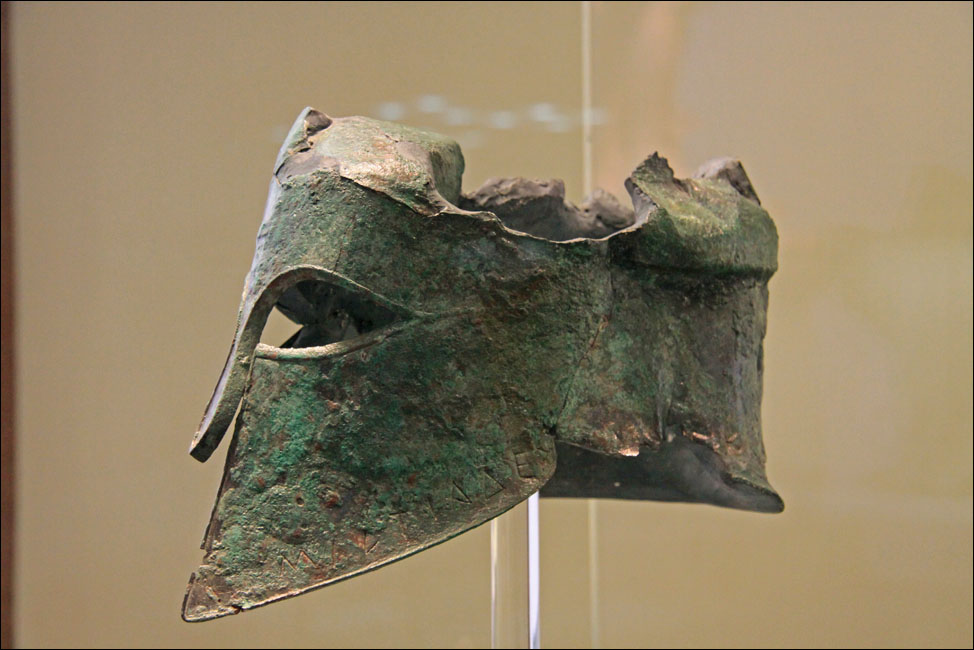
Helmet of Miltiades

Image result for helmet of miltiades
"The helmet Miltiades dedicated to Zeus at the sanctuary after he led the Athenians in victory at Marathon. The act is inscribed on the helmet itself "ΜΙΛΤΙΑΔΕΣ ΑΝΕΘΕΚΕΝ ΤΟΙ ΔΙΙ" (the name Miltiades is clearly visible in the lower left part of the helmet). 490 BCE."


Olympia Museum, Greece

"By the time Theodosius I banned the Olympics and ordered the destruction of the temples, the sanctuary had amassed an incredible amount of buildings, fountains, baths, statues, trophies, and votive offerings of every kind. Even though Olympia was plundered several times in antiquity, archaeologists have unearthed a wealth of objects during excavations that started in 1875 and continue to our day. The Museum at Olympia shelters and exhibits the most striking of these finds, some of which are worth traveling around the world to experience in person."


Wednesday, October 26, 2016

Lord Ribblesdale -- John Singer Sargent (1902)

 Image result for lord ribblesdale


The World of Portrait Painting
"Thomas Lister, fourth Baron Ribblesdale (1854-1925), the eldest son of the third Baron Ribblesdale of Gisburne Park, near Skipton in Yorkshire, was born in Fontainebleau and spent much of his childhood in France. His father's extravagance and gambling debts had injured the family's finances, compelling him to mortgage the Gisburne estate and let the house itself to tenants. The young Thomas Lister returned to England to be educated at Harrow, joining the army (64th Foot) in 1873, transferring to the Rifle Brigade in 1874, and retiring as major in 1886. He succeeded to the title as fourth Baron Ribblesdale on the suicide of his father in 1876 and took his seat in the House of Lords in 1877, where he sat as a Liberal. That same year, he married Charlotte ('Charty') Monckton Tennant, daughter of the industrialist and collector Sir Charles Tennant (see no. 406) and a leading figure in the aristocratic coterie known as 'the Souls'; it was the Tennant fortune that paid off the Gisburne mortgage and bought the Ribblesdales' Mayfair home, 32 Green Street. Charlotte suffered from consumption and died in 1911, and their sons, Thomas and Charles, were killed in Somaliland (1904) and in the First World War (1914), respectively."


Tuesday, March 15, 2016

"All that is necessary for ugliness to prosper is for artists to reject beauty."

Could it be that we live in an ugly world because we are girding ourselves to slaughter each other?


by Theodore Dalrymple, City Journal

"The picture that adorns the cover of the Dumas exhibition catalog is titled The Painter. It is of a naked girl...who stands up straight, facing the viewer. Her expression is of a defiant scowl, almost menacing. Her dark, deep-set, intense but indistinct eyes seem to express hatred, not of a particular object but of the world itself (inclusive of the viewer). Most of her torso is covered in light blue paint; far more disturbing, her hands, which hang by her side, are covered in paint: the right hand the color of dark, venous blood and the left hand the color of bright, arterial blood. One gets the impression that she has just come from the postmortem room or has perhaps murdered her mother. One is never too young to be a psychopath.
It is an extremely disturbing image, painted with talent. You are not likely to pass it by or to forget it. When I showed it to friends, not artistically inclined and unfamiliar with the notion of transgression as the highest good, they shuddered and said that it was sick and that it displayed a diseased imagination. Some will retort that outraged bourgeois have often reacted in this way to new art that subsequent generations took in stride and perhaps considered great. But it does not follow from the fact that a great work once caused outrage that a work that causes outrage is great. For myself, I have no difficulty in both admiring and disliking Dumas’s art.
...[I]t is not that the world has become “objectively” worse in the interval between [18th Century British painter Joshua] Reynolds and Dumas. In many respects, precisely the reverse is true, though many terrible things were done in that interval. Childhood is not less childhood than it was; children are not physically the uglier. Nor is it that we have become more intellectually sophisticated in the meantime, such that we have a better understanding of what human life is about and how it should be lived, or of the true wellsprings of human action.
...Marlene Dumas was indeed fortunate that, having attended art school in Cape Town, she was saved from the kind of provincialism now rampant in London, Paris, and New York. Her writing, collected in a volume titled Sweet Nothings (a title intended, one suspects, to ward off serious criticism), has an apodictic, take-it-or-leave-it quality: “Art is a low-risk, high-reward crime.” Or: “Now that we know that images can mean whatever, whoever wants them to mean, we don’t trust anybody anymore, especially ourselves.” This is a world without enchantment. The following words are revealing:
My generation cherishes loneliness
prizing it even above sex.
They are so sensitive,
they are allergic to each other.
One cannot help but suspect that there is bad faith in all this, that this is not so much how people feel as how they feel they ought to feel in order not to appear naïve.
...Dumas is guilty of a much greater evasion, caused by a fear of beauty. In a perceptive note in the catalog of her exhibition, by the critic Wendy Simon, we learn of this fear. Simon draws attention to “the extreme ambivalence we now feel towards beauty both within and outside art,” and continues: “We distrust it; we fear its power; we associate it with compulsion and uncontrollable desire of a sexual fetish. Embarrassed by our yearning for beauty, we demean it as something tawdry, self-indulgent, or sentimental.”
All that is necessary for ugliness to prosper is for artists to reject beauty.
Lenin abjured music, to which he was sensitive, because it made him feel well-disposed to the people around him, and he thought it would be necessary to kill so many of them. Theodor Adorno said that there could be no more poetry after Auschwitz. Our view of the world has become so politicized that we think that the unembarrassed celebration of beauty is a sign of insensibility to suffering and that exclusively to focus on the world’s deformations, its horrors, is in itself a sign of compassion."


Saturday, March 12, 2016

Friday, March 11, 2016

Damned Man, from Michelangelo's The Last Judgment (1536-1541)


Michelangelo's famous Damned Man.
I suppose a theological, if not artistic, criticism of Michelangelo's The Last Judgment is that it is inspired more by Dante's  (c. 1265–1321) Divine Comedy than by The New Testament.

Thursday, March 10, 2016

Baigio da Cesena as Minos, from Michelangelo's The Last Judgment (1536-1541)


Minos, judge of the Underworld by Michelangelo
Baigio da Cesena was the papal master of ceremonies (The Pope's M.C.!) who criticized Michelangelo's depictions of nude figures, saying that they would be more fitting for a "public tavern" than the Sistine Chapel. So Michelangelo painted him into the scene, with the ears of an ass and a viper biting his genitals, about to be cast into the Second Circle of Hell. When da Cesena protested, Pope Paul III (God bless him), said, "I have no jurisdiction over Hell."

Wednesday, March 9, 2016

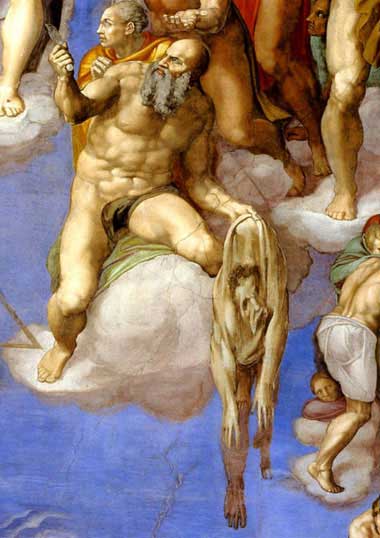
St. Bartholomew holding his own skin, from Michelangelo's The Last Judgment (1536-1541)

St Bartholomew, from Michelangelo's Last Judgement
He's holding the knife with which he was flayed alive, a martyr to his faith, and a reminder of mankind's brutality and rejection of Christ, i.e., the deservedness of their damnation. Legend has it that the flayed skin is a self-portrait of Michelangelo.

Tuesday, March 8, 2016

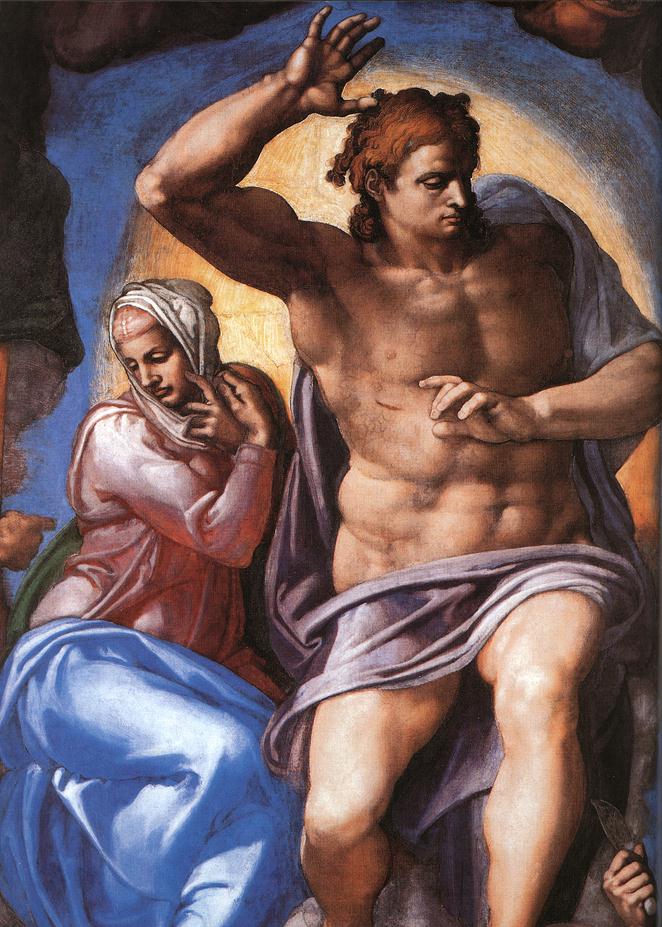
Mary and Jesus, from Michelangelo's The Last Judgment (1536-1541)


Mary and Jesus, from Michelangelo's The Last Judgment (Sistine Chapel), 1536-1541. He's casting the damned into hell, and she can't bear to look.


Friday, May 15, 2015

Depictions of Madness -- Andrew Scull

2161762323_983946a7ca_o
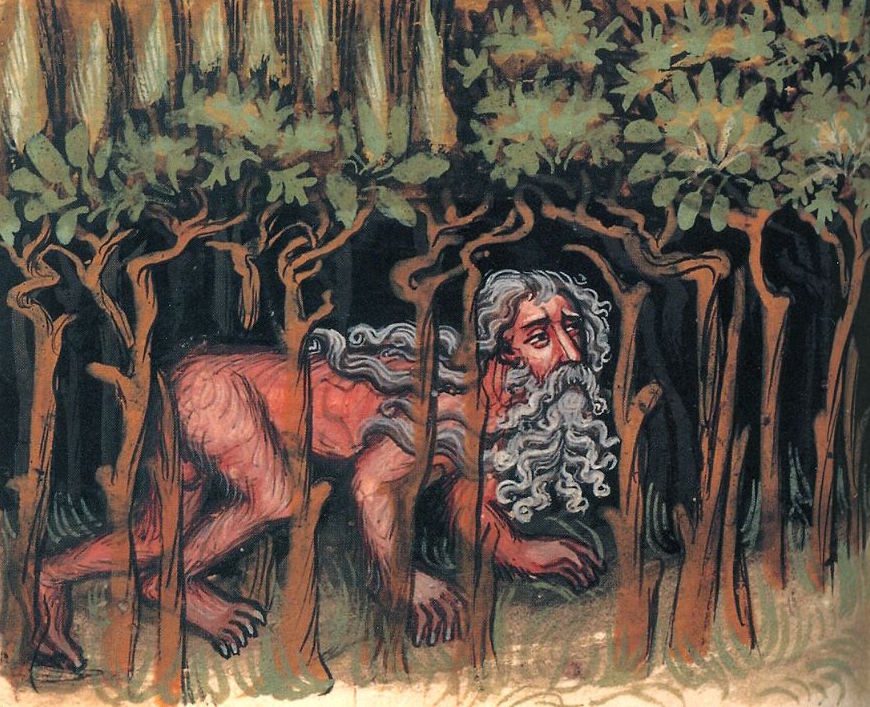
Nebuchadnezzar turned into an animal, 1410.


Paris Review
"Modern psychiatry seems determined to rob madness of its meanings, insisting that its depredations can be reduced to biology and nothing but biology. One must doubt it. The social and cultural dimensions of mental disorders, so indispensable a part of the story of madness and civilization over the centuries, are unlikely to melt away, or to prove no more than an epiphenomenal feature of so universal a feature of human existence. Madness indeed has its meanings, elusive and evanescent as our attempts to capture them have been.
Western culture throughout its long and tangled history provides us with a rich array of images, a remarkable set of windows into both popular and latterly professional beliefs about insanity. The sacred books of the Judeo-Christian tradition are shot through with stories of madness caused by possession by devils or divine displeasure. From Saul, the first king of the Israelites (made mad by Yahweh for failing to carry out to the letter the Lord’s command to slay every man, woman, and child of the Amalekite tribe, and all their animals, too), to the man in the country of the Gaderenes “with an unclean spirit” (maddened, naked, and violent, whose demons Christ casts out and causes to enter a herd of swine, who forthwith rush over a cliff into the sea to drown), here are stories recited for centuries by believers, and often transformed into pictorial form.

Sunday, November 9, 2014

In Time of Pestilence -- Thomas Nashe (1593)

The Triumph of Death -- Pieter Bruegel the Elder (1562)


ADIEU, farewell earth's bliss! 
This world uncertain is: 
Fond are life's lustful joys, 
Death proves them all but toys. 
None from his darts can fly;         5
I am sick, I must die— 
        Lord, have mercy on us! 
 
Rich men, trust not in wealth, 
Gold cannot buy you health; 
Physic himself must fade;  10
All things to end are made; 
The plague full swift goes by; 
I am sick, I must die— 
        Lord, have mercy on us! 
 
Beauty is but a flower  15
Which wrinkles will devour; 
Brightness falls from the air; 
Queens have died young and fair; 
Dust hath closed Helen's eye; 
I am sick, I must die—  20
        Lord, have mercy on us! 
 
Strength stoops unto the grave, 
Worms feed on Hector brave; 
Swords may not fight with fate; 
Earth still holds ope her gate;  25
Come, come! the bells do cry; 
I am sick, I must die— 
        Lord, have mercy on us! 
 
Wit with his wantonness 
Tasteth death's bitterness;  30
Hell's executioner 
Hath no ears for to hear 
What vain art can reply; 
I am sick, I must die— 
        Lord, have mercy on us!  35
 
Haste therefore each degree 
To welcome destiny; 
Heaven is our heritage, 
Earth but a player's stage. 
Mount we unto the sky;  40
I am sick, I must die— 
        Lord, have mercy on us! 


Friday, October 10, 2014

The Execution of the Emperor Maximilian -- Edouard Manet (1867-68)


NYT

Manet’s images are electrifying. For him, painting was thinking, and his thoughts shoot out in bold, impetuous strokes, ricocheting off multiple targets.  
One of his targets was the conservative French emperor Napoleon III. In the mid-19th-century this ruler, ravenous for new territory, had his eye on Mexico. When a reformist government under Benito Juárez came to power in the country, a privileged minority of landowners and clergy appealed to France for help, and Napoleon (counting on the United States being distracted by the Civil War) sent his army their way in 1862.  
The initial invasion, under the pretext of collecting debts owed by Mexico, resulted in a mortifying French defeat, now celebrated by Mexicans as Cinco de Mayo. To provide a cover for a second one, Napoleon [n.b., Napoleon III, not Bonaparte] persuaded Maximilian, the idealistic younger brother of the Austrian emperor Franz Joseph, to become emperor of Mexico, backed by the French military. Maximilian, who knew nothing in particular about Mexico, accepted the offer with a missionary zeal, giving Napoleon both a colony and a Hapsburg alliance.  
But problems instantly arose. The new emperor arrived in 1864 and was led to believe by Mexican monarchists that he would be embraced. He wasn’t. Popular support was for Juárez, pushed north by the French but poised to return. Maximilian, despite his liberal sentiments, made repressive moves, alienating everyone.  
Napoleon soon realized he had a fiasco on his hands and wanted out. Maximilian was urged to abdicate, but stayed on, as his wife dashed in a panic to Europe to rally support. None came. The French Army departed. Juárez returned. Maximilian was arrested and, along with two of his generals, Miguel Miramón and Tomás Mejía, was tried for treason and sentenced to die. He was 35. 
On the morning of June 19, 1867, the three were brought to open ground near a walled cemetery and shot by a squad of Mexican Army riflemen. Maximilian’s end was agonizingly protracted. The initial round of fire didn’t kill him; the coup de grâce was botched and had to be repeated to finish the job.


Thursday, June 26, 2014

Terry Teachout on Art and Truth

                                       
Room in New York -- Edward Hopper (1932)
 

WSJ

The artist whose chief goal is not to make everything more beautiful but to enlist his audience in a cause—no matter what that cause may be—is rarely if ever prepared to tell the whole truth and nothing but. He replaces the true complexity of the world with the false simplicity of the ideologue. He alters reality not to make everything more beautiful, but to stack the deck.
This is what Oscar Wilde meant when he said that no artist ever tries to prove anything, though I'd put it another way. Great art doesn't tell—it shows. And this act of showing is itself a moral act, a commitment to reality.
A man who thought otherwise said, "Philosophers have hitherto only interpreted the world in various ways; the point is to change it." But Karl Marx, as usual, got it wrong. The greatest philosophers and the greatest artists seek not to change the world, but to see the world as it is, then show it to the rest of us with the transforming clarity that is beauty. That is a supreme act of freedom. It's what Shakespeare and Mark Twain and Flannery O'Connor did. What Rembrandt and Sargent and Edward Hopper did. What Mozart and Aaron Copland and Louis Armstrong did. They looked, they saw, they showed—and we understood.
In writing about art, I try never to moralize, nor do I look with favor upon artists who do. But I seek to be ever and always alive to the moral force of art whose creators aspire merely to make everything more beautiful, and in so doing to pierce the veil of the visible and give us a glimpse of the transcendently true.


Tuesday, June 24, 2014

Terry Teachout's Proposal for "The American Experience in Art"

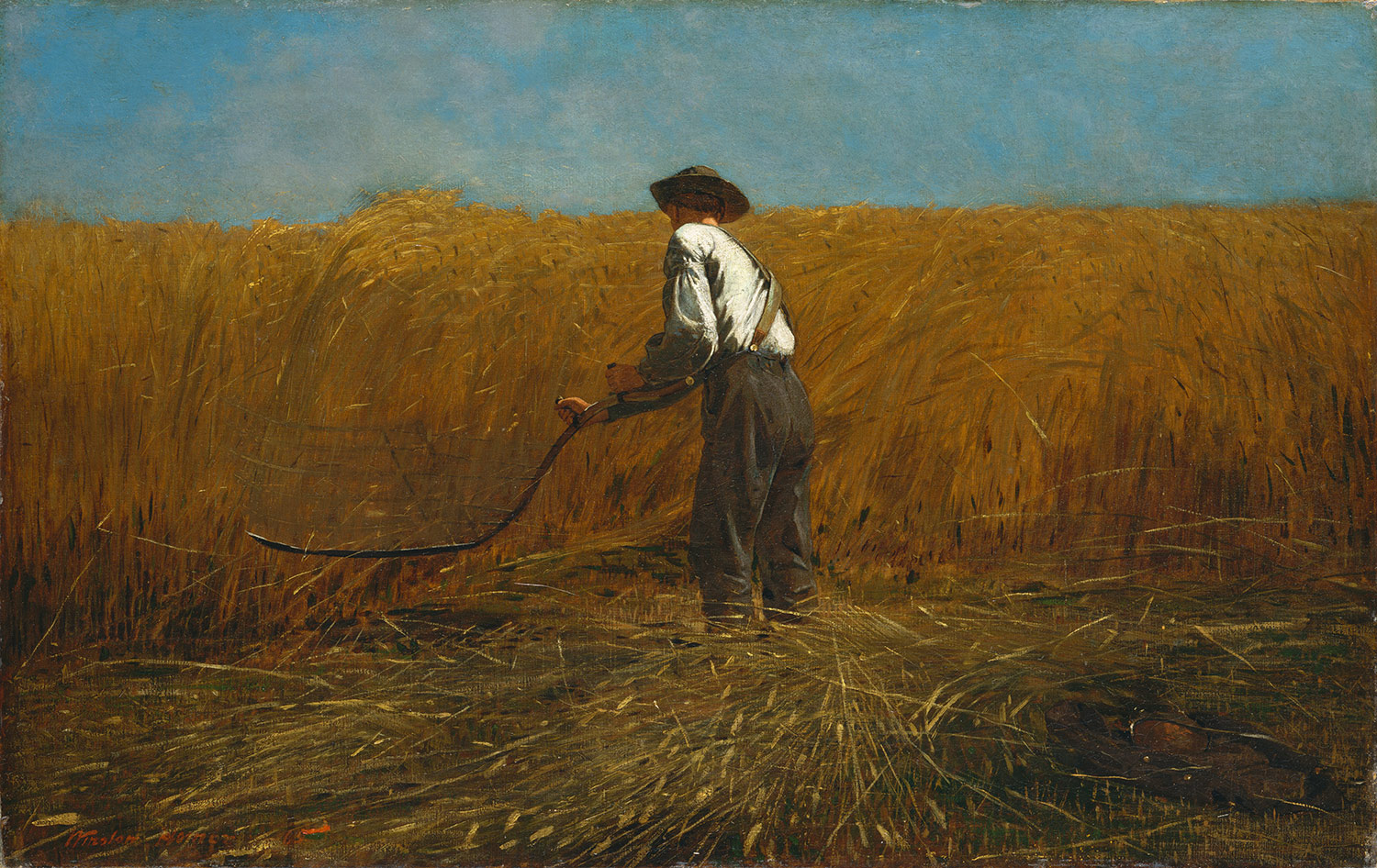
The Veteran in a New Field -- Winslow Homer (1865)


WSJ

Were I to be appointed Secretary of Education, I'd issue a prospectus for a compulsory nation-wide high-school course called "The American Experience in Art." Every student who took this year-long course would be required to read, view and listen to the following American masterpieces while simultaneously studying the aspects of U.S. history that they illustrate and illuminate:
• Two full-length novels, Willa Cather's "O Pioneers!" and Robert Penn Warren's "All the King's Men";
• One short novel, F. Scott Fitzgerald's "The Great Gatsby";
• Two plays, Thornton Wilder's "Our Town" and Tennessee Williams's "The Glass Menagerie";
• A selection of poems by Emily Dickinson, Robert Frost and Langston Hughes;
• One group of paintings, Jacob Lawrence's "Migration Series," studied in conjunction with a selection of recordings by Louis Armstrong and Duke Ellington;
• One dance, Martha Graham's "Appalachian Spring" (music by Aaron Copland);
• One musical, Leonard Bernstein's "West Side Story" (choreography by Jerome Robbins, lyrics by Stephen Sondheim);
• Three films, John Ford's "The Searchers," Orson Welles's "Citizen Kane" (music by Bernard Herrmann) and William Wyler's "The Best Years of Our Lives."
The main objective of this class would be to expose American students to a widely varied assortment of American masterpieces, none of them contemporary and none of which they would nowadays be likely to encounter outside of school. (Yes, even "Citizen Kane.") But what makes "The American Experience in Art" even more valuable is that it situates these masterpieces in the larger context of U.S. history.
You don't have to know anything about the Shakers to appreciate Mr. Copland's score for "Appalachian Spring" any more than you have to know who William Randolph Hearst was to understand "Citizen Kane." But one of the most effective ways to bring great art alive to those for whom it is terra incognita is to explain how it relates to the world they know. If I wanted to open a student's ears to prewar jazz, I'd start by talking about how Louis Armstrong, like hundreds of thousands of African-Americans, migrated from the Deep South to one of the major Northern cities between the world wars—and I'd play his 1928 record of "West End Blues" after first having used the "Migration Series" paintings to dramatize what it meant for a black sharecropper to turn his back on the past and move to Chicago or Los Angeles or New York.
That's the point of my course. It uses art to illuminate history—and vice versa. How better to hammer home the realities of war than to watch "The Best Years of Our Lives," one of whose characters is played by an actual World War II veteran whose hands were blown off? Or to explore the grubby intricacies of politics by reading "All the King's Men," with its fictionalized portrait of Huey Long?
None of the works on this list are fearsomely complex or intrinsically controversial. All should be familiar to every culturally literate American. All are well within the reach of ordinary high-school students. All could be adequately discussed in a well-written textbook. All could be studied in a year's time. Any takers?

Sounds like a great course. I balk at the "compulsory" and "nation-wide" aspects though.  And who's going to teach it? In most school districts it would probably be the baseball coach. (How much improved would American education be if you had to get at least 1200 on your SATs in order to be licensed as a high school teacher?)

I might substitute the paintings of Winslow Homer for the Migration Series. And nothing against Louis Armstrong, but I prefer Ella Fitzgerald. And they should read Ernest Hemingway's short stories (especially In Our Time). I can't complain about the film selections, or the musical. I appreciate his leaving out Walt Whitman.

By the way, if you aren't familiar with these works, it won't be too difficult to become familiar with them. At least now you have the list to work from. Or, you could continue plodding along in your cultural ignorance, a choice that seems both boorish and unpatriotic.


The Fox Hunt -- Winslow Homer (1893)


Wednesday, October 9, 2013

Does reading literature increase empathy?


Young Man Reading by Candlelight -- Matthias Stom (c. 1600-1650)


Here's a report on a series of studies that purport to show that reading a few minutes of "literary fiction" improves scores on a test of emotional empathy ("Reading the Mind in the Eyes"), compared to reading non-fiction. Reading popular fiction did nothing to improve scores over those of non-reading controls.


New York Times
People ranging in age from 18 to 75 were recruited for each of five experiments. They were paid $2 or $3 each to read for a few minutes. Some were given excerpts from award-winning literary fiction (Don DeLillo, Wendell Berry). Others were given best sellers like Gillian Flynn’s “Gone Girl,” a Rosamunde Pilcher romance or a Robert Heinlein science fiction tale.
In one experiment, some participants were given nonfiction excerpts, but we’re not talking “All the President’s Men.” To maximize the contrast, the researchers — looking for nonfiction that was well-written, but not literary or about people — turned to Smithsonian Magazine. “How the Potato Changed the World” was one selection. “Bamboo Steps Up” was another.
After reading — or in some cases reading nothing — the participants took computerized tests that measure people’s ability to decode emotions or predict a person’s expectations or beliefs in a particular scenario. In one test, called “Reading the Mind in the Eyes,” subjects did just that: they studied 36 photographs of pairs of eyes and chose which of four adjectives best described the emotion each showed.
Is the woman with the smoky eyes aghast or doubtful? Is the man whose gaze has slivered to a squint suspicious or indecisive? Is she interested or irritated, flirtatious or hostile? Is he fantasizing or guilty, dominant or horrified? Or annoyed that his tech stock dropped half a percent on the Nasdaq in a round of late trading after news from the Middle East? (Just kidding — that last one isn’t on the test.)
The idea that what we read might influence our social and emotional skills is not new. Previous studies have correlated various types of reading with empathy and sensitivity. More recently, in a field called “theory of mind,” scientists have used emotional intelligence perception tests to study, for example, children with autism.
But psychologists and other experts said the new study was powerful because it suggested a direct effect — quantifiable by measuring how many right and wrong answers people got on the tests — from reading literature for only a few minutes.
“It’s a really important result,” said Nicholas Humphrey, an evolutionary psychologist who has written extensively about human intelligence, and who was not involved in the research. “That they would have subjects read for three to five minutes and that they would get these results is astonishing.”
Dr. Humphrey, an emeritus professor at Cambridge University’s Darwin College, said he would have expected that reading generally would make people more empathetic and understanding. “But to separate off literary fiction, and to demonstrate that it has different effects from the other forms of reading, is remarkable,” he said.

Caveat: When your results are "astonishing" and "remarkable," be prepared for when they do not replicate. It would be interesting to see a study of college students enrolled in a literature course (to see if their scores improve from Time 1 to Time 2) and also their roommates not taking a literature course that semester. I would also like to see a study of the reading habits of graduate students in clinical psychology who are rated as excellent psychotherapists by their supervisors versus those rated as average.

Vocabulary skill is a potential moderator of Reading the Mind in the Eyes scores, but I doubt that reading for just a few minutes affected vocabulary enough to account for the effect -- unless reading passages with more emotional/interpersonal vocabulary temporarily activated those cognitive networks, thus making those vocabulary words more accessible during the test.

As I have suggested before, I would rather engage in psychotherapy with a therapist who reads Dostoevsky and Melville than with one who reads books about the brain. It would be lovely if a case could be built that shows that the reading of literature can make you a better (e.g., more empathetic) person.


Man Reading -- John Singer Sargent (1910)


Tuesday, August 6, 2013

Alfred Munnings, Painter


Here is a nice little piece on Alfred Munnings (1878-1959), who until recently had been written off as a mere painter of horses, but was actually nearly as great as John Singer Sargent.

"In 1899, the year his first painting was accepted in a Royal Academy exhibition, the 20-year old artist was blinded in the right eye by a thorny branch while rescuing a puppy. Yet the skillful perspective of his work shows no trace of his monocular vision, nor visible anywhere is the crippling effect of gout in his hands, which tormented him, especially later in life.


In 1912 he married Florence Carter-Wood who, in one of the most bizarre acts of a newlywed, attempted suicide on their honeymoon. (She succeeded two years later, swallowing cyanide.) The exhibition includes two equestrian portraits of Florence. In the first, "The Morning Ride: Florence Munnings on Horseback" (1913), she's on a sprightly gray horse, her red hacking jacket enlivening the edge of the dappled woods through which she rides. In the second, "Portrait of an Equestrienne: Florence Munnings on the Grey Mare" (1914), painted just months before her death, she's dressed in black, the atmosphere is darker, and horse and rider are set against a leaden sky...


...At the outbreak of World War I, he repeatedly volunteered for service, but was rejected because of his blind eye. Eventually, he was posted to a Canadian Cavalry Brigade as a war artist in France. There, close to the German front in 1918, he painted in a single day an equestrian portrait of the unit's commander, Maj. Gen. Jack Seely, astride his charger, Warrior. It is one of the highlights of the exhibition. Dashed down in just browns and greys, it conveys not only the grim determination of horse and rider but also the cold bleakness of the shell-mutilated landscape of the Western front."


File:AlfredMunnings by HaroldKnight.jpg
 
Alfred Munnings reading aloud outside on the grass, circa 1911, by Harold Knight


Saturday, March 30, 2013

Vincent Van Gogh

Born March 30, 1853.


Van Gogh has always been an fascinating case study for psychiatrists and others. Historical psychiatric detective work is always an interesting diversion.

I have always been partial to Kay Redfield Jamison's argument for a manic-depressive illness diagnosis for Van Gogh.  This letter to the editor by Kay Redfield Jamison ("Vincent Van Gogh's illness") is well worth reading as an example of sound diagnostic reasoning (which happens to take base rates into account). She rips apart another diagnostician's conclusion that Van Gogh suffered from acute intermittent porphyria and makes a solid case for manic-depression. This special edition of Scientific American has a good article by Jamison on manic-depressive illness and creativity (starting on page 44).


In 2002, the American Journal of Psychiatry published a case study by Dietrich Blumer that argues for a form of epilepsy (combined with a bipolar illness). Here's the abstract:

"Vincent van Gogh (1853–1890) had an eccentric personality and unstable moods, suffered from recurrent psychotic episodes during the last 2 years of his extraordinary life, and committed suicide at the age of 37. Despite limited evidence, well over 150 physicians have ventured a perplexing variety of diagnoses of his illness. Henri Gastaut, in a study of the artist’s life and medical history published in 1956, identified van Gogh’s major illness during the last 2 years of his life as temporal lobe epilepsy precipitated by the use of absinthe in the presence of an early limbic lesion. In essence, Gastaut confirmed the diagnosis originally made by the French physicians who had treated van Gogh. However, van Gogh had earlier suffered two distinct episodes of reactive depression, and there are clearly bipolar aspects to his history. Both episodes of depression were followed by sustained periods of increasingly high energy and enthusiasm, first as an evangelist and then as an artist. The highlights of van Gogh’s life and letters are reviewed and discussed in an effort toward better understanding of the complexity of his illness."Abstract Teaser


Here's a portrait by Van Gogh of one of his psychiatrists, completed while in the asylum at Saint-Remy.
 
 
Portrait of Doctor Gachet
 
Letters by Van Gogh suggest some ambivalence about the good doctor:

"I think that we must not count on Dr. Gachet at all. First of all, he is sicker than I am, I think, or shall we say just as much, so that's that. Now when one blind man leads another blind man, don't they both fall into the ditch?"

In a letter dated two days, he wrote, "I have found a true friend in Dr. Gachet, something like another brother, so much do we resemble each other physically and also mentally."


Finally, last summer 60 Minutes aired an interesting segment that suggests that Van Gogh was a victim of a firearm accident, not suicide. You can view it here.


Sunday, March 24, 2013

Jerusalem

And did those feet in ancient time
Walk upon England’s mountains green?
And was the holy Lamb of God
On England’s pleasant pastures seen?
And did the Countenance Divine
Shine forth upon our clouded hills?
And was Jerusalem builded here
Among these dark Satanic Mills?
Bring me my bow of burning gold!
Bring me my arrows of desire!
Bring me my spear! O clouds, unfold!
Bring me my chariot of fire!
I will not cease from mental fight,
Nor shall my sword sleep in my hand,
Till we have built Jerusalem
In England’s green and pleasant land.


-- William Blake (1810)


Here is the poem as hymn: