Showing posts with label intelligence. Show all posts

Tuesday, February 7, 2017

Intelligence, Self-Control, and Success

IQ below 100 and you have poor impulse control? Good luck achieving material success in modern society. I agree with Dr, Boutwell that our "cognitive elites" should become more aware that their achievements are merely the consequence of having won a genetic lottery.


Quillette, Brian Boutwell
"Though often maligned by commentators, general intelligence (or IQ) is a trait that psychologists have studied for the better part of a century. Our understanding of it rocketed forward when Charles Spearman proposed his general theory of intelligence, which was remarkably simple. Linda Gottfredson, in fact, best summed it up when she noted:
Intelligence is a very general mental capability that, among other things, involves the ability to reason, plan, solve problems, think abstractly, comprehend complex ideas, learn quickly, and learn from experience. It is not merely book-learning, a narrow academic skill, or test-taking smarts. Rather, it reflects a broader and deeper capability for comprehending our surroundings, ‘catching on’, ‘making sense’ of things, or ‘figuring out’ what to do.
Yes, intelligence is a controversial topic. But it has also been closely scrutinized for decades now, and the results are quite impressive. Stuart Ritchie detailed many of them in a brisk, very accessible book recently. As he noted, intelligence is not some vague social construct that we (academics) conjured up. Intelligence is a trait that emerges very early in life and is linked directly to brain functioning. We measure it very well, and it predicts important life outcomes. In particular, as intelligence increases, occupational success goes up, income earned goes up, educational attainment goes up, odds of getting arrested go down, violent behavior goes down, and life expectancy increases.
We can move now to our second trait; self-control. Behavioral researchers actually use different names sometimes when studying this trait — executive functioning or gratification delay — but for the most part these denote an ability to manage impulses and to delay getting what you want right now in favor of getting a better version of it down the road. Saving for retirement, saving money period, going to college, showing up consistently to your job, all of these are indicative of having low levels of impulsivity (high self-control).
Like intelligence, we have a wealth of good research regarding self-control. People with high impulsivity are more likely to break the law, get arrested, use drugs, have poor health, and be obese. A rather incredible study, published by the psychologist Terrie Moffitt and her team, examined the effects of self-control across decades of life. Individuals with higher self-control were simply better off in the long run. They made more money and were generally healthier and more productive citizenry as adults. But what makes all of this so relevant to the current discussion is that self-control and intelligence are highly correlated. The two traits — both linked to brain functioning — often come packaged together."


Tuesday, January 17, 2017

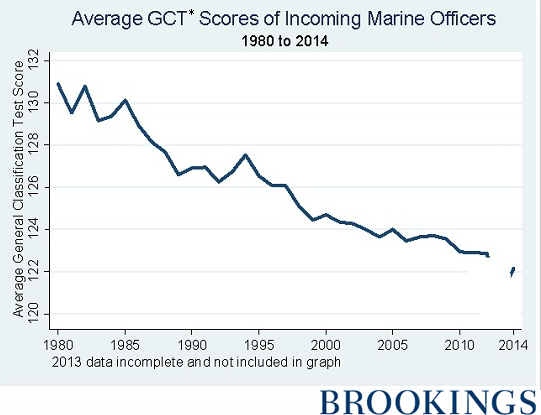
Declining Quality of U.S. Marine Corps Officers, 1980-2014


The GCT has a mean of 100 and a standard deviation of 20. A score of 120 is roughly equivalent to an IQ of 115.

I wonder what the IQ scores of the Chinese officer class look like? 


"Through a Freedom of Information Act (FOIA) request to the Marine Corps, Klein and Cancian received data on the GCT scores of all officers—46,000 altogether—from Fiscal Year 1980 to Fiscal Year 2014.
After analyzing the data, the authors uncovered a startling trend: A statistically significant decline in scores over the past 34 years, the magnitude of which, the authors say, “is relevant given the distribution of the scores.” 
Other key findings include:
  1. Eighty-five percent of those taking the test in 1980 exceeded a score of 120, which was the cut-off score for officers in World War II. In 2014, only 59 percent exceeded that score.
  2. At the upper end of the distribution, 4.9 percent of those taking the test scored above 150 in 1980 compared to 0.7 percent in 2014.
  3. Over 34 years, the average score decreased by 6.6 percent, from 130.9 to 122.1.
  4. Taken together, the 8.2-point drop in average score represents 80 percent of an entire standard deviation’s decline (from 10.5 in 1980 to 9.6 in 2014). In other words, today’s Marine officers scored nearly an entire standard deviation worse, on average, than their predecessors 34 years ago.Klein and Cancian stress the importance of acknowledging and reversing the decline in officer quality as measured by the GCT score not just for the short-term impacts it has. The junior officers of today will become the generals of tomorrow; if the military does not receive the intelligent young leaders today that it used to receive in the past, it will not have high quality generals in the future.
What has been the impact of this drop in quality on the effectiveness of the military? Answering this question is beyond the scope of this paper. Given the myriad studies associating performance with intellect, however, it is hard to imagine anything other than a seriously deleterious impact on the quality of officers and, by extension, on the quality and efficacy of the military,” say the authors.


Monday, January 16, 2017

Declining IQ scores due to natural selection, says Icelandic study


Image result for declining iq scores
Source: zerohedge.com


"A study from Iceland is the latest to raise the prospect of a downwards spiral into imbecility. The research from deCODE, a genetics firm in Reykjavik, finds that groups of genes that predispose people to spend more years in education became a little rarer in the country from 1910 to 1975.
The scientists used a database of more than 100,000 Icelanders to see how dozens of gene variants that affect educational attainment appeared in the population over time. They found a shallow decline over the 65 year period, implying a downturn in the natural inclination to rack up [academic] qualifications.
But the genes involved in education affected fertility too. Those who carried more “education genes” tended to have fewer children than others. This led the scientists to propose that the genes had become rarer in the population because, for all their qualifications, better educated people had contributed less than others to the Icelandic gene pool.
Spending longer in education and the career opportunities that provides is not the sole reason that better educated people tend to start families later and have fewer children, the study suggests. Many people who carried lots of genes for prolonged education left the system early and yet still had fewer children that the others. “It isn’t the case that education, or the career opportunities it provides, prevents you from having more children,” said Kari Stefansson, who led the study. “If you are genetically predisposed to have a lot of education, you are also predisposed to have fewer children.”
...
Robert Plomin, a behavioural geneticist at King’s College London said that the paper was a demonstration of how polygenic scores – which measure a person’s genetic strengths and weaknesses – are at the frontline of the DNA revolution. “They have already changed science and will soon affect the clinic and society,” he said.
“Although the effect of the polygenic score for educational attainment on fertility is weak and needs replication in populations other than Iceland, this study is a harbinger for the new directions in research that will be possible as bigger and better polygenic scores come online,” Plomin added."


Tuesday, January 3, 2017

The Breeder's Equation, regression to the mean, and eugenics


R = h2 S

Annual Edge Question, Gregory Cochran
"R is the response to selection, S is the selection differential, and h2 is the narrow-sense heritability. This is the workhorse equation for quantitative genetics. The selective differential S, is the difference between the population average and the average of the parental population (some subset of the total population). Almost everything is moderately to highly heritable, from height and weight to psychological traits.
Consider IQ. Imagine a set of parents with IQs of 120, drawn from a population with an average IQ of 100. Suppose that the narrow-sense heritability of IQ (in that population, in that environment) is 0.5. The average IQ of their children will be 110. That’s what is usually called regression to the mean.
Do the same thing with a population whose average IQ is 85. We again choose parents with IQs of 120, and the narrow-sense heritability is still 0.5. The average IQ of their children will be 102.5—they regress to a lower mean.
You can think of it this way. In the first case, the parents have 20 extra IQ points. On average, 50% of those points are due to additive genetic factors, while the other 50% is the product of good environmental luck. By the way, when we say ‘environmental”, we mean “something other than additive genetics”. It doesn’t look as if the usual suspects—the way in which you raise your kids, or the school they attend—contribute much to this ‘environmental’ variance, at least for adult IQ. We know what it’s not, but not much about what it is, although it must include factors like test error and being hit on the head with a ball-peen hammer.
The kids get the good additive genes, but have average ‘environmental’ luck—so their average IQ is 110. The luck (10 pts worth) goes away
The 120-IQ parents drawn from the IQ-85 population have 35 extra IQ points, half from good additive genes and half from good environmental luck. But in the next generation, the luck goes away… so they drop 17.5 points.
The next point is that the luck only goes away once. If you took those kids from the first group, with average IQs of 110, and dropped them on a friendly uninhabited island, they would eventually get around to mating —and the next generation would also have an IQ of 110. With tougher selection, say by kidnapping a year’s worth of National Merit Finalists, you could create a new ethny with far higher average intelligence than any existing. Eugenics is not only possible, it’s trivial."


Wednesday, December 28, 2016

The Flynn Effect is Reversing in the West


Original research study is here


James Thompson (read his entire blog post)

These results are from a study of experts in intelligence in general, and on the Flynn Effect in particular. The expert consensus is that the Flynn effect (rising IQ scores throughout the 20th century) was the result of improved general health and mass education, but is now petering out or reversing in the West. The experts expect East Asia, India, and African to see continued gains over the next several decades. The USA, however, will see a significant downward shift, due mostly to 1) migration from lower IQ countries, and 2) lower IQ people having more children than higher IQ people. It is of course interesting that the experts also cited "decline in educational values" and "worse education and school-systems."

With regard to the increase, recognize that "improved general health" means that fewer people were exposed to hunger, lead exposure, etc. Mass education doesn't necessarily boost intelligence, but it does make one more familiar with abstractions, e.g., "How are a tiger and a horse alike?" It is important that the Flynn Effect was always observed to be stronger for Fluid, rather than Crystallized Intelligence (i.e., the sort of knowledge that one might, ideally, obtain at school). Schooling also makes one less reluctant to guess on IQ tests (which is not penalized). Schooling also makes IQ testing less of a novel experience, which it was originally intended to be.


US Census data supports the lower fertility of the more educated. In 2014, these were the Childlessness Rates for Women aged 40 to 50, by educational attainment:


No High School Diploma     9.9%

High School Diploma           15%

Some College                       13.9%

Bachelor's Degree                 18.2%

Graduate/Prof'l Degree         22.5%


Thought experiment: Imagine the United States fifty years from now (2066) with these numbers, and then imagine it with the numbers reversed (i.e., 22.5% childlessness for non-high school grads and 9.9% childlessness for graduate degree holders).


Wednesday, September 21, 2016

"Education is the last backwater of anti-genetic thinking" -- Robert Plomin


Image result for public education
"Yes, I have a question. Why I am the same classroom as my genetic inferiors?"


Marty Nemko, Psychology Today
"Robert Plomin is ranked among the most influential living psychologists (link is external). He has received lifetime achievement awards from the Behavior Genetics Association, American Psychological Society, and the International Society for Intelligence Research.
In Plomin's recent The Edge interview, (link is external)he reports that his lab at King's College, London has already identified a gene cluster that:
"explains almost 10 percent of the variance in tests of school performance. Those scores are about 60 percent heritable... Explaining 10 percent of the variance in the social and behavioral sciences is pretty good going…If you don't believe in genetics, you're going to have to argue with DNA. You can't just say, 'The twin study is no good,' or 'the adoption study is no good.' DNA is real…
For the first time, it will allow us to make genetic predictions for an individual…It's the difference between getting into university or not... 
It's better to make policy based on knowledge than on fiction. A lot of what I see in education is fiction…Education is the last backwater of anti-genetic thinking... I want to get people in education talking about genetics because the evidence for genetic influence is overwhelming. The things that interest them—learning abilities, cognitive abilities, behavior problems in childhood—are the most heritable things in the behavioral domain. Yet it's like Alice in Wonderland. You go to educational conferences and it's as if genetics does not exist."
It's understandable that educators put their fingers in their ears and sing "la-la-la-la" to drown out the word genetics. It can make teachers feel impotent. Of course, that’s not true, any more than a car’s performance can’t be improved by tuning it up. In nearly all traits in all of the animal and plant kingdoms, both genes and environment matter. [Environment does matter, of course, but mostly with regard to reducing intelligence, not increasing it.]
In fact, teachers might benefit from realizing that they don't deserve to be the whipping boy for American students floundering near the bottom of developed nations in international comparisons (link is external). Teachers are dispirited—and quitting. According to a National Education Association study, almost half of teachers quit within the first five years of teaching (link is external). Of course, there are many factors but it certainly can't help for teachers to feel they're the Bad Guys."


Tuesday, September 13, 2016

Study of Mathematically Precocious Youth (SMPY)

Image result for SMPY
We need to find these kids early (age 13) and accelerate and intensify their schooling. As the article suggests, we should attend as closely to academic talent as we do athletic talent. Interesting point about spatial ability, too -- no mention of sex differences, though, which might be one reason those tests are not used.


Nature
"In March 1972, [psychologist Julian] Stanley rounded up 450 bright 12- to 14-year-olds from the Baltimore area and gave them the mathematics portion of the SAT. It was the first standardized academic 'talent search'. (Later, researchers included the verbal portion and other assessments.)
“The first big surprise was how many adolescents could figure out math problems that they hadn't encountered in their course work,” says developmental psychologist Daniel Keating, then a PhD student at Johns Hopkins University. “The second surprise was how many of these young kids scored well above the admissions cut-off for many elite universities.”
Stanley hadn't envisioned SMPY as a multi-decade longitudinal study. But after the first follow-up survey, five years later, Benbow proposed extending the study to track subjects through their lives, adding cohorts and including assessments of interests, preferences, and occupational and other life accomplishments. The study's first four cohorts range from the top 3% to the top 0.01% in their SAT scores. The SMPY team added a fifth cohort of the leading mathematics and science graduate students in 1992 to test the generalizability of the talent-search model for identifying scientific potential.
“I don't know of any other study in the world that has given us such a comprehensive look at exactly how and why STEM talent develops,” says Christoph Perleth, a psychologist at the University of Rostock in Germany who studies intelligence and talent development.
Spatial skills 
As the data flowed in, it quickly became apparent that a one-size-fits-all approach to gifted education, and education in general, was inadequate.
“SMPY gave us the first large-sample basis for the field to move away from general intelligence toward assessments of specific cognitive abilities, interests and other factors,” says Rena Subotnik, who directs the Center for Gifted Education Policy at the American Psychological Association in Washington DC.
In 1976, Stanley started to test his second cohort (a sample of 563 13-year-olds who scored in the top 0.5% on the SAT) on spatial ability — the capacity to understand and remember spatial relationships between objects5. Tests for spatial ability might include matching objects that are seen from different perspectives, determining which cross-section will result when an object is cut in certain ways, or estimating water levels on tilted bottles of various shapes. Stanley was curious about whether spatial ability might better predict educational and occupational outcomes than could measures of quantitative and verbal reasoning on their own.
Follow-up surveys — at ages 18, 23, 33 and 48 — backed up his hunch. A 2013 analysis5 found a correlation between the number of patents and peer-refereed publications that people had produced and their earlier scores on SATs and spatial-ability tests. The SAT tests jointly accounted for about 11% of the variance; spatial ability accounted for an additional 7.6%.
The findings, which dovetail with those of other recent studies, suggest that spatial ability plays a major part in creativity and technical innovation. “I think it may be the largest known untapped source of human potential,” says Lubinski, who adds that students who are only marginally impressive in mathematics or verbal ability but high in spatial ability often make exceptional engineers, architects and surgeons. “And yet, no admissions directors I know of are looking at this, and it's generally overlooked in school-based assessments.”"


Thursday, September 8, 2016

What is intelligence and why is it important?

Image result for general intelligence and life outcomes


Plomin & Deary (2015)
"Although there are many types of cognitive ability tests of individual differences, they almost all correlate substantially and positively; people with higher ability on one cognitive task tend to have higher ability on all of the others. Intelligence (more precisely, general cognitive ability or g, as discovered and defined by Spearman in 190417) indexes this covariance, which accounts for about 40 per cent of the total variance when a battery of diverse cognitive tests is administered to a sample with a good range of cognitive ability.18,19 As long as a battery of cognitive tests is diverse and reliable, a general ‘factor’ (often represented by the first unrotated principal component, which is not strictly a factor, but that is the terminology that is often used) indexing intelligence differences will emerge and correlate highly with such factors derived from other batteries using wholly different cognitive tests.20 The general intelligence component (factor) is a universally found statistical regularity, which means that some have tried to provide an epithet for what it might capture. According to one view, the core of this general intelligence factor is ‘the ability to reason, plan, solve problems, think abstractly, comprehend complex ideas, learn quickly, and learn from experience’ (Gottfredson et al.21 p.13; see also Deary22). Intelligence is at the pinnacle of the hierarchical model of cognitive abilities that includes a middle level of group factors, such as the cognitive domains of verbal and spatial abilities and memory, and a third level of specific tests and their associated narrow cognitive skills.18,23
Intelligence is important scientifically and socially. Because intelligence represents individual differences in brain processes working in concert to solve problems, it is central to systems approaches to brain structure and function,24, 25, 26 and to the conceptualisation of how diverse cognitive abilities decline with age.27 It is also one of the most stable behavioural traits, yielding a correlation of 0.63 in a study of people tested at age 11 and then again at age 79.28 Socially, intelligence is one of the best predictors of key outcomes such as education and occupational status.29 People with higher intelligence tend to have better mental and physical health and fewer illnesses throughout the life course, and longer lives.22,30
...It would be reasonable to assume that as we go through life, experiences—Shakespeare’s ‘whips and scorns of time’—have a cumulative effect on intelligence, perhaps overwhelming early genetic predispositions. However, for intelligence, heritability increases linearly, from (approximately) 20% in infancy to 40% in adolescence, and to 60% in adulthood. Some evidence suggests that heritability might increase to as much as 80% in later adulthood47 but then decline to about 60% after age 80.48"


Thursday, November 27, 2014

RIP: John T. Downey, former prisoner of the Red Chinese


Washington Post

"HARTFORD, Conn. — John T. Downey, a former CIA agent who survived more than 20 years in Chinese prisons during the Cold War before becoming a Connecticut judge, died Monday. He was 84.
Downey was diagnosed with cancer a month ago and died at a hospice facility in Branford, according to his son, Jack Downey, of Philadelphia.
The elder Downey had graduated from Yale University and joined the Central Intelligence Agency a year before his plane was shot down during a botched cloak-and-dagger flight into China in November 1952. He spent the next 20 years, three months and 14 days in Chinese prisons. He was released in March 1973 shortly after President Richard Nixon publicly acknowledged Downey’s CIA connection.
After returning to the United States, he graduated from Harvard Law School and was appointed to the Connecticut bench in 1987.
 ...
Downey and Fecteau [his fellow intelligence officer] were hauled off to prison, interrogated and isolated in separate cells. Each spent long stretches in solitary confinement.
After their release, Fecteau said they would visit occasionally during Downey’s time in law school and split a pint of ice cream, because neither of them drank. He said he admired his friend’s mental strength during their time in captivity. 
He never weakened. He never felt sorry for himself,” Fecteau, 87, said Monday. “What happened happened and he lived with it as best he could, and I liked that.”"


Great story. Hey, Washington Post! He was a United States Intelligence Officer, not a "CIA agent." The guy he was going to pick up was an "agent" [i.e., a foreign national working clandestinely for the U.S.]. I will settle for "CIA officer." Decades of imprisonment in China, by the way, is what happened to Paul Christopher in the excellent spy novels by Charles McCarry. Christopher also handled it with aplomb.


Thursday, October 10, 2013

Average is Over: Morlocks and Eloi

From Michael Barone's review of Tyler Cowan's near-futurist Average is Over. Cowan is the author of the blog, Marginal Revolution.

The big winners in the economy he foresees will be those who can work with and harness machine intelligence and those who can manage and market such people.
Such "hyperproductive" people, about 15 percent of the population, will be wealthier than ever before. Also doing well will be those providing them personal services. [College professors and psychotherapists?]
For jobs lower down on the ladder, there will be a premium on conscientiousness. That's good for women and bad for men, who are more likely to do things their own way. [Meaning that men are more likely to have ADHD, alcoholism, and authority problems.]
Middle-level jobs, Cowen says, are on the way out. He argues that many of those laid off after the financial crisis were "zero marginal product" workers. They weren't producing anything of value and employers won't replace them.
Upward mobility will still be possible, he says, thanks to machine-aided education, which can spot talent in unlikely places. But I think he overestimates how likely that will be. [The SAT was created to spot talent in unlikely places, e.g. Nebraska farm kids.]
Assortative mating (people marrying similar people) and the considerable hereditability of intelligence means that many or most of those with the talents to get to the top will start out there. A fair society, ironically, may have less social mobility.

 
How will this society handle the pending fiscal shortfall? Cowen's prediction: by raising taxes a bit (but it's hard to get more out of rich, clever people), cutting Medicaid (the poor are a weak constituency) [I suppose that means Obamacare, too], maintaining aid to the elderly (a strong constituency) and squeezing employees (by imposing mandates on employers that will reduce cash income).
Those at the bottom will move to cheaper places like Texas. He recommends beans and tortillas as a delicious and nutritious diet (as in "An Economist Gets Lunch").
Much of this is already happening to some extent. Our most liberal areas (New York, the Bay Area) have the greatest income disparities. Drive down Middlefield Road in Silicon Valley and in one mile you go from $4 million walled mansions to what looks like rural Mexico.
Barone digresses a bit here, for no apparent purpose. He seems to agree with Cowan's predictions but wants to temper them with an insouciant "don't worry about the bottom 85% -- they might be desperately poor, but they'll be happy with their families and tortillas."
Brookings's William Galston, writing in the Wall Street Journal, feels "justified revulsion" at this. He accuses Cowen of "moral indifference." I would accuse him of focusing too narrowly on economics.
People get satisfaction out of more than just earning money. They get satisfaction out of what American Enterprise Institute president Arthur Brooks calls earned success.
Earned success can come from high earnings or from simply doing a job well. It can come from raising children and meeting family obligations.
It can come from working with people in your community or your church, or with others with common interests. Even people of very limited abilities can earn success and live fulfilling lives.
Cowen predicts the masses won't revolt. They will have comfortable lives and good entertainment -- bread and circuses.
I suspect he's right.

Source: Real Clear Politics


Thursday, October 3, 2013

Warning! Most People are of Average Intelligence!


The Atlantic

This Year's SAT Scores Are Out, and They're Grim

Fewer than half of the 2013 graduating seniors who took the test got "college-ready" scores.
  

Of the 1.66 million high school students in the class of 2013 who took the SAT, only 43 percent were academically prepared for college-level work, according to this year’s SAT Report on College & Career Readiness. For the fifth year in a row, fewer than half of SAT-takers received scores that qualified them as “college-ready.”
The College Board considers a score of 1550 to be the “College and Career Readiness Benchmark.” Students who meet the benchmark are more likely to enroll in a four-year college, more likely to earn a GPA of a B- or higher their freshman year, and more likely to complete their degree.

Wednesday, September 25, 2013

Alison Gopnik -- Genes and Intelligence

[image]

Wall Street Journal
We all notice that some people are smarter than others. You might naturally wonder how much these differences in intelligence depend on genes or upbringing. But that question, it turns out, is impossible to answer.
That's because changes in our environment can actually transform the relationship among our traits, our upbringing and our genes.
Okay, Genetic X Environmental interactions (genotype x environment = phenotype). But the amount of variance in a population that can be attributed to either genes or environment is not an "impossible" question. What she is avoiding saying right off the bat is that most of the variation in intelligence observed in people from middle-class (or better) backgrounds is attributable to genetic variation.


From Steve Hsu's blog
 
The textbook illustration of this is a dreadful disease called PKU. Some babies have a genetic mutation that makes them unable to process an amino acid in their food, and it leads to severe mental retardation. For centuries, PKU was incurable. Genetics determined whether someone suffered from the syndrome, which gave them a low IQ.
Then scientists discovered how PKU works. Now, we can immediately put babies with the mutation on a special diet. Whether a baby with PKU has a low IQ is now determined by the food they eat—by their environment.
We humans can figure out how our environment works and act to change it, as we did with PKU. So if you're trying to measure the relative influence of human nature and nurture, you have to consider not just the current environment but also all the possible environments that we can create.
Gotta love the PKU example. A great way to illustrate G x E interaction. However, it is one of the rarest causes of low intelligence (although, barring the dietary intervention, it will lead to mental retardation). Don't make the mistake of thinking that if you observe someone with low intelligence, they are a victim of PKU. The rate of babies born with PKU is about 1 in every 15,000 live births.

This doesn't just apply to obscure diseases. In the latest issue of Psychological Science, Timothy C. Bates of the University of Edinburgh and colleagues report a study of the relationship among genes, SES (socio-economic status, or how rich and educated you are) and IQ. They used statistics to analyze the differences between identical twins, who share all DNA, and fraternal twins, who share only some.
When psychologists first started studying twins, they found identical twins much more likely to have similar IQs than fraternal ones. They concluded that IQ was highly "heritable"—that is, due to genetic differences. But those were all high SES twins. Erik Turkheimer of the University of Virginia and his colleagues discovered that the picture was very different for poor, low-SES twins. For these children, there was very little difference between identical and fraternal twins: IQ was hardly heritable at all. Differences in the environment, like whether you lucked out with a good teacher, seemed to be much more important.

Identical twins are clones -- creepy, huh? 
In the new study, the Bates team found this was even true when those children grew up. IQ was much less heritable for people who had grown up poor. This might seem paradoxical: After all, your DNA stays the same no matter how you are raised. The explanation is that IQ is influenced by education. Historically, absolute IQ scores have risen substantially as we've changed our environment so that more people go to school longer.
I probably would have summarized this research differently. Among twins from decent backgrounds, there is a high heritability for intelligence. Among very poor twins, there is little to no heritability. The awfulness of their environment wipes out whatever chance there was for higher intelligence. This is not the same as saying that better schools yield higher IQ. It does suggest that the genes associated with higher intelligence cannot flourish in poor environments. We are talking about IQ being suppressed by an impoverished environment. [Another news report here, quoting Eric Turkheimer from UVa., but getting itself confused with "nature v. nuture".]

Richer children have similarly good educational opportunities, so genetic differences among them become more apparent. And since richer children have more educational choice, they (or their parents) can choose environments that accentuate and amplify their particular skills. A child who has genetic abilities that make her just slightly better at math may be more likely to take a math class, so she becomes even better at math.
But for poor children, haphazard differences in educational opportunity swamp genetic differences. Ending up in a terrible school or one a bit better can make a big difference. And poor children have fewer opportunities to tailor their education to their particular strengths.
How your genes shape your intelligence depends on whether you live in a world with no schooling at all, a world where you need good luck to get a good education or a world with rich educational possibilities. If we could change the world for the PKU babies, we can change it for the next generation of poor children, too.
Here's the kicker. What happens when we give everyone the same environment? Everyone gets a two-family home in which at least one parent is employed and both are non-drug using, non-criminal high school graduates. Everyone goes to schools of the same quality. We will still see variations in intelligence (that is, some people will still be smarter than others). But then 100% of the variation in intelligence will be attributable to genetic variations in the population. Control for environment and the only explanation left for observed differences is genetic.


Footnote:

A version of this article appeared September 21, 2013, on page C2 in the U.S. edition of The Wall Street Journal, with the headline: Good Genes Only Get You So Far With Intelligence. It was released online with a different, more accurate headline: Poverty Can Trump a Winning Hand of Genes.


Monday, September 23, 2013

Larry Summers and "the unfortunate truth"


I was a bit disappointed when Larry Summers withdrew his name from consideration to be the next head of the Federal Reserve. I was hoping that his nomination hearings would re-air the controversy over his statements he made while he was President of Harvard regarding why there aren't more women working in the upper levels of science and math.


Remarks at NBER Conference on Diversifying the Science & Engineering Workforce
Lawrence H. Summers
Cambridge, Mass.
January 14, 2005


"The second thing that I think one has to recognize is present is...why is the representation [of women] even lower and more problematic in science and engineering than it is in other fields....It does appear that on many, many different human attributes-height, weight, propensity for criminality, overall IQ, mathematical ability, scientific ability-there is relatively clear evidence that whatever the difference in means-which can be debated-there is a difference in the standard deviation, and variability of a male and a female population. And that is true with respect to attributes that are and are not plausibly, culturally determined. If one supposes, as I think is reasonable, that if one is talking about physicists at a top twenty-five research university, one is not talking about people who are two standard deviations above the mean. And perhaps it's not even talking about somebody who is three standard deviations above the mean. But it's talking about people who are three and a half, four standard deviations above the mean in the one in 5,000, one in 10,000 class. Even small differences in the standard deviation will translate into very large differences in the available pool substantially out. I did a very crude calculation, which I'm sure was wrong and certainly was unsubtle, twenty different ways. I looked at the Xie and Shauman paper-looked at the book, rather-looked at the evidence on the sex ratios in the top 5% of twelfth graders. If you look at those-they're all over the map, depends on which test, whether it's math, or science, and so forth-but 50% women, one woman for every two men, would be a high-end estimate from their estimates. From that, you can back out a difference in the implied standard deviations that works out to be about 20%. And from that, you can work out the difference out several standard deviations. If you do that calculation-and I have no reason to think that it couldn't be refined in a hundred ways-you get five to one, at the high end. Now, it's pointed out by one of the papers at this conference that these tests are not a very good measure and are not highly predictive with respect to people's ability to do that. And that's absolutely right. But I don't think that resolves the issue at all. Because if my reading of the data is right-it's something people can argue about-that there are some systematic differences in variability in different populations, then whatever the set of attributes are that are precisely defined to correlate with being an aeronautical engineer at MIT or being a chemist at Berkeley, those are probably different in their standard deviations as well. So my sense is that the unfortunate truth-I would far prefer to believe something else, because it would be easier to address what is surely a serious social problem if something else were true-is that the combination of the high-powered job hypothesis and the differing variances probably explains a fair amount of this problem."


"He said WHAT?"


Larry Summers lost his job over those remarks. Steven Pinker, an evolutionary psychologist at Harvard, offered a strong defense of Summers, in an article in the New Republic.
 
Summers's critics have repeatedly mangled his suggestion that innate differences might be one cause of gender disparities (a suggestion that he drew partly from a literature review in my book, The Blank Slate) into the claim that they must be the only cause. And they have converted his suggestion that the statistical distributions of men's and women's abilities are not identical to the claim that all men are talented and all women are not--as if someone heard that women typically live longer than men and concluded that every woman lives longer than every man. Just as depressing is an apparent unfamiliarity with the rationale behind political equality, as when Hopkins sarcastically remarked that, if Summers were right, Harvard should amend its admissions policy, presumably to accept fewer women. This is a classic confusion between the factual claim that men and women are not indistinguishable and the moral claim that we ought to judge people by their individual merits rather than the statistics of their group.
...
The psychologist Philip Tetlock has argued that the mentality of taboo--the belief that certain ideas are so dangerous that it is sinful even to think them--is not a quirk of Polynesian culture or religious superstition but is ingrained into our moral sense. In 2000, he reported asking university students their opinions of unpopular but defensible proposals, such as allowing people to buy and sell organs or auctioning adoption licenses to the highest-bidding parents. He found that most of his respondents did not even try to refute the proposals but expressed shock and outrage at having been asked to entertain them. They refused to consider positive arguments for the proposals and sought to cleanse themselves by volunteering for campaigns to oppose them.
 
 
Amanda Schaffer offers another view on the topic that is worth considering.


Monday, September 2, 2013

Grit - Angela Duckworth's TED talk

Here's the link to the video (transcript below).


"Grit" (which is really just a facet of the Big Five trait of Conscientiousness) is a very popular, feel-good notion. People like it as much as Malcolm Gladwell's popularization of the "10,000 hour" rule, because both ideas make it seem like IQ (or any other innate talent or ability) doesn't matter, as suggested in this graphic:


But think carefully about Duckworth's examples. "Grit" predicted success at West Point and in the National Spelling Bee, and among sales reps. In fact, "grit" was a better predictor than IQ in those populations. But the simple reason that IQ wasn't a better predictor of success in those population was restriction of range (everybody at West Point, Spelling Bee, etc. is already much smarter than the average person, and just about as smart as each other).

In no way should the predictive power of "grit" be used to assert that "IQ doesn't matter." That would be utter and complete nonsense. In fact, the overwhelming weight of the scientific evidence suggests that "nothing matters more than IQ" when it comes to life success. (Oh, and not becoming an alcoholic.)


Furthermore, there isn't much evidence that kids (or anyone else) can be taught or trained to increase their levels of "grit." There is some efficacy for temporarily boosting perseverance and diligence -- with ADHD medications. By the way, this is how ADHD meds got to be so widely prescribed -- parents have intuitively figured out that these drugs can help their low Conscientiousness children behave in ways that high Conscientiousness children do naturally.

The reason why people care about concepts like "grit" isn't that we really think that it is "more important than IQ" but that we have established that you can't raise people's IQs, so we are desperately looking for some trait that is associated with life success and that can be influenced by some kind of intervention.

As I said, with the exception of ADHD meds, and removing children from toxic or inept parents, good luck with that project. I won't be staying up nights breathlessly anticipating the results.


ANGELA LEE DUCKWORTH: When I was 27 years old, I left a very demanding job in management consulting for a job that was even more demanding: teaching. I went to teach seventh graders math in the New York City public schools. And like any teacher, I made quizzes and tests. I gave out homework assignments. When the work came back, I calculated grades.

What struck me was that I.Q. was not the only difference between my best and my worst students. Some of my strongest performers did not have stratospheric I.Q. scores. Some of my smartest kids weren't doing so well.

And that got me thinking. The kinds of things you need to learn in seventh grade math, sure, they're hard: ratios, decimals, the area of a parallelogram. But these concepts are not impossible, and I was firmly convinced that every one of my students could learn the material if they worked hard and long enough.

After several more years of teaching, I came to the conclusion that what we need in education is a much better understanding of students and learning from a motivational perspective, from a psychological perspective. In education, the one thing we know how to measure best is I.Q., but what if doing well in school and in life depends on much more than your ability to learn quickly and easily?

So I left the classroom, and I went to graduate school to become a psychologist. I started studying kids and adults in all kinds of super challenging settings, and in every study my question was, who is successful here and why? My research team and I went to West Point Military Academy. We tried to predict which cadets would stay in military training and which would drop out. We went to the National Spelling Bee and tried to predict which children would advance farthest in competition. We studied rookie teachers working in really tough neighborhoods, asking which teachers are still going to be here in teaching by the end of the school year, and of those, who will be the most effective at improving learning outcomes for their students? We partnered with private companies, asking, which of these salespeople is going to keep their jobs? And who's going to earn the most money? In all those very different contexts, one characteristic emerged as a significant predictor of success. And it wasn't social intelligence. It wasn't good looks, physical health, and it wasn't I.Q. It was grit.

Grit is passion and perseverance for very long-term goals. Grit is having stamina. Grit is sticking with your future, day in, day out, not just for the week, not just for the month, but for years, and working really hard to make that future a reality. Grit is living life like it's a marathon, not a sprint.

A few years ago, I started studying grit in the Chicago public schools. I asked thousands of high school juniors to take grit questionnaires, and then waited around more than a year to see who would graduate. Turns out that grittier kids were significantly more likely to graduate, even when I matched them on every characteristic I could measure, things like family income, standardized achievement test scores, even how safe kids felt when they were at school. So it's not just at West Point or the National Spelling Bee that grit matters. It's also in school, especially for kids at risk for dropping out. To me, the most shocking thing about grit is how little we know, how little science knows, about building it. Every day, parents and teachers ask me, "How do I build grit in kids? What do I do to teach kids a solid work ethic? How do I keep them motivated for the long run?" The honest answer is, I don't know. (Laughter) What I do know is that talent doesn't make you gritty. Our data show very clearly that there are many talented individuals who simply do not follow through on their commitments. In fact, in our data, grit is usually unrelated or even inversely related to measures of talent.

So far, the best idea I've heard about building grit in kids is something called "growth mindset." This is an idea developed at Stanford University by Carol Dweck, and it is the belief that the ability to learn is not fixed, that it can change with your effort. Dr. Dweck has shown that when kids read and learn about the brain and how it changes and grows in response to challenge, they're much more likely to persevere when they fail, because they don't believe that failure is a permanent condition.

So growth mindset is a great idea for building grit. But we need more. And that's where I'm going to end my remarks, because that's where we are. That's the work that stands before us. We need to take our best ideas, our strongest intuitions, and we need to test them. We need to measure whether we've been successful, and we have to be willing to fail, to be wrong, to start over again with lessons learned.

In other words, we need to be gritty about getting our kids grittier.

Thank you.


Wednesday, July 31, 2013

Steve Hsu's blog -- Information Processing

Is it tacky to repost something in its entirety from someone else's blog? Maybe.

But this item from Steve Hsu's blog is certainly worth reading and pondering, and is his older post on Gladwellism. Browse Dr. Hsu's blog for posts on IQ and you will learn a lot. If you prefer, watch him lecture here.


Wednesday, July 17, 2013


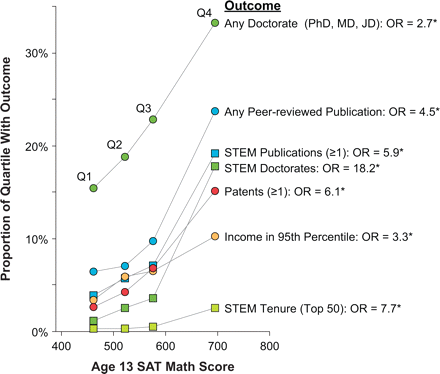
A new paper from David Lubinski and collaborators looks at spatial ability measured at age 13 to see whether it adds predictive power to (SAT) Math and Verbal ability scores. The blobs in the figure above (click for larger version) represent subgroups of individuals who have published peer reviewed work in STEM, Humanities or Biomedical research, or (separately) have been awarded a patent. Units in the figure are SDs within the SMPY population.
Creativity and Technical Innovation: Spatial Ability’s Unique Role
DOI: 10.1177/0956797613478615

In the late 1970s, 563 intellectually talented 13-year-olds (identified by the SAT as in the top 0.5% of ability) were assessed on spatial ability. More than 30 years later, the present study evaluated whether spatial ability provided incremental validity (beyond the SAT’s mathematical and verbal reasoning subtests) for differentially predicting which of these individuals had patents and three classes of refereed publications. A two-step discriminant-function analysis revealed that the SAT subtests jointly accounted for 10.8% of the variance among these outcomes (p < .01); when spatial ability was added, an additional 7.6% was accounted for—a statistically significant increase (p < .01). The findings indicate that spatial ability has a unique role in the development of creativity, beyond the roles played by the abilities traditionally measured in educational selection, counseling, and industrial-organizational psychology. Spatial ability plays a key and unique role in structuring many important psychological phenomena and should be examined more broadly across the applied and basic psychological sciences.
Note that SAT composite accounted for 10 percent of variance in research success even within this already gifted subpopulation. This non-zero result, despite the restriction of range, contradicts the Gladwellian claim that IQ above 120 does not provide additional returns. In fact, the higher the IQ score above the 99.5 percentile cutoff for this group, the greater the likelihood that an individual has been awarded a patent or has published a research paper.

Monday, July 1, 2013

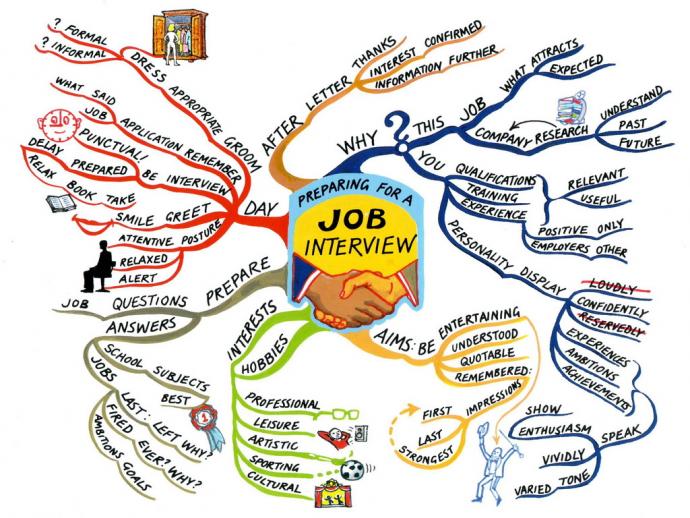
The Psychology of Job Interviews


From the New Yorker:

Imagine that you are the captain of a pirate ship. You’ve captured some booty, and you need to divide it among your crew. But first the crew will vote on your plan. If you have the support of fewer than half of them, you will die. How do you propose to divide the gold, so that you still have some for yourself—but live to tell the tale?
There is a correct answer: divide it among the top fifty-one per cent of the crew. If you knew that, you’ve passed what used to be one of Google’s infamous, mind-scrambling job-interview questions, which would have placed you one step closer to a career at the technology giant. (Google reportedly banned the practice a couple of years ago.) In a surprising June 19th interview with the New York Times, Laszlo Bock, Google’s senior V.P. of “people operations,” explained why: the company discovered these brainteasers are “a complete waste of time,” and “don’t predict anything” when it comes to job success. Google shouldn’t be shocked. A psychologist would have known at the outset that tests of this nature hardly ever work, and that there are much better predictors of who will get hired and how they will perform.
Researchers have always tried to use psychology for predictive ends: Can what we already know about a person tell us how she will behave in a given situation? The results of these endeavors have been mixed. While there is some evidence for links between certain personality traits and later outcomes, the correlations tend to be limited, and the predictions that can be made are broad at best. For instance, we can tell when a given person will generally succeed at academic pursuits, but not if she’ll excel in a particular seminar on ancient hieroglyphics.
Wait a minute -- first of all, those Google brain teasers are not "personality tests" but cognitive reasoning tests. Secondly, there is plenty of evidence (e.g., Schmidt & Hunter, 1998) that demonstrates the very strong predictive ability of intelligence tests and personality measurement (especially when used in combination). A test of General Mental Ability and a test of Conscientious predicts overall job performance across a wide range of jobs with a validity coefficient of 0.60. That's not quite as good as a GMA test and a Structured Interview (i.e., asking all the candidates the same questions and then rating their responses), which is 0.63, but it beats a GMA test and an unstructured interview (0.55). By the way, an unstructured interview alone, which is the way most hiring is done, predicts overall job performance at only 0.38 (which is still better than hiring at random).

The major problem with most attempts to predict a specific outcome, such as interviews, is decontextualization: the attempt takes place in a generalized environment, as opposed to the context in which a behavior or trait naturally occurs. Google’s brainteasers measure how good people are at quickly coming up with a clever, plausible-seeming solution to an abstract problem under pressure.
But employees don’t experience this particular type of pressure on the job. What the interviewee faces, instead, is the objective of a stressful, artificial interview setting: to make an impression that speaks to her qualifications in a limited time, within the narrow parameters set by the interviewer. What’s more, the candidate is asked to handle an abstracted “gotcha” situation, where thinking quickly is often more important than thinking well. Instead of determining how someone will perform on relevant tasks, the interviewer measures how the candidate will handle a brainteaser during an interview, and not much more.
Actually, the problem with Google's hiring procedure is called restriction of range. When everyone you are interviewing is super-smart, intelligence is not going to predict job performance. Think about it -- every one you hire is super-smart, and some of them will perform better than the others you hire. Even your relative failures are super-smart. So does that mean intelligence doesn't predict success at Google? Nonsense. If they want to, they could try hiring some people who couldn't crack 1200 on the SAT and see how well they do.

So those brain teasers didn't predict job performance at Google because everyone you are interviewing is super-smart already and some of them got your puzzles right (maybe because they think better on their feet, or maybe because they recognized the format of the puzzle) and some of them didn't. The reason they can dump the brainteasers from the interview is that they are already screening for high cognitive ability (B.S. degree in Electrical Engineering from Stanford? Come on in for an interview!).


College GPAs didn't predict performance either, but only because there's no much difference between a guy who earned a 3.7 GPA in Electrical Engineering at Stanford and a guy who earned a 3.3. Again, this is a problem called restriction of range, not a problem with selection tests.

Interviews in general pose a particular challenge when it comes to predictive validity—that is, the ability to determine someone’s future performance based on limited data. Not only are they relatively brief but also, over the past twenty years, psychologists have repeatedly found that few of a candidate’s responses matter. What is significant is the personal impression that the interviewer forms within the first minute (and sometimes less) of meeting the prospective hire. In one study, students were recorded as they took part in mock on-campus recruiting interviews that lasted from eight to thirty minutes.  
The interviewers evaluated them based on eleven factors, such as over-all employability, professional competency, and interpersonal skills. The experimenters then showed the first twenty or so seconds of each interview to untrained observers—the initial meet-and-greet, starting with the interviewee’s knock on the door and ending ten seconds after he was seated, before any questions—and asked them to rate the candidates on the same dimensions. What the researchers found was a high correlation between judgments made by the untrained eye in a matter of seconds and those made by trained interviewers after going through the whole process. On nine of the eleven factors, there was a resounding agreement between the two groups.
This phenomenon is broadly known as “thin-slice” judgment. As early as 1937, Gordon Allport, a pioneer of personality psychology, argued that we constantly form sweeping opinions of others based on incredibly limited information and exposure. Since then, multiple studies have shown the truth of that observation: first impressions are paramount. Once formed, they reliably color the rest of our impression formation. The exact same interview response given by two different candidates, one of whom the interviewer preferred, would be rated differently.
So the author is suggesting that we go on first impressions instead of interviewing? Ambady's research is really cool (even though most people think that Malcolm Gladwell did it) but I'm not sure it applies to selection methods. On the other hand, if a candidate meets with several members of your team (including the administrative assistants!) and somebody doesn't like him or her, for whatever reason, or even for no reason, then you will never regret giving that person a pass.

Bottom line: Don't trust your initial positive impressions (even psychopaths are charismatic!) but NEVER ignore a twinge of negative reaction that you just can't put into words. You, or someone else in the organization, sensed that there was something "off" about the candidate.

Given the failure of typical interviews to predict job performance consistently, what should companies do instead? Two things have been shown to make the interview process more successful. One is using a highly standardized interview process—for instance, asking each candidate the same questions in the same order. This produces a more objective measure of how each candidate fares, and it can reduce the influence of thin-slice judgment, which can alter the way each interview is conducted.
The other solution is to focus on relevant behavioral measures, both in the past and in the future. The ubiquitous interview question “Describe a situation where you did well on X or failed on Y” is an example of a past behavioral measure; asking a programmer to describe how she would solve a particular programming task would be a future measure. Google and many other tech companies may also ask some candidates to write code on the spot, a task that solves the problem of decontextualization by closely approximating what they would do on the job.
To Google’s credit, the company admitted its failure, and moved its interviews in a different direction. Finding the one right candidate in a group is hard, and companies don’t have much time to figure out exactly which questions can help them tell similar-seeming candidates apart. Or, to quote from another of the banned Google questions, “You have eight balls of the same size. Seven of them weigh the same, and one of them weighs slightly more. How can you find the ball that is heavier by using a balance and only two weighings?”
One thing that Google doesn't have to deal with as much as other organizations is selling the candidate on the job. The selection process has two goals -- determining which candidate is the best "fit" for the open position, and getting the candidate to want the job. A good reason to jettison the brainteaser questions would be that they annoy job candidates that you want to seduce. And, again, brainteasers are redundant because you have already screened for high cognitive ability with the c.v. (college and major).

A work sample might be a better applicant test for Google. Send the candidates you like home with an assignment to code something, solve a business-related problem, prepare a report, etc. Hire the people who turn in the best work.