Wednesday, April 9, 2014

Classic videos for Intro Psych: "Still Face" Experiment


Check out the video and you can see why maternal depression (postpartum or otherwise) and maternal drug or alcohol use are such powerful risk factors for developmental psychopathology, including problems with attachment.


Source

In 1975, Edward Tronick and colleagues first presented the “still face experiment” to colleagues at the biennial meeting of the Society for Research in Child Development. He described a phenomenon in which an infant, after three minutes of “interaction” with a non-responsive expressionless mother, “rapidly sobers and grows wary. He makes repeated attempts to get the interaction into its usual reciprocal pattern. When these attempts fail, the infant withdraws [and] orients his face and body away from his mother with a withdrawn, hopeless facial expression.” It remains one of the most replicated findings in developmental psychology.
Once the phenomenon had been thoroughly tested and replicated, it became a standard method for testing hypotheses about person perception, communication differences as a result of gender or cultural differences, individual differences in attachment style, and the effects of maternal depression on infants. The still-face experiment has also been used to investigate cross-cultural differences, deaf infants, infants with Down syndrome, cocaine-exposed infants, autistic children, and children of parents with various psychopathologies, especially depression.
Why has this experiment, first published in the mid-1970s, become so important?
The still face experiment demonstrated that very young infants already have several basic building blocks of social cognition in place. It suggested that they have some sense of the relationship between facial expression and emotion, that they have some primitive social understanding, and that they are able to regulate their own affect and attention to some extent. The infants’ attempts to re-engage with their caregivers also suggest that they are able to plan and execute simple goal-directed behaviors.
In addition, the still face experiment is among the more reliable and valid measurements of infant cognition and behavior; infants find it more disturbing than other violations of normal social interactions (such as the Ainsworth Strange Situation). The response is very complex, with infants displaying subtle facial cues such as dampened smiles, yawns, and sideways glances at the mother. Further, and perhaps most importantly, the still face experiment was the most revealing experiment conducted in terms of infant social cognition. By 1975, researchers had already devised ways to describe and quantify the reciprocal social exchanges that are characteristic of infants and their caregivers. However, the still face experiment allowed researchers to examine the ways in which infants spontaneously initiate social exchanges and the way they modulate their affect and attention, and provides rich data on the ways in which infants re-organize their behavior after the re-establishment of the reciprocal interaction. Importantly, it is a very easy experiment for researchers and parents to properly execute, which is perhaps why it is so popular.
The still face experiment has also proved useful in determining the extent of an infant’s social world. That is, the still face effect is not only elicited by the mother (i.e. the primary caregiver), but also by fathers, strangers, and even by televised images of other adults. However, infants do not respond in similar ways to objects, no matter how interesting, interactive, or dynamic they appear to be. This provides more evidence that young infants readily categorize the world into potential social partners and inanimate objects.
The still-face experiment has likewise been useful in answering questions about how the still face effect may be related to earlier experiences and how it may predict later social-emotional variables. For example, variations in the still-face effect have been associated with mothers’ baseline sensitivity and interactive style, and the infants’ later attachment classification at age 1, internalizing (e.g. depression, anxiety) and externalizing (e.g. aggression, impulsivity) behaviors at 18 months, and behavior problems at age 3.
For an experiment that is so useful, so robust, so popular, one might think that it has outlived its usefulness, at least as far as research is concerned. But despite the robustness of the effect, nobody has been able to fully explain it. No theoretical paradigm has been able to account for the infants’ response. Therefore, it is an area open for more investigation.

Adamson, L., & Frick, J. (2003). The Still Face: A History of a Shared Experimental Paradigm Infancy, 4 (4), 451-473 DOI: 10.1207/S15327078IN0404_01


Tronick, E., Adamson, L.B., Als, H., & Brazelton, T.B. (1975, April). Infant emotions in normal and pertubated interactions. Paper presented at the biennial meeting of the Society for Research in Child Development, Denver, CO.


Tuesday, April 8, 2014

H.D. Thoreau on "Liberal Education"


"We seem to have forgotten that the expression "a liberal education" originally meant among the Romans one worthy of free men; while the learning of trades and professions by which to get your livelihood merely, was considered worthy of slaves only. But taking a hint from the word, I would go a step further and say, that it is not the man of wealth and leisure simply, though devoted to art, or science, or literature, who, in a true sense, is liberally educated, but only the earnest and free man."


"The Last Days of John Brown" was originally published in The Liberator on July 27, 1860. The version of the essay that appears here comes from Miscellanies by Henry David Thoreau (Houghton, Mifflin and Company, 1893)


Monday, April 7, 2014

Charles Murray -- The Europe Syndrome


Mosaic

Throughout most of its history, American culture has run with the concept of the autonomous individual as no other culture has ever done. One of the signal features of American exceptionalism is the fierce belief that, if they are willing to work hard enough, people can achieve whatever they set their minds to.
But that sense of autonomy has been deteriorating for at least a half-century.
One of the most important psychological measures for predicting success in life (apart from IQ score) is one’s place on the “locus of control” scale. This positions people on a spectrum from “highly internal”—i.e., believing that one’s fate is within one’s own control—to “highly external”—i.e., believing that one’s fate is determined by outside forces. In other words, the locus-of-control scale is a direct measure of the sense of autonomy. According to a meta-analysis of 97 studies with results running from 1960 to 2002, locus of control among college students fell steadily over the course of that four-decade-plus span, with the average student of 2002 displaying a lower (less “internal”) sense of autonomy than did 80 percent of college students in 1960.
Apart from the social-science data, indicators in everyday life reveal how much the traditional American veneration of individuals triumphing by dint of perseverance and hard work has faded. A few decades ago, it would have been unthinkable for a president of the United States to make President Obama’s “You didn’t build that” speech, celebrating the supremacy of the collective and denigrating the contribution of the individual. It would have been political suicide. No longer.
The data on sense of purpose tell a similar story of decline. We know from questions asked by the General Social Survey that people attach more and more importance to job security and short working hours and less and less importance to work that “gives a feeling of accomplishment.” The government’s Current Population Survey tells us that the percentage of employed males who work fewer than 40 hours a week has been rising even in the healthiest economies, and so has the percentage of males who aren’t in the labor force even when they’re in their prime working years and even in periods when the economy has had jobs for anyone who has wanted to work for any number of hours per week.
Those trends began among men with lower levels of education. In the last decade, they have been increasing among the college-educated as well. Among the latter, the percentage of men who work more than 48 hours a week has been decreasing since the turn of the century. There do remain niches in the economy where people routinely work long hours—new hires at prestigious hedge funds and investment banks, associates at top law firms seeking to make partner, and in much of the IT industry. There also remain many people in other fields who love their vocations and work long hours all their lives. But for American culture as a whole, the drive to find meaning in work and to do whatever it takes to be the best appears to have been diminishing.

What accounts for the declines in purpose and autonomy? I have already hinted at the answer, which resides in the second place to look for the sources that ignite or suppress the fires of innovation: namely, the cultural milieu in which potential innovators grow up.
One plausible part of the answer is secularization. If you have been put on earth for a purpose, the universe must have a purpose, which in turn necessitates some form of God. Since 1972, the proportion of Americans aged thirty to forty-nine who are explicitly nonbelievers has quintupled, reaching 20 percent in 2010. Another 30 percent in the same year said they had a religion but attended worship services no more than once a year. Both of these trends have accelerated in the last two decades.
Secularization is particularly evident among intellectuals. In the population at large, explicit atheists may be at only 20 percent, but among members of the National Academy of Sciences, 65 percent in one poll said they did not believe in God. To put it another way, the people who are best positioned to be great innovators in science and technology are precisely the people who are now least likely to have a sense of vocation coming from God. Most of the people who make it into the National Academy of Sciences have had a strong sense of vocation without religion, so religion is not a necessary condition for a sense of vocation. But it helps. The question to be asked is: how much has secularization contributed to vocational ennui among those with the intellectual potential to become great scientists or innovators?
Growing wealth and security are also implicated. For the first time in human history, a high proportion of the most talented people in advanced societies get advanced educations, find good careers, and take prosperity and security for granted. Furthermore, affluence and technology have proliferated attractive leisure alternatives: second homes, trips abroad, and a multitude of time-intensive avocations that were unknown a half-century ago and that compete with spending 60 hours a week in the laboratory.
Combine all this with a worldview that says there is no God, no destiny, no ultimate good, and it is natural that people develop what I have elsewhere called the “Europe Syndrome,” after the Western European countries where it is most visible: a way of life based on the belief that humans are collections of chemicals activated by conception and deactivated by death, and that the purpose of life is to while away the intervening years as pleasantly as possible, with as little trouble as possible.


Sunday, April 6, 2014

Sonnet 30 -- William Shakespeare


When to the sessions of sweet silent thought
I summon up remembrance of things past,
I sigh the lack of many a thing I sought,
And with old woes new wail my dear time's waste:
Then can I drown an eye, unus'd to flow,
For precious friends hid in death's dateless night,
And weep afresh love's long since cancell'd woe,
And moan the expense of many a vanish'd sight:
Then can I grieve at grievances foregone,
And heavily from woe to woe tell o'er
The sad account of fore-bemoaned moan,
Which I new pay as if not paid before.
But if the while I think on thee, dear friend,
All losses are restor'd and sorrows end.


Source:

SONNET 30 PARAPHRASE
When to the sessions of sweet silent thought When in these sessions of gratifying silent thought
I summon up remembrance of things past, I think of the past,
I sigh the lack of many a thing I sought, I lament my failure to achieve all that I wanted,
And with old woes new wail my dear time's waste: And I sorrowfully remember that I wasted the best years of my life:
Then can I drown an eye, unused to flow, Then I can cry, although I am not used to crying,
For precious friends hid in death's dateless night, For dear friends now hid in death's unending night,
And weep afresh love's long since cancell'd woe, And cry again over woes that were long since healed,
And moan the expense of many a vanish'd sight: And lament the loss of many things that I have seen and loved:
Then can I grieve at grievances foregone, Then can I grieve over past griefs again,
And heavily from woe to woe tell o'er And sadly repeat (to myself) my woes
The sad account of fore-bemoaned moan, The sorrowful account of griefs already grieved for,
Which I new pay as if not paid before. Which (the account) I repay as if I had not paid before.
But if the while I think on thee, dear friend, But if I think of you while I am in this state of sadness, dear friend,
All losses are restor'd and sorrows end. All my losses are compensated for and my sorrow ends.


Notes

sessions (1): the sitting of a court. The court imagery is continued with 'summon up' in line 2. The court motif is used several times by Shakespeare - note Othello 3.3.140: "Keep leets and law days, and in session sit/With mediations lawful?" (Leets = court sessions).

old woes (4): By replaying his 'old woes' over in his mind, the poet is wasting precious time that could be spent thinking more joyous thoughts. Hence 'my dear time's waste.'

love's long since cancell'd woe (7): is the sorrow the poet had once felt over the loss of his close friends; loss that has dulled over the years but now returns as he thinks of the past.

And moan...sight (8): Some scholars interpret this line to mean 'I lament the cost to me of many a lost sigh.' "'Sight' for 'sigh' was archaic by Shakespeare's time and seems only to have been used for the sake of rhyme (see OED). Sighing was considered deleterious to health; compare 2 Henry VI 3.2.61-3: 'blood-consuming sighs . . ./Look pale as primrose with blood-drinking sighs', and 47.4." (Blakemore Evans, 142). However, the ordinary word 'sight' also makes sense in this context; that is, the poet has lost many things that he has seen and loved.

dear friend (13): Shakespeare's first use of the term 'dear friend' in the Sonnets.

All losses...end. (14): His friend is as great as the sum of all the many things the poet sought but did not find.

Saturday, April 5, 2014

Comanche -- Cake (1994)


You need to straighten your posture and suck in your gut.
You need to pull back your shoulders and tighten your butt.
Yeah, come Comanche, Comanche, Comanche, commode.
If you want to have cities, you've got to build roads.

You need to find some new feathers and buy some new clothes.
Just get rid of the antlers and lighten your load.
Yeah, come Comanche, Comanche, Comanche, commode.
Yeah, if you want to have cities, you've got to build roads.

You need to straighten your posture and suck in your gut.
You need to pull back your shoulders and tighten your butt.
Yeah, come Comanche, Comanche, Comanche, commode.
Ah, if you want to have cities,
Yeah, if you want to have cities,
No, if you want to have cities,
You've got to build roads.

Friday, April 4, 2014

Chicago Judge found Not Guilty by Reason of Insanity


This is interesting -- not because it involves a person in a high status occupation who happens to have a serious mental illness (plenty of those around), but because I had never heard of a Not Guilty by Reason of Insanity (NGRI) acquittal for a misdemeanor charge before. Most of the time, if the prosecutor finds out that the defendant in a shoving case has a big-time psychiatric hospitalization track record (like Her Honor), they would just drop the charge. Guess they wanted to make sure she got the message about sticking with treatment. By the way, just being on medications isn't enough to reduce the risk of relapse -- I'd recommend regular meetings with a psychotherapist as well.

Chicago Tribune
Can a suspended Cook County judge return to the bench after being declared legally insane at the time she shoved a sheriff’s deputy in 2012?
For the first time in Illinois, attorneys on the case say, a judicial disciplinary panel has begun tackling the question of whether a judge whose psychotic episodes can apparently be controlled through medication should be allowed to return to the bench.
Judge Cynthia Brim, 55, testified before the Illinois Courts Commission for more than two hours on Friday in a bid to save her $182,000-a-year job. The seven-member panel – made up of judges from outside of Cook County as well as two citizens – will later issue a written decision.
Brim was found not guilty of misdemeanor battery by reason of insanity last year for shoving a sheriff’s deputy outside the Daley Center during a manic episode in March 2012. A day earlier, while on the bench, she broke into an extended rant while presiding over a traffic court call at the Markham courthouse.
“I just broke like a pencil,” Brim told the commission Friday, saying she was feeling stressed that day because there was only one courtroom deputy present for a busy call. “It was totally inappropriate for me to say what I did at that time – or any other time.”
Brim was effectively suspended from her duties as a judge after the battery charges were filed but was nonetheless returned to the bench by voters weeks later. She has continued to collect her $182,000 salary since her 2012 suspension.
On Friday, Brim said she was once again able to fulfill her duties as judge. Over the last two years, she said, she has consistently taken her medications – a requirement of her probation in the battery case – and has not had any psychotic episodes.
“I can serve as a judge with full capability as long as I continue to take the medication as prescribed,” she said. “I've had two years to think about this, and I have a different perspective and understanding of my condition. I realize now I have to stay on my medications and see a psychiatrist on a regular basis.”
But John Gallo, an attorney for the Judicial Inquiry Board that filed the disciplinary charges, questioned whether it was proper to return Brim to the bench.
If she was allowed to serve again, parties who had important cases before her would soon learn about her past and wonder about her ability, he said.
“They’re looking at a judge who said to a court that she was at one point in time...insane,” Gallo said.
Brim “bears some responsibility for putting herself” in the position that led to her highly public breakdown in 2012, he said.
“Judge Brim decided to go without any kind of psychiatric treatment of any sort after 15-plus years of these episodes while she was a sitting judge,” Gallo said.
Brim, who has been hospitalized at least nine times for mental illness since 1994, acknowledged she had once been carried out of a Bridgeview courtroom on a stretcher after going “catatonic” during her court call. Her physicians had repeatedly allowed her to discontinue taking mood-stabilizing drugs, she said, but she wasn’t diagnosed with a bipolar type of schizoaffective disorder until 2009.
Still, she had once gone off medication on her own and in the two years before her 2012 breakdown had stopped taking medications or seeing a psychiatrist or therapist.
But her psychiatrist, Dr. Roueen Rafeyan, told the commission there was only at most a 10 percent chance that Brim would ever have another relapse and he said others in stressful, important fields can function with the illness.
“There are heart surgeons who have the same diagnosis and operate on patients all day long,” he said.
Brim’s attorney, James Montgomery, suggested that the commission could allow the judge to return to the bench for two years and then revisit the case if it was concerned about her continued stability.

Excuse me, Dr. Rafeyan, 10% chance that she will ever relapse? Based on what? Her nine hospitalizations over the past 20 years? Based on those numbers, there is a 45% chance she will relapse within the next 12 months.

But what the heck, she's just a Traffic Court judge, so what's the big deal? (Man, traffic court judges get paid $182,000 a year?!)


Thursday, April 3, 2014

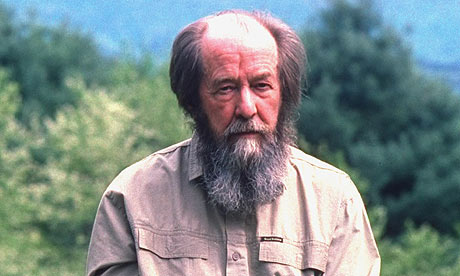
Prosperity at any price! -- Alexandr Solzhenitsyn (1970)


WSJ

From Alexandr Solzhenitsyn's 1970 Nobel lecture, accepting the prize in literature:


The spirit of Munich has by no means retreated into the past; it was not merely a brief episode. I even venture to say that the spirit of Munich prevails in the 20th century. The timid civilized world has found nothing with which to oppose the onslaught of a sudden revival of barefaced barbarity, other than concessions and smiles. The spirit of Munich is a sickness of the will of successful people, it is the daily condition of those who have given themselves up to the thirst after prosperity at any price, to material well-being as the chief goal of earthly existence. Such people—and there are many in today's world—elect passivity and retreat, just so as their accustomed life might drag on a bit longer, just so as not to step over the threshold of hardship today—and tomorrow, you'll see, it will all be all right. (But it will never be all right! The price of cowardice will only be evil; we shall reap courage and victory only when we dare to make sacrifices.)


Solzhenitsyn's 1978 Harvard commencement speech is often anthologized as "A World Split Apart," but the original title, "The Exhausted West," seems much more appropriate. An excerpt:
 
A decline in courage may be the most striking feature which an outside observer notices in the West in our days. The Western world has lost its civil courage, both as a whole and separately, in each country, each government, each political party, and, of course, in the United Nations. Such a decline in courage is particularly noticeable among the ruling groups and the intellectual elite, causing an impression of loss of courage by the entire society. Of course, there are many courageous individuals, but they have no determining influence on public life.
Political and intellectual bureaucrats show depression, passivity, and perplexity in their actions and in their statements, and even more so in theoretical reflections to explain how realistic, reasonable, as well as intellectually and even morally worn it is to base state policies on weakness and cowardice. And decline in courage is ironically emphasized by occasional explosions of anger and inflexibility on the part of the same bureaucrats when dealing with weak governments and with countries not supported by anyone, or with currents which cannot offer any resistance. But they get tongue-tied and paralyzed when they deal with powerful governments and threatening forces, with aggressors and international terrorists.
Should one point out that from ancient times declining courage has been considered the beginning of the end?
When the modern Western states were created, the principle was proclaimed that governments are meant to serve man and man lives to be free and to pursue happiness. See, for example, the American Declaration of Independence. Now, at last, during past decades technical and social progress has permitted the realization of such aspirations: the welfare state.
Every citizen has been granted the desired freedom and material goods in such quantity and of such quality as to guarantee in theory the achievement of happiness -- in the morally inferior sense of the word which has come into being during those same decades. In the process, however, one psychological detail has been overlooked: the constant desire to have still more things and a still better life and the struggle to attain them imprint many Western faces with worry and even depression, though it is customary to conceal such feelings. Active and tense competition fills all human thoughts without opening a way to free spiritual development.
The individual's independence from many types of state pressure has been guaranteed. The majority of people have been granted well-being to an extent their fathers and grandfathers could not even dream about. It has become possible to raise young people according to these ideals, leaving them to physical splendor, happiness, possession of material goods, money, and leisure, to an almost unlimited freedom of enjoyment. So who should now renounce all this? Why? And for what should one risk one's precious life in defense of common values and particularly in such nebulous cases when the security of one's nation must be defended in a distant country? Even biology knows that habitual, extreme safety and well-being are not advantageous for a living organism. Today, well-being in the life of Western society has begun to reveal its pernicious mask.